

Parmigianino - Kunsthistorisches Museum Wien, Bilddatenbank
Saul meanwhile, ever quivering in threat and slaughter against the Lord's disciples, presented himself to the high priest and asked him for letters to the synagogues of Damascus in order to be authorized to lead in chains to Jerusalem men and women, followers of the doctrine of Christ, who had found. And it came to pass that as he was on his way and about to approach Damascus, suddenly a light from heaven enveloped him, and as he fell to the ground he heard a voice saying to him, "Saul, Saul, why do you persecute me?" He answered, "Who are you, O Lord?". And the voice, "I am Jesus, whom you are persecuting! Come now, arise and enter the city, and you will be told what you must do." The men making the journey with him had stopped dumbfounded, hearing the voice but seeing no one. Saul got up from the ground but, opening his eyes, he could see nothing. So, leading him by the hand, they led him to Damascus, where he remained three days without seeing or taking food or drink.
Thus, in Acts of the Apostles, chapter 9, is described the terrible tumble in which the Pharisee Saul, who, from then on, would be known as Paul, the St. Paul the Apostle of the Christian tradition. Terrible because it would mark the fate of Saul, but also of the church of Jesus Christ, and above all of the whole world in the centuries to come: for if he had not fallen, he would not have converted, joined what until then was considered a subversive sect of little consequence, and embarked on those missionary journeys that marked the beginning of Christian preaching.
Saul\Paul himself recalls the tumbling, varying some details a bit, in Acts chapters 22 and 26, when he talks about his story, and how he ended up in chains, first with Governor Porcius Festus, and then with King Herod Agrippa; even with varying some elements (the blinding light, the mysterious voice, the reaction of fellow travelers) the fixed event is that of the fall. And that is precisely what we want to talk about in five minutes: how did Paul fall? The immediate and natural answer would be: from a horse! But how do we know? We know ... no, we don't, we imagine it, because it is suggested to us by the artistic representations of the conversion, spread by sacred art.
The presence of the horse
Indeed, the Christian artistic tradition has depicted the fall to the ground as a fall from a horse, but the detail is absent from the biblical account, although it is likely, since it is an event that occurred during a journey, Pauline iconography is so strongly characterized by the presence of the animal, which becomes so prominent that it steals the focus of the viewer's attention from Paul, almost as if the back of the horse was the real protagonist of the work,

Conversion of St. Paul, painting by Caravaggio (1600-1601, currently housed in the Basilica of Santa Maria del Popolo in Rome)
 Photographed artwork is in the public domain
an artistic addition that makes the metaphor of falling\rising more accessible, thanks to divine intervention, as well as drawing on a mythopoetic tradition already present in pagan culture, just think of Phaeton falling after stealing the chariot from Helios.
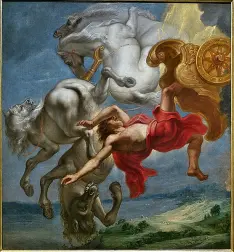
Phaeton shot down by Zeus - Jan Carel van Eyck (1636-1638)
The earliest representations of the event, however, do not depict the horse, see, for example, this figuration in a miniature of the Christian Topography by Cosmas Indicopleuste, pseudonym of Constantine of Antioch, from the second half of the 6th century:

Miniature from Cosma Indicopleuste, Christian Topography, Biblioteca Apostolica Vaticana,
Cod. vat. Gr. 699, fol. 83v . (© BAV), Christian Topography by Cosmas Indicopleuste, pseudonym of Constantine of Antioch
The Alexandrian original has come down to us in a ninth-century Constantinopolitan copy, preserved in the Vatican Library. Indeed, nothing in the biblical text suggests a fall from a horse; on the contrary, in Acts 26 there is the phrase "led by the hand of my companions," which suggests the idea of a journey made on foot.
This iconographic scheme is perfectly adhered to by the mosaic in the Palatine Chapel in Palermo, where, among the episodes from Paul's life, we can see the Apostle on the ground, helpless, struck by lightning as solid as a long golden bolt.

Why then, insert the horse?
The equestrian monument, recurs often in the history of art, summing up instances of glory and solemnity, not only in celebratory representations of military men or royals, but also in the depiction of saints who have demonstrated virtues such as courage, put to the service of the Christian cause: for example, St. George, or the archangel Michael.

Image St. George (icon from 1725 - 1750) preserved in the Pitti Palace – Florence

Michael image - Novgorod icon late 14th century. Russian Museum, St. Petersburg
Here, then, is the explanation for the presence of the proud steed: it is a symbol of vanity and pride par excellence, that pride that Paul was snatched from the most famous fall in history, and which, thanks to the (pedagogical) deception of art, has entered forever into the collective imagination, inextricably linked to the horse.
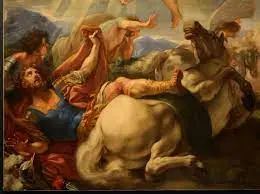
Giovan Battista Gaulli (1690), Conversione di San Paolo preserved in Chiesa di San Paolo, Fiastra






