
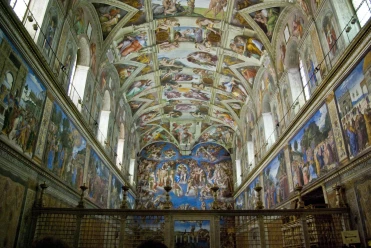
Image from https://it.m.wikipedia.org/wiki/File:Chapelle_sixtine2.jpg
It is one of the most well-known frescoes in the world, one of the reasons why the Italian Renaissance is mentioned in art history texts, one of the main tourist destinations in the whole of Europe: we are talking about the frescoes that adorn the Sistine Chapel, a place visited by at least 5 million tourists every year. Let's dispel one belief right away: the Last Judgment is not depicted in the main nave in St. Peter's, but in the chapel named after Pope Sixtus IV, who had the existing Cappella Magna renovated between 1477 and 1480. In 1508 Pope Julius II, nephew of Sixtus, altered the decorations, and commissioned Michelangelo Buonarroti, who, believing himself to be a sculptor and not a painter, hardly accepted the commission. All of which can be found very easily on the web.
There are thousands of volumes, sites, films and documentaries that analyze from myriad facets this place, but we will make our own very modest contribution ... a little article, as always, to be read in five minutes, just enough time to talk about what, more than a little mystery, is a gem, a divertissement hidden by Michelangelo Buonarroti, concealed, but in plain sight.
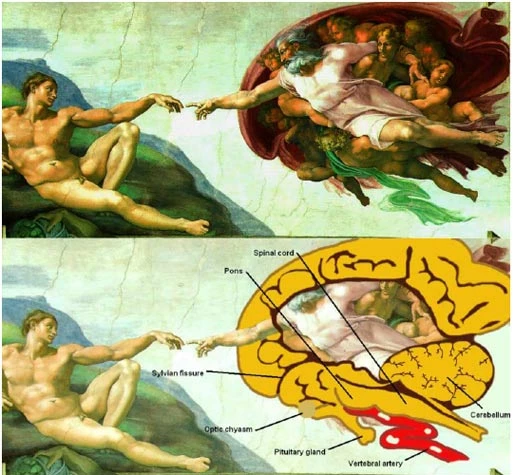
No, we are not talking about the section of the human brain, which would be (conditional obligatory) depicted in what is perhaps the most famous detail of the entire fresco; this is at least Frank Meshberger's hypothesis, on which there is now an impressive online bibliography: by way of example only we refer to the article found at the link (in English):
https://anatomiaitaliana.com/wp-content/uploads/2013/05/MichelangeloCreationBrain.pdf
and (italian language):
http://www.filosofiprecari.it/wordpress/?p=1723
From this last link is taken a fairly explanatory image:
Michelangelo's contemporaries were immediately aware that the fresco concealed more than just the depiction of biblical passages, as in the depiction of Minos. The hellish janitor moves away from the traditional depiction of a devil with traditionally demonic, snarling features, as Dante had described him, to wit, more than two centuries earlier; Giorgio Vasari (Le vite de' più eccellenti pittori, scultori e architettori, 1568) reveals, in fact, that Minos has the face of Biagio da Cesena, the Master of Ceremonies of Pope Paul III Farnese. Biagio aveva criticato i nudi dipinti da Michelangelo, secondo lui troppi e non adatti a quel luogo santo, ed ecco che il pittore gli attribuisce due enormi orecchie d’asino, e, invece della tradizionale lunga coda, c’è un serpente che gli morde i genitali, mentre un altro demone sogghignante lo indica con la lama di un pugnale.
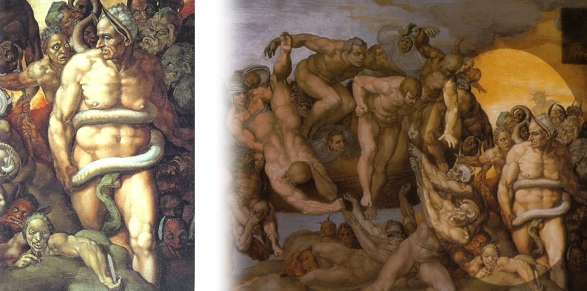
Image from https://michelangelobuonarrotietornato.com/2014/06/18/vendette-artistiche-minosse/
A punishment, for poor Blaise, as eternal as that of the anonymous damned he must judge, if, even today, his name is handed down only for this portrait.
Buonarroti, hid-as did all artists of a certain caliber, much to the chagrin of those who, post-Dan Brown, insist on sounding out the paintings of authors such as Leonardo da Vinci on websites that promise high quality, but certainly cannot compete with spectroscopy-quotations, metaphors and allusions in his works. When it comes to the symbolism inserted by artists in their works, we are talking, however, not of obscure esoteric references, but of metaphors and cross-references perfectly readable by their contemporaries, more or less explicit messages and symbols, such as references to the transience of life: famous is the example of Holbein, whose skull, the symbol of death, is "camouflaged" with a pictorial expedient
http://www.cultorweb.com/Holbein/H.html
to visit for an interesting analysis of the other symbols hidden in the painting, and a "suspicious" similarity between Holbein's floors
and that of the Sistine Chapel.
Buonarroti himself, in Florence, carved an owl and (perhaps) poppies at the foot of "Notte" (Night) symbols that appear unrelated to the theme of the work.
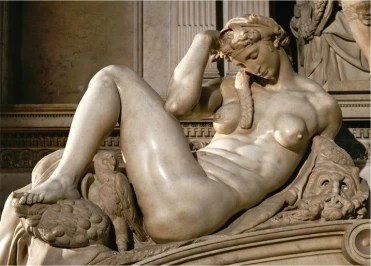
1534, San Lorenzo, Sacrestia Nuova, Florence
They are, for those who can read them, symbols of the night and sleepiness, as well as a theatrical mask that might allude to night dreams.
Symbolic readings can also be attempted elsewhere in the Sistine fresco, just think of the quantity of angels, all strictly wingless, depicted there. Why are they apterous? Because they are impossible to portray anatomically consistently? Or because they allude to an intermediate dimension that Michelangelo wanted to humanize to the fullest?
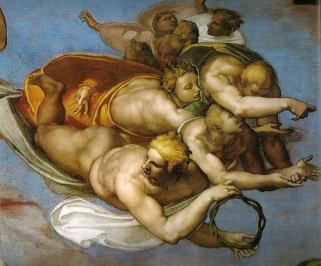
Michelangelo, we said, reserved a terrible fate for Biagio da Cesena, condemning him to be bitten by a snake and mocked by the rest of the world for eternity, while he reserved a place of honor for his mentor and benefactor, that Julius II who commissioned him to build the chapel ... or not?
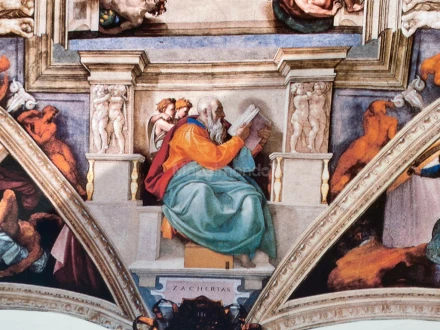
Above the entrance door of the chapel, Zechariah is portrayed with all the canons of an Old Testament prophet, thick beard, bare feet, and ample robes, and he is the portrait of Julius II, as can be deduced from a quick comparison with the portrait done by Raphael Sanzio:
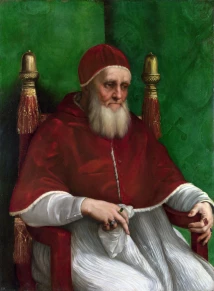
Raffaello Sanzio National Gallery, London - online catalogue., Public domain, https://commons.wikimedia.org/w/index.php?curid=100865
Michelangelo, perhaps to thank him for the pains he had put him through in the making of the fresco, or because of the dualism and rivalry the pope had nurtured with Raphael, has him accompanied by two putti. One of them puts his arm amicably on the other's shoulder, and only a close look allows us to notice that he has his thumb between his index and middle fingers.
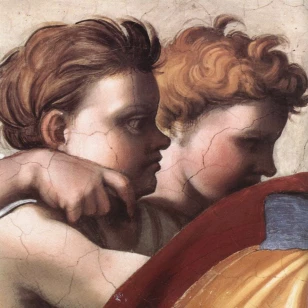
Web Gallery of Art: Immagine Info about artwork, Pubblico dominio, https://commons.wikimedia.org/w/index.php?curid=11422559
This gesture in Florence was called "fare le fiche" basically corresponding to our middle finger!
What risk did Michelangelo take? What personality must he have had, to dare so much? And how grateful should we be to him, for including, in the most famous Catholic fresco in history, such an imperishable and - as universal as the Judgment in its entirety - brazen "fuc** off?
Bonus:
For all those unable to visit the Sistine Chapel, recommended virtual tour at:
in order to enjoy Pope Julius II in the guise of the prophet Zechariah, one must "enter" the chapel by clicking on the double arrow pointing to the right, rotate the image with the mouse to frame the door we entered through, and then frame the ceiling immediately above the door. With the + symbol you can enlarge the image of the two irreverent cherubs.







