IJCH - Inside JaiChai's Head (Meaning: My Warped, Personal Opinions and Musings)

From the Author:
Salutations.
I am JaiChai.
And if I haven't had the pleasure of meeting you before, I'm delighted to make your acquaintance now.

I invite you to interact with everyone, learn, and have as much fun as possible!
For my returning online friends, "It's always great to see you again!"
Question: Why Did I write This? Answer: Haskell Programming
You're probably wondering why I wrote this article.
It's simple.
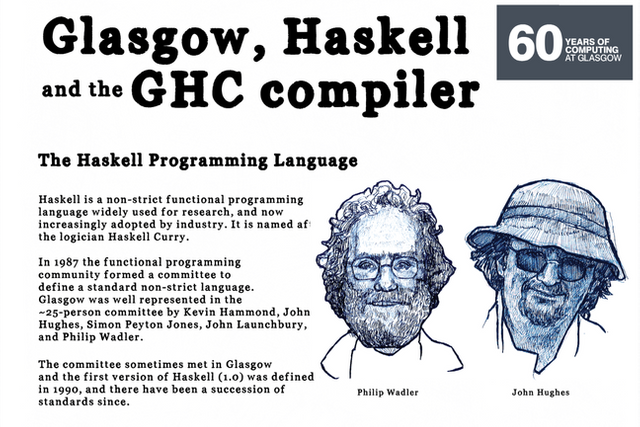
I decided to learn Haskell programming. Haskell is a functional language that is based on Lambda Calculus.
Very quickly, I realized my math skills have severely deteriorated over time and needed to be either refreshed, upgraded, or totally overhauled - especially if I wanted to learn Haskell functioning programming.
Rather than trying to remember vague snippets of knowledge from my high school math, I decided to take a different approach and begin from square one.
And instead of memorizing and working tedious math problems - the methods that had me falling asleep in class, I am re-learning math from the ground up from a historical point of view.
From the outset, I've already learned several fascinating things about math that I'd never been taught in school.
Imagine that?
At age 55, I am falling in love with math!
And that's why I wrote this article.
No doubt, several future math posts are sure to follow.
Egyptian Math - Lauded by Classical Greek Icons
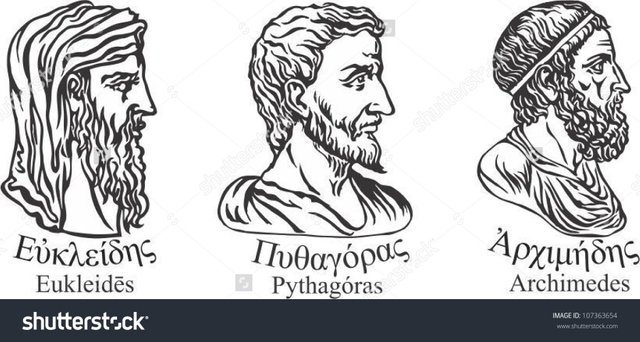
Many people know about the great mathematicians from ancient Greece.
But few people know that Egyptian math both predated and significantly influenced the famous math figures from the Classical Greek era.
The Greeks pay tribute to Egyptian Math; explicitly acknowledging that Egyptian mathematics is the foundation for which they advanced their own mathematical theory.
For example, Pythagoras formed most of his ideas from what he saw during his travels in Egypt.
Herodotus, Proclus in his Commentary on Euclid, as well as Aristotle and Democritus all credited their neighbors in Egypt with the invention of geometry and with excellence in its practice.
Also, Plato relates that the Egyptians taught arithmetic to their children with lessons based on enjoyment and games, so at least some of them must have kept that zest for the exploration of numbers as they grew older.
Egyptian Mathematical Hieroglyphs
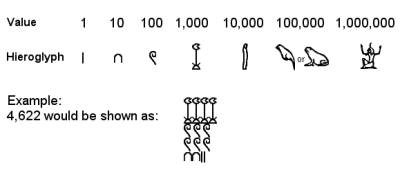
It is thought that the Egyptians introduced the earliest fully-developed base 10 numeration system at least as early as 2700 BCE (and probably much early).
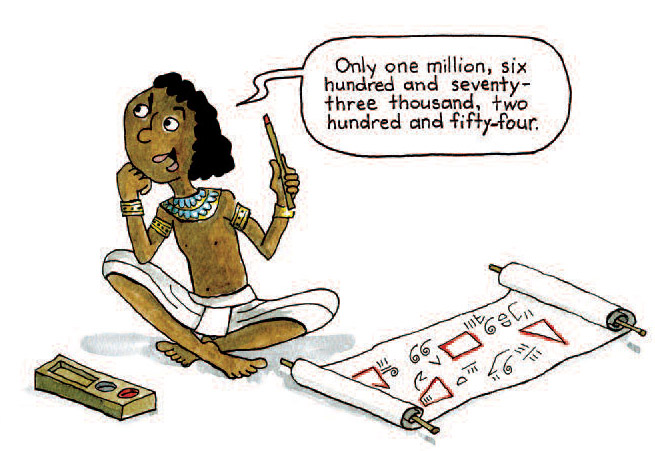
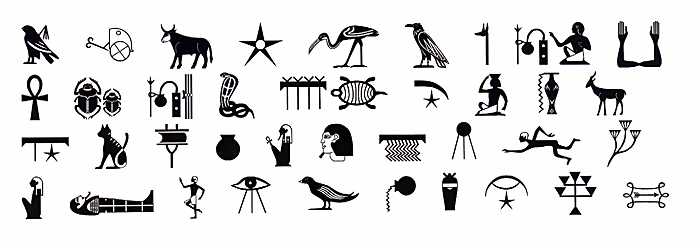
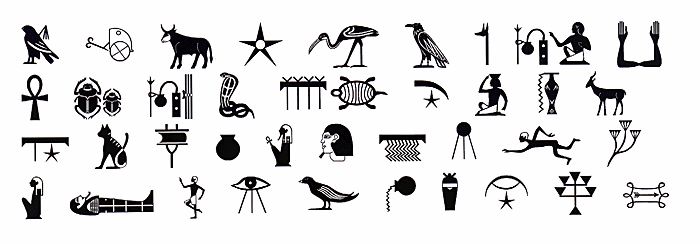
Written numbers used a stroke for units, a heel-bone symbol for tens, a coil of rope for hundreds and a lotus plant for thousands, as well as other hieroglyphic symbols for higher powers of ten up to a million.
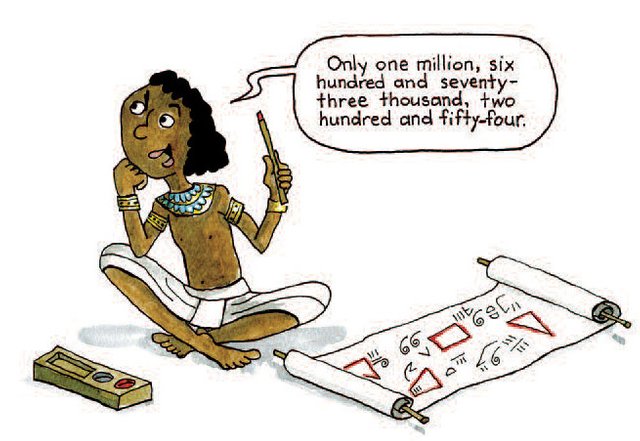
However, there was no concept of place value, so larger numbers were rather unwieldy (although a million required just one character, a million minus one required fifty-four characters).
Egyptian Scribes
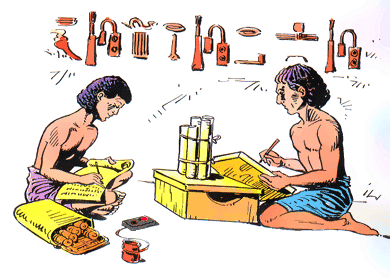
What is a Scribe?
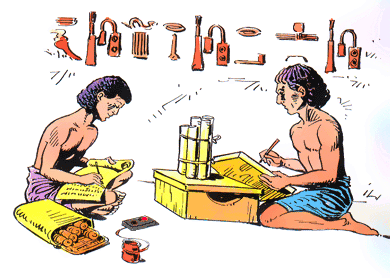
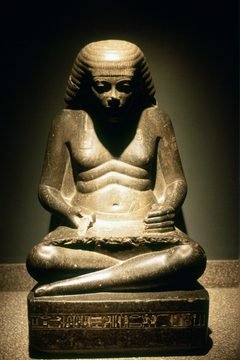
An Egyptian Scribe was tasked to accurately record and copy huge amounts of official documentation.
Prospective Scribes endured a long mentorship under the wing of a seasoned, professional Scribe.
The training consisted of problem solving and the adherence to very high standards of meticulous attention to detail.
Why?
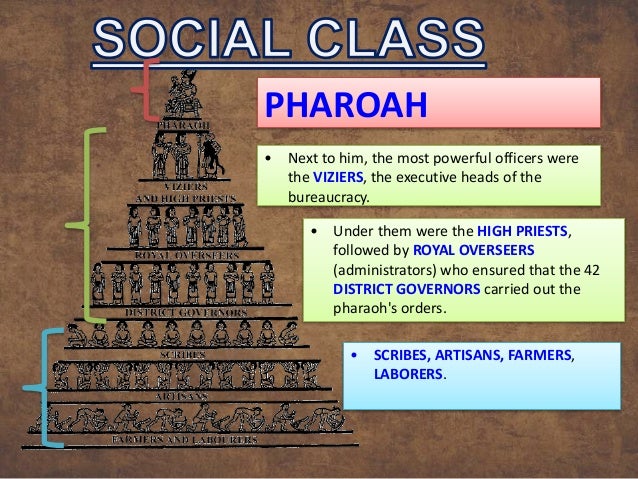
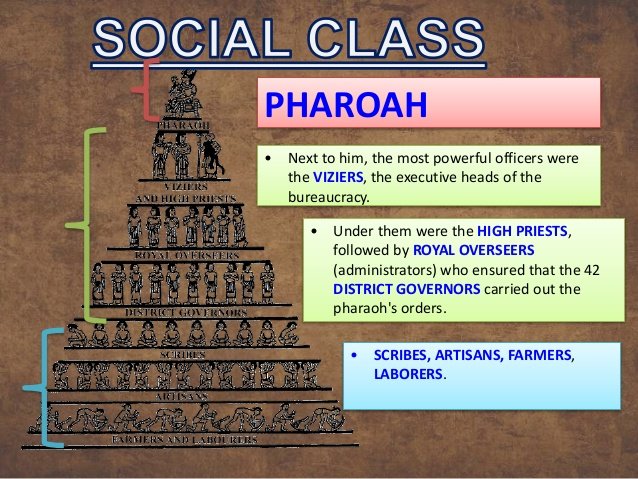
Because of the Scribe's social status within Egyptian culture - at the bottom and answering to everyone above him.
In other words, if a mistake by a Scribe (or his protege) was discovered by the higher ranking class, harsh punishments were meted out to anyone connected with the error.
Ahmose - The Famous Egyptian "Math" Scribe
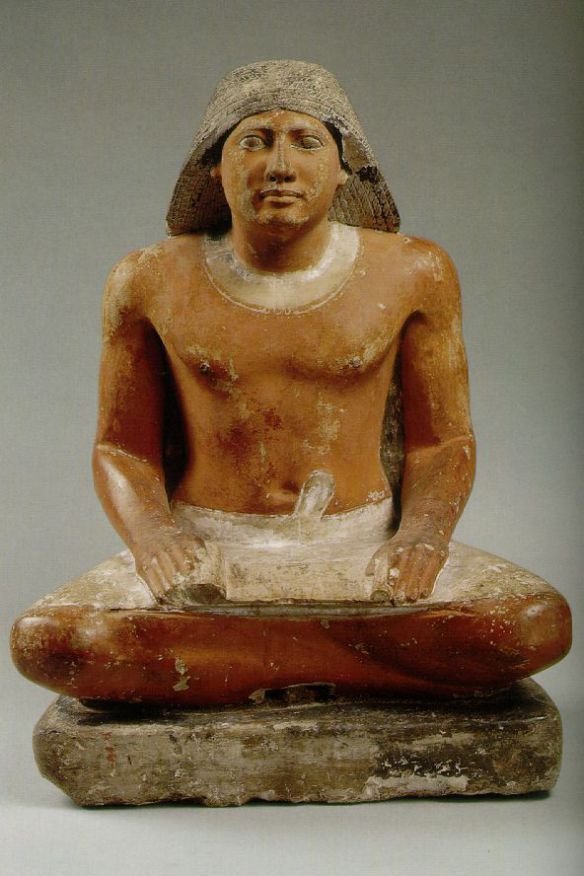
Ahmes (more accurately Ahmose) was an ancient Egyptian scribe who lived towards the end of the Fifteenth Dynasty (and of the Second Intermediate Period) and the beginning of the Eighteenth Dynasty (and of the New Kingdom).
He wrote the Rhind Mathematical Papyrus, a work of Ancient Egyptian mathematics that dates to approximately 1550 BC; he is the earliest contributor to mathematics whose name is known.
The Rhind Mathematical Papyrus
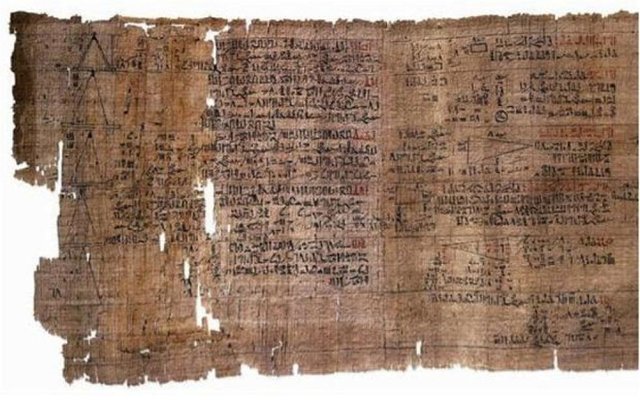
In 1858, a man named Alexander Henry Rhind bought an amazing papyrus manuscript that describes ancient Egyptian Mathematics.
The Rhind Papyrus is one of the oldest documents in the world relating the math (the Moscow Mathematical Papyrus is older, but the Rhind Papyrus is much larger and contains far more examples and in-depth mathematical discussions).
In the opening paragraphs of the papyrus, Ahmes presents the papyrus as giving "Accurate reckoning for inquiring into things, and the knowledge of all things, mysteries...all secrets".
He continues with:
This book was copied in regnal year 33, month 4 of Akhet, under the majesty of the King of Upper and Lower Egypt, Awserre, given life, from an ancient copy made in the time of the King of Upper and Lower Egypt Nimaatre.
The scribe Ahmose writes this copy.
Summary of the Rhind Papyrus
Book I - Arithmetic and Algebra
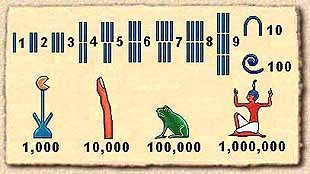
The beginning of the Rhind Papyrus contains reference tables.
Then 21 arithmetic and 20 algebraic problems are submitted. The problems start with simple fractional expressions, then completion (sekem) problems, and ends with linear equations (aha problems).
Book II - Geometry
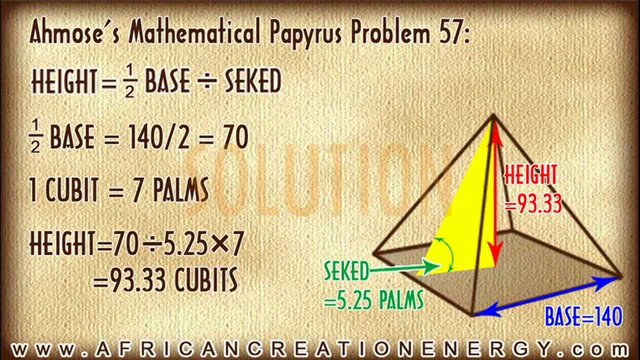
This section contains geometry problems (41-59, 59B and 60).
Note: Problem 48 computes the area of a circle by approximating π.
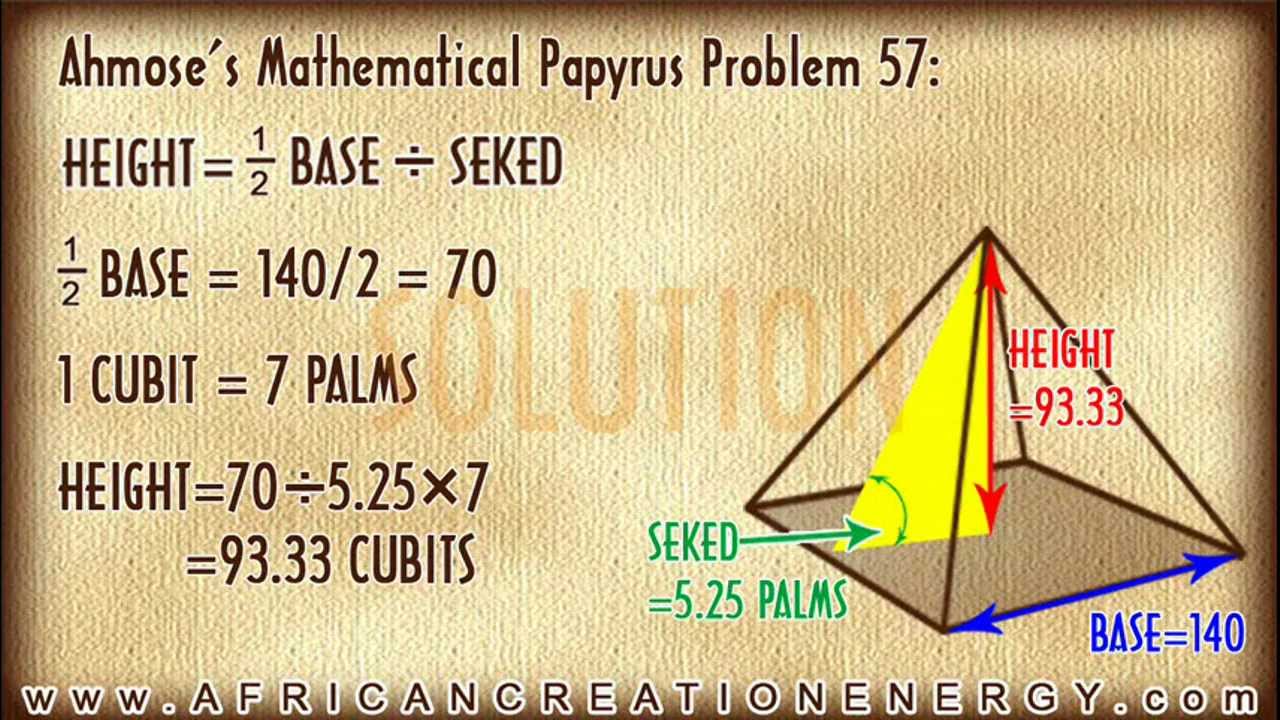
Other problems show how to find the area of rectangles, triangles, trapezoids, and slopes of pyramids.
Book III - Miscellany
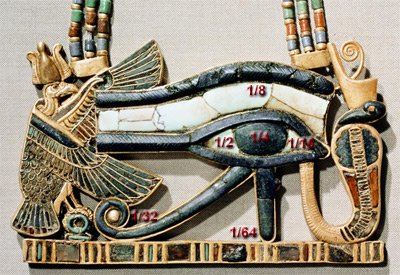
The third section describes the rest of the math problems (61, 61B, 62-82, 82B, 83-84).
More complicated tables of data are then posted which frequently involve Horus eye fractions and several pefsu problems (elementary algebraic problems concerning food preparation).
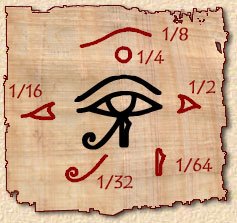
Problem (79) suggests geometric progressions, and geometric series.
Note: Non-mathematical "Problems" (85-91) are also thrown into this "Miscellany" section.
Conclusion
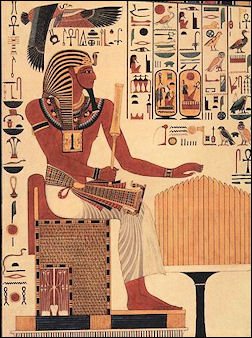
IMHO, Egyptian Mathematics has not been given its proper recognition in modern society; especially within the traditional education system.
From my own experience, Classical Greek mathematicians were always emphasized in school.
In fact, it wasn't until my personal journey into the history of mathematics that I first encountered the Rhind Papyrus and Ahmose the Egyptian Scribe.
I hope you enjoyed this tiny peek into the history of mathematics.
Like I said in the beginning, I began this inquiry into math because of my ambition to learn Haskell.
But now I see that it will further increase my understanding of other passions (quantum mechanics, emergence theory, blockchains, cryptocurrency, game theory, smart contracts/platforms, etc.) - and much more.
Ahmose's Prologue:
"The entrance to all objects and the key to all secret knowledge is math." - Ahmose 1575 B.C.
You are more than welcome to join me on this exciting journey into math's nooks and crannies.
By JaiChai
Thanks for stopping by.

About the Author
Believing that school was too boring, he dropped out of High School early; only to earn an AA, BS and MBA in less than 4 years much later in life – while working full-time as a Navy/Marine Corps Medic.
In spite of a fear of heights and deep water, he performed high altitude, free-fall parachute jumps and hazardous diving ops in deep, open ocean water.
After 24 years of active duty, he retired in Asia.
Since then, he's been a full-time, single papa and actively pursuing his varied passions (Writing, Disruptive Technology, Computer Science and Cryptocurrency - plus more hobbies too boring or bizarre for most folk).
He lives on an island paradise with his teenage daughter, longtime girlfriend and three dogs.