IJCH - Inside JaiChai's Head (meaning: My warped, personal opinions and musings)
From the Author
Salutations. I am JaiChai.
And if I haven't had the pleasure to make your acquaintance, I'm delighted to meet you now.
Great Video & Introduction to HashGraph
I recommend that everyone view this high quality, eye opening, and information packed video.
You'll instantly become a Mike Maloney fan.
Towards the end of the video, HashGraph is introduced and briefly discussed.
I must have watched that section over and over again - only because it sounded too good to be true.
Then my skeptical, OCD self forced me to immediately go on a 60+ hours, HashGraph speed-learning trip.
It was exhausting, but very exciting. I learned a lot. And this article is based on that learning.
As the title suggests, I will not dig too deeply into the technical details. Those topics will be presented in future posts.
BTW, View all the fascinating videos on his awesome website:
https://goldsilver.com/hidden-secrets/
Game Changer

The goal of this article is to give you the key aspects that sets HashGraph apart from the rest of the major players in the decentralized platform arena.
In other words, only the "wow factors" or "game changers" - the reason for all the huge interest and excitement currently happening in the cryptocurrency and blockchain space - will be covered.
And after reading this post, I suspect that you (like me) will be keeping a keen eye on HashGraph.
Note:
Don't worry if you're not an algorithm guru or blockchain coder extraordinaire. Prior knowledge of complicated consensus mechanisms is not necessary.
As usual - and as best as I can, I will explain things in plain language; simple enough for almost anyone to understand.
So, with that in mind, let's charge on...

HashGraph is an algorithm from a company called Swirlds, Inc.
Gossip About Gossip Protocol - UnGodly Speed!

"With barely 7-12 transactions per second (tps) - in the most optimum conditions, Bitcoin and Ethereum are tortoises compared to other platforms.
Several platforms - even credit cards - can process many more transactions per second; and in some cases, achieving thousands of tps.
Even PayPal averages 120 tps; while VISA averages 1,500-2,000 tps and supposedly has a max peak load capacity of 56,000 tps."
HashGraph boasts 250,000 transactions per second!
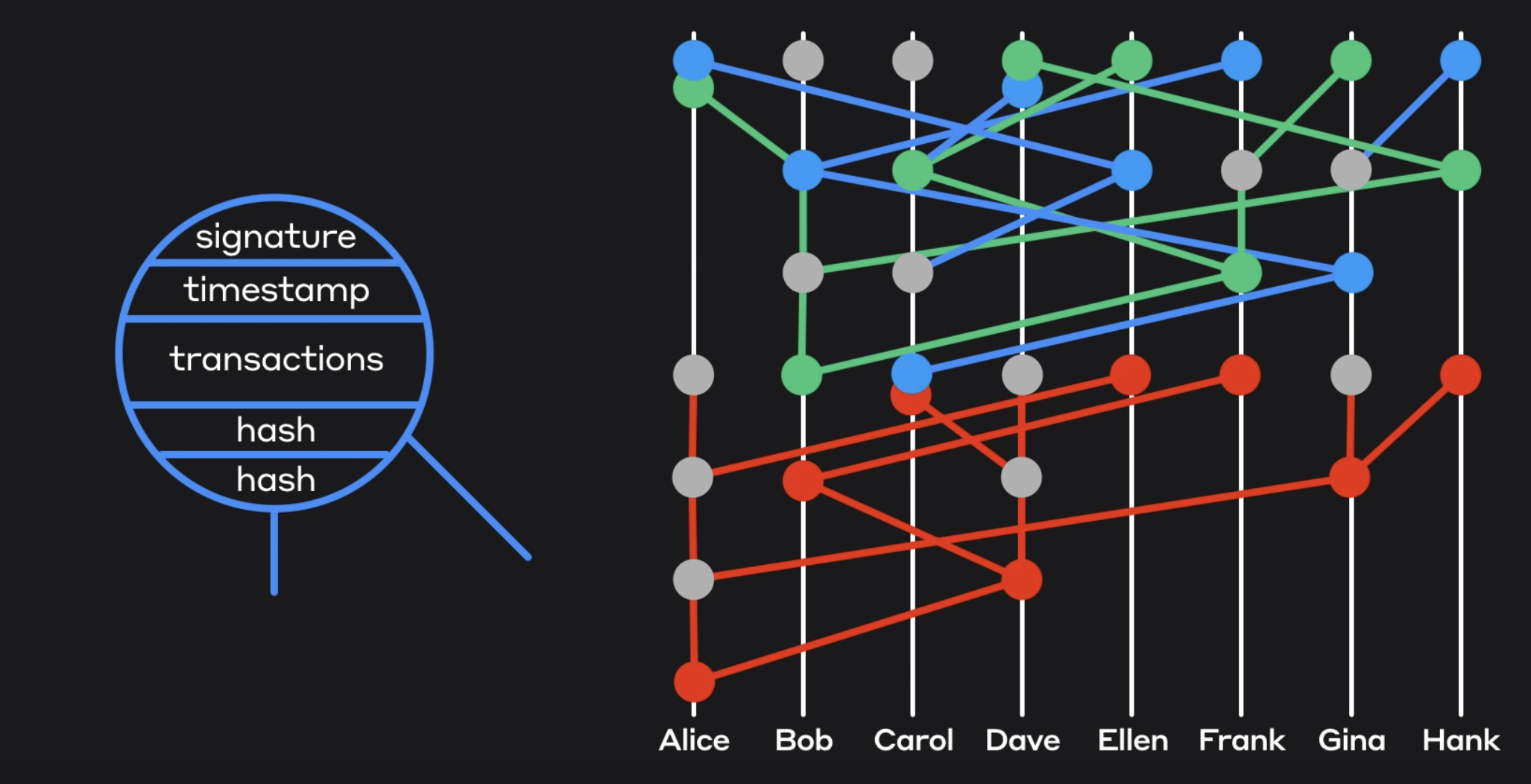
This blazing speed is achieved by taking the well established, robust and highly effective computer protocol called "Gossip Protocol" - a method of broadcasting information in the same manner that office gossip or a virus spreads, and then adding two tiny bits of information (in the form of hashes).
The Gossip Protocol and additional hashes enable HashGraph to do everything a blockchain can do without the blockchain - and its inherent speed limitations.
Stated differently, in HashGraph, instead of the original "Gossip Protocol", the "Gossip About Gossip Protocol" is implemented; drastically improving performance.
Simply Brilliant.

The creator of the "Gossip About Gossip Protocol" is a man named Leemon Baird, Co-Founder and CTO of Swirlds, Inc.
Among many academic, business and professional achievements, he also holds the record for the fastest PhD in Computer Science ever to be earned from Carnegie Mellon. He did it in 2 1/2 years!
Voting w/o the Voting - Consensus w/o the Bandwidth

Although voting systems are the most egalitarian way to reach consensus, and voting algorithms have been around for over three decades, they were too impractical to be widely deployed in the real world.
The legacy voting system requires redundant, multiple steps; not to mention the inordinate time needed to complete each of those steps.
The heaps of bulky data that had to be sent and returned by each node before each round of voting could be accomplished gobbled up enormous bandwidth.
And for instances when voting resulted in a tie, more rounds were required to reach consensus!
So, for thirty years, these voting systems and algorithms were shelved...until Leemon Baird came along and made them useable for real life operations.
How did Leemon Baird do this?
By incorporating a voting mechanism in a way that allows HashGraph to get all the benefits of consensus via voting - without the voting!
HashGraph performs "virtual voting".
It is based on a voting algorithm that mathematically proves how each node would have voted; thereby, making it unnecessary to actually go through all the bandwidth eating steps mentioned before.
Again, simply brilliant!
Bank Grade Security - The Gold Standard

"...Byzantine fault tolerance (BFT) has become the gold standard for security in distributed systems. As the name suggest, Byzantine fault tolerance means that a system can tolerate (i.e. still achieve consensus in the presence of) Byzantine faults - the category of faults where nodes may be malicious."
http://www.information-age.com/gold-standard-security-distributed-systems-like-blockchain-123469395/
An algorithm is said to be "BFT" if it always leads to a moment in time where all participants reach consensus, know when that consensus has been reached, and they are never wrong.
Contrary to popular belief, Bitcoin's PoW algorithm is not BFT. It's rounds of confirmations build towards, but never reaches 100% consensus - and may still not be correct.
Hashgraph is the only "Bank-Grade" consensus algorithm because it possesses mathematical proof of asynchronous Byzantine fault tolerance (BFT).
It is resistant to DDoS attacks, network partitions, sybil attacks and firewall/virus campaigns.
Goliath Slayer

Two years ago, in a modern day version of "David and Goliath", Swirlds, Inc. - an obscure, tiny Distributed Ledger Platform company of only six employees, competed against the likes of IBM to secure a contract to build a distributed ledger platform for the whole U.S. Credit Union industry.
IBM showcased its impressive "HyperLedger Fabric" that processes 700 transactions per second.
Enter Swirlds with their proposal based on HashGraph.
Surprising everyone (except maybe Swirlds), the huge contract was awarded to the HashGraph ledger model from Swirlds, Inc.
The end result was the formation of CULedger:
http://www.cutimes.com/2016/08/03/cu-ledger-could-save-costs-enhance-banking
Challenges and Clues

HashGraph has already proven successful in "permissioned" networks - where all nodes are known beforehand, but has yet to be deployed in a "non-permissioned" setting; such as public distributed ledgers like Bitcoin and Ethereum.
Recent "hints" (clues) on various social media, have many pundits speculating that Swirlds, Inc. will soon be announcing their plans for adapting to the "non-permissioned" networks setting - possibly through sharding.
Other Swirlds, Inc. news include a monetization strategy - incentivizing through PoB/PoSt (Proof of Bandwidth and Proof of Storage), and much more.
Impressions
The HashGraph innovations discussed in this primer is just the tip of the iceberg.
HashGraph's architecture yields several significant innovations within the Distributed Ledger domain.
Stay tuned for further, in depth articles about this promising technoolgy.
By JaiChai

About the Author
"My mind was a terrible thing to waste..."
JaiChai has been in the Disruptive Technology, Computer Science and Cryptocurrency spaces for many years. He is an enigma, regarded by his cohorts as sarcastic, funny, intuitive, but most of all - elusive. He’s known for randomly submitting philosophical and contrarian posts on several diverse forums.
When asked about his vanishing acts, he says, "I’m just somebody who enjoys being nobody because I look like everybody. Besides, time checking things off my 'bucket list’ - sans notoriety - is time well spent.”