Bienvenidos mis ositos, tu siempre eres mis queridos! (Welcome back little bears you are always my dears!)
I’ve been waiting awhile to write this up. I’ll try not make it too complicated BUT I recommend activating a few brain cells. If you love finance, tech, fintech, or DeFi you’ll love this!
In my humble opinion, Tastyworks is the gold standard for options trading. Fast, slick, AND cheap. BUT LOOKOUT! The Mirror protocol from the Terra ecosystem has entered the chat. Although the Mirror protocol is NOT an options trading platform they do offer synthetic stocks (derivatives by another name).
It’s recommended that you brush up on some financial lingo. Let me drop some links:
This is the tastytrade definition for the delta neutral options strategy:
https://www.tastytrade.com/definitions/straddle
The tweet that inspired part of this post:
https://twitter.com/danku_r/status/1409169207112179721
If you want to watch the original Terra Bites tutorial on delta neutral trading on Mirror:
https://www.youtube.com/watch?v=Ttqo4s6is5c
Now let’s watch the financial version of Godzilla vs King Kong unfold!
So let me give you a crash course on selling an at the money option straddle. I’m just a dopey lazy panda, so I’m not going to lecture you on how risky options or the ins and outs of the Black Scholes option pricing model.
I’ll give you a high level overview of what the trades aim to do.
The theoretical goal of a delta neutral trade is to make money without taking directional price risk. Delta refers to the theoretical number of stock you have on a trade.
So if I decide to buy 100 shares of Twitter (TWTR) I am LONG +100 delta.
If I decide to sell short 100 shares of Twitter (TWTR) I am SHORT -100 delta.
In options trading each contract is worth 100 shares. So if I buy a TWTR call I am also LONG +100 delta and if I buy a put I am SHORT -100 delta.
Options trading can be a little tricky because I can BUY or SELL calls and puts and create all kinds of crazy combinations. Then it can get really confusing with the terms in the money (ITM), at the money (ATM) or out of the money (OTM).
Buying options is usually easier to understand but more disastrous to your profits long term.
Why?
Because options “bleed” a little bit of value every day until expiration. Buyers of options need big explosive moves in their favor by expiration in order to have any hope for a profit.
Sellers of options generally are net profitable (assuming they control their risk) because they generally are selling depreciating assets and then buying them back when they get cheap enough.
In this example for the TradFi options trading side I will sell a delta neutral straddle.
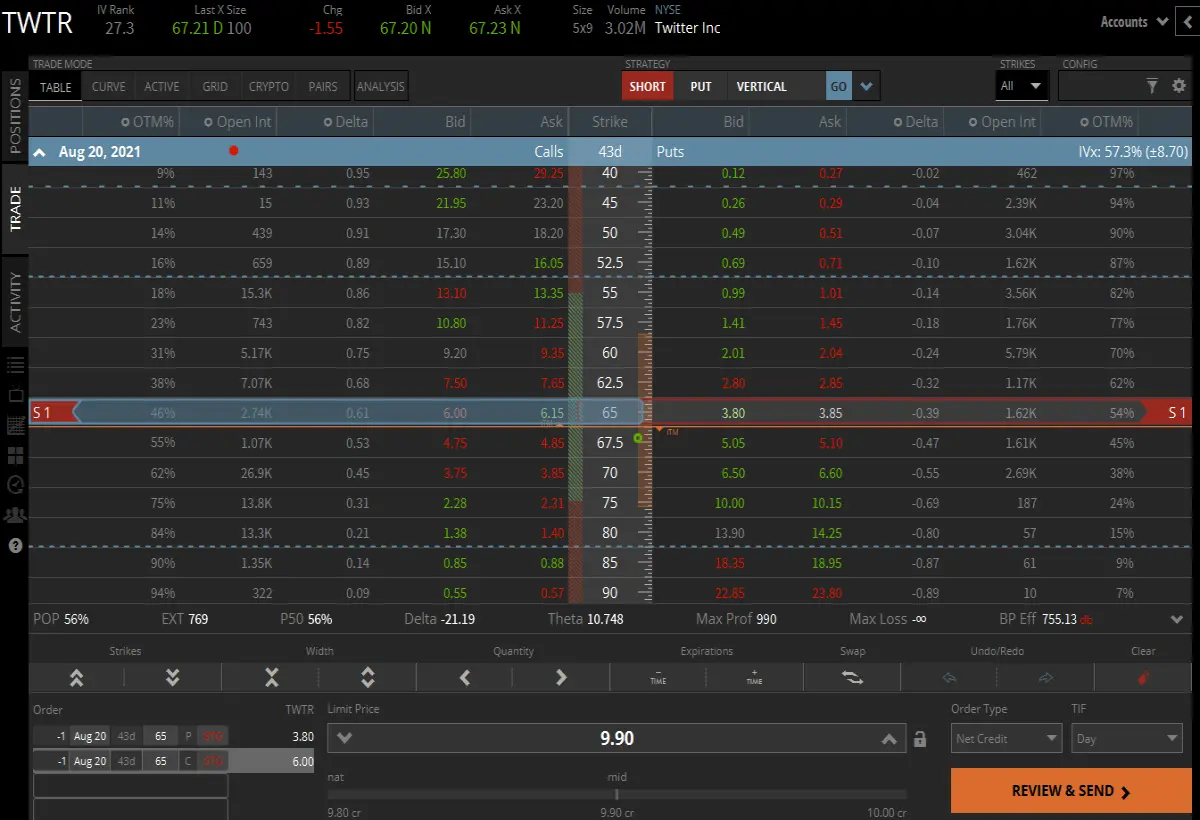
I’m selling a call and put at the same strike price closest to being at the money. In this example I’m selling both the August 20 2021 expiration call and put for TWTR at the $65 strike.
I’m collecting $990 upfront (9.90 premium times 100 shares per contract). Near the lower right of the picture you’ll see that Tastyworks wants me to put up at least $755.13 to do this trade. They call it BP Effect or Buying Power Effect. Other brokers call it margin or maintenance margin.
If you notice at the time of the trade the Delta isn’t perfectly neutral or zero. It’s actually -21.19 or I’m short roughly 21 shares of TWTR stock. Over the course of the trade the delta will be all over the place depending on how TWTR stock moves.
By the way if you really want to nerd out or anal retentive, there is a technique called “Gamma Scalping” where you can use stock to make your options trade delta neutral. I’ll let you dive down THAT rabbit hole in your spare time.
There are a few reason why someone would want to do this trade.
The trader assumes the volatility will go down at the expiration date
AND/OR
The trader just wants to collect the premium from the trade.
The RISK is that if TWTR has an extreme move either up or down, the option seller can incur a big loss. The loss is worse on the call side because if you haven’t noticed we’re in a strong bull market. The call option seller has a CONTRACTUAL obligation to buy and deliver stock to close out the contract.
If TWTR tanks, the put option seller has a CONTRACTUAL obligation to buy and take a stock that is losing value to close out the contract.
If your brain hurts, no worries re-read this or head over to any options trading primer. It’ll sink in after a few tries.
Let’s get back to what makes this straddle trade so attractive: Capital efficiency
If the trade works out perfectly and TWTR flops arounds $65 per share for around a month and a half…
The trader that sells this TWTR options straddle makes about 131% in 43 days! ($990 premium divided by $755.13 Buying Power Effect). If we annualize this (131% times 365/43) that gets to roughly 1,113%!
That’s degen yield farming territory!
Of course before you ape in, know that the losses can just be as brutal. Imagine if TWTR cured cancer, and established world peace AND apes just like the stock. TWTR then goes to $650 your loss could be ($65 - $650) x 100 shares per contract less the $990 premium collected = -$57,510 LOSS!!!
Or -7,616% (-$57,510/$755.13) BRUTAL!!! REKT!
In real life, extreme outcomes like this rarely happens. Most likely you’ll be monitoring your positions and closing your trades early to either grab profits or escape brutal losses. But NASTY LOSSES ARE possible.
Now thank goodness there are clever DeFi degens that come up with clever workarounds.
I am thankful that Do Kwon and the Terra Ecosystem community for creating a Defi playground where new financial services and techniques can be created. I am certain that there is more to come.
Now let’s take a look at how DeFi approaches delta neutral trading.
In the Terra ecosystem you will get similar if not cheaper transaction costs than TradFi. So far in my experience Terra is a bit more expensive to transact than Polygon but Terra is faster (for now).
One thing I really like about DeFi is Composability. That means DeFi is less restrictive with how I move money around (as long as I’m in the same ecosystem). If I make a trade on Tastyworks I can’t just take that TWTR options trade and take it to Fidelity to earn interest for example.
There’s no size requirements in DeFi. Gas fees might make certain transactions impractical. (NOTE: Hi Arbitrum and Optimism teams hurry up please!). With options trading the lowest you can go is 1 contract which represents 100 shares.
With DeFi there is even more scalability especially for smaller traders.
In DeFi you can recycle and reuse capital to compound in some interesting ways.
Let’s take a look at what we can do with Terra’s Anchor and Mirror protocols.
I first started by depositing a little over 200 UST (Terra’s stable coin) in Anchor. The great thing is that you get almost the same amount in aUST. This is a receipt that you can use as collateral in Mirror Protocol. More on that in a bit.
So I started with the long mTWTR farm first because it made more sense to me. I bought about 50 UST worth of mTWTR and combined that with roughly another 50 UST to put in the mTWTR-UST liquidity pool. This cost about .72 UST.
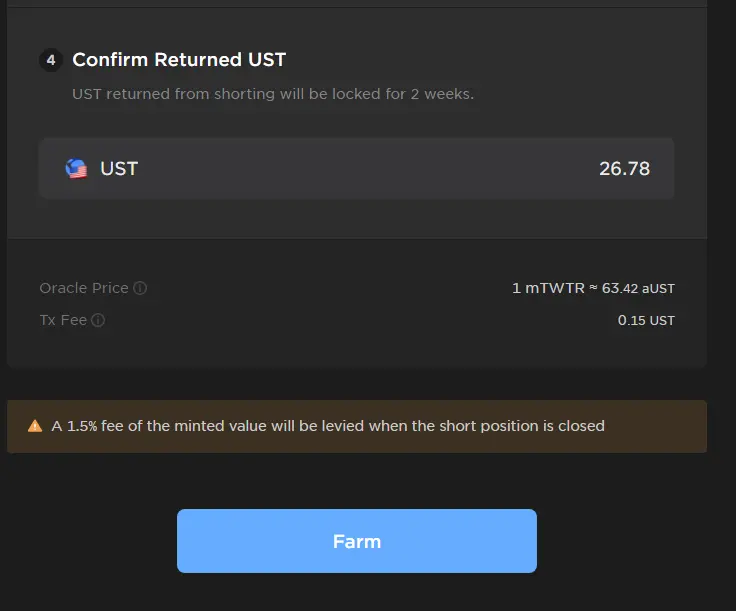
The short farm is slightly more involved. I set aside 50 aUST so I could borrow some mTWTR to short.

So I short sold .394188 worth of TWTR and received 26.78 UST back in proceeds.
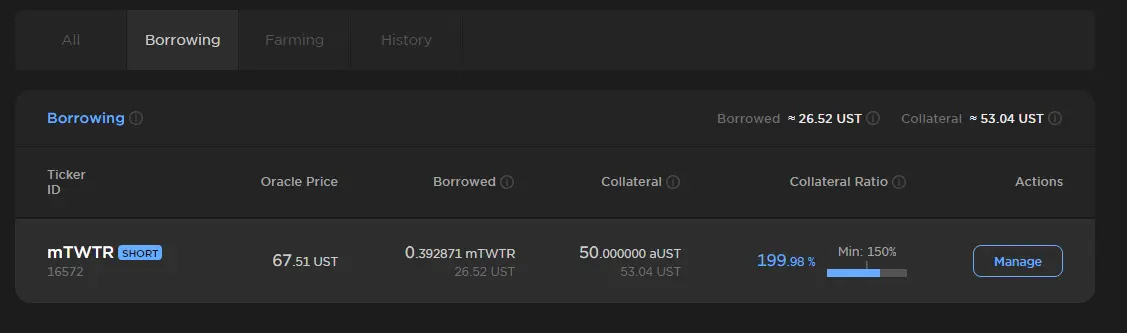
You can track your positions on the “My Page” section
This is the Borrowing tab:
This is the farming tab:
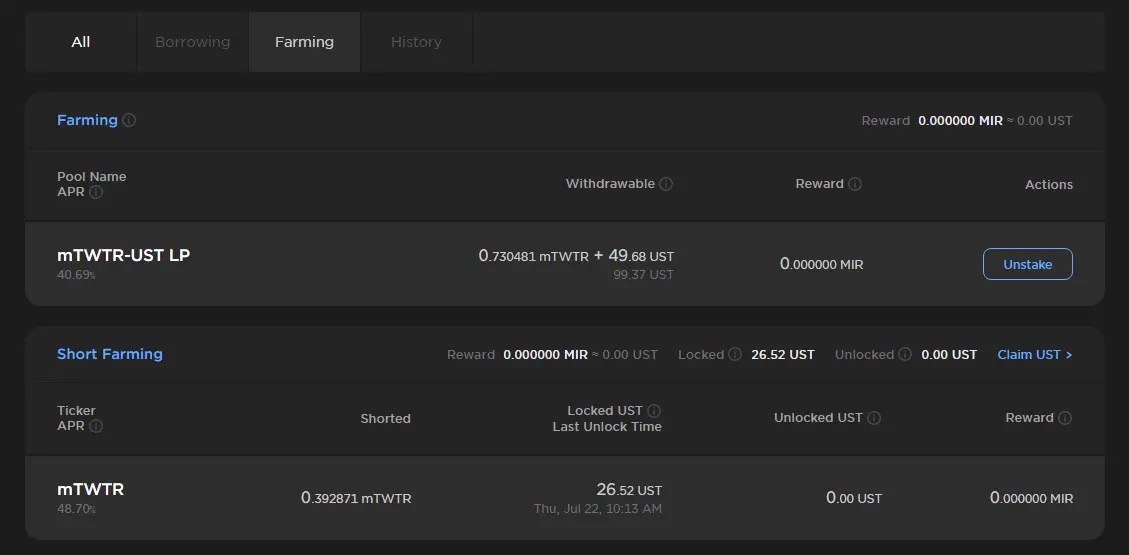
This isn’t exactly delta neutral because I chose to overcollateralize at 200% on the short side. I would prefer not to get liquidated in case mTWTR skyrockets.
If for some reason you really want to be delta neutral you can buy less mTWTR.
Don’t get me wrong Tastyworks is a pretty darn good platform but they better look over their shoulder. They are an open minded TradFi broker. They offer a select number of digital assets but you can’t withdraw to your own wallet (for now).
It might be hard to tell from the last pic but the APR at the time of the trade for the LONG FARM was about 40.69%. The APR on the SHORT FARM was 48.70%. Don’t forget about the roughly 20% on any spare UST on Anchor. So 40.69% + 48.70% + 20% which adds up to a still tasty 109.39%
You get slightly less return with the Terra DeFi delta neutral trades but you take a heck of a lot less risk!
Also notice with the Terra Ecosystem I didn’t even use up the entire 200 UST. It might take some getting used to but this is a way more capital efficient way for small traders to play around with delta neutral trading!
Whew I need to take a break, these fancy trades can take a lot out of you! Until next time…
Be sharp, stay hungry let’s get that money!