in Portuguese and Spanish at the bottom
 Today we speak of Angelo Damiano the Neapolitan "scugnizzo".
The beginning of the pedaling activity happens for the young Angelo in the footsteps of his father Vincenzo, a good runner, nicknamed "iron thigh" because, following a fall, he had engraved on a thigh, the design of the teeth segmented profile of a pedal of the time.
The agonism attracts him so much that Angelo, cheating on the date of birth (the same operation had put in action to its beginnings a certain Antonio Maspes), obtains a competitive card a year before completing the canonical sixteen years necessary, wearing the jersey of the "G.S. Augusta" winning, obviously in sprint, a ten competitions. It also begins to attend the track of the Arenaccia, long 606 meters, in the structure of the military stadium Albricci where he had played the Naples soccer and then the Neapolitan rugby formation, track with flat curves, usual place of arrival of a classic (then) as the Tour of Campania, stages of the Tour of Italy and other events.
His notoriety also grows at the national level so much so that the Cycling Federation summoned him to the Ferrara headquarters of the Fausto Coppi School where the most promising pistards of the different regions were hosted. The supervision was entrusted to the intuitive abilities and the long eye of Guido Costa, historical technical commissioner, "guru" of the Italian track, that brings the young Damiano to make experiences in the intense program of activity of the international velodromes.
First important medal that of Paris in 1959, in the mythical and historical covered velodrome, the Velodrome D'Hiv.
The atmosphere was pleasant, intriguing, both inside and outside. The speed trials always "to three" with the triads of runners simultaneously on the track and which provided the final in March and where he competed with friends, the Milanese Carlo Rancati, said "Eagle" then good professional pistard and Carlo Cressari, exponent of a family dedicated to cycling, both male and female. A sporting newspaper entitled, to full page, "one scugnizzo to Paris" in order to represent its "exploits" parisians.
For the last three years from amateur Angelo Damiano has dressed the jersey of the S.C. Padovani. An environment and a society that he also felt as his own, carrying out an intense activity on the track, and also on the road, until the magic moment of Tokyo in couple with the friend Sergio Bianchetto.
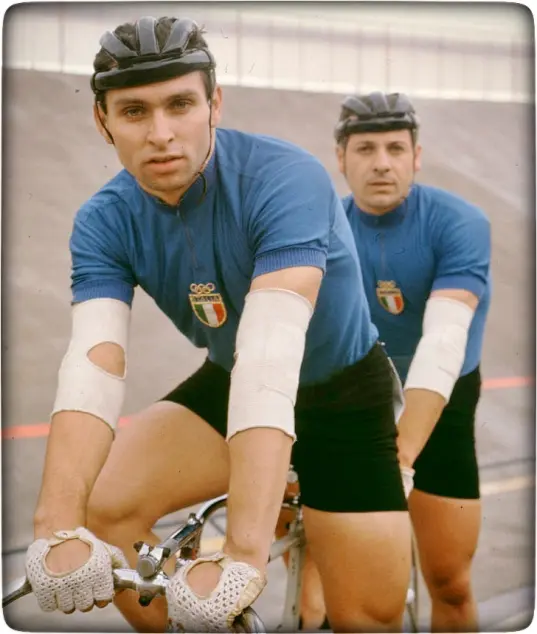
Beghetto (leading) and Damiano, Tokyo 1964
After the Olympics he passes professional dressing first, for two years, the jersey of the Termozeta FBE of the passionate president Piero Belloni, then the yellow one of the Ignis of patron Giovanni Borghi, the black and white one of the SCIC in 1969 and, in the two following years, the jersey of the Tuscan Ferretti guided by Alfredo Martini, then extraordinary technical commissioner and reference of first value of the Italian cycling.
It closes the professional career in the Conterosso Padova, in 1972. In the difficult world-wide of speed of those years, rich also of choices and contingent situations, land of clash between great names, obtains various good placing and succeeds to climb on the third step of the podium to Amsterdam, in 1967, with rainbow jersey the great Belgian Patrick Sercu and the silver medal for Giuseppe Beghetto.

 Hoje falamos de Angelo Damiano, o "scugnizzo" napolitano.
O início da actividade de pedalar acontece para o jovem Angelo nos passos do seu pai Vincenzo, bom corredor, apelidado de "coxa de ferro" porque, após uma queda, ele tinha gravado numa coxa, o desenho do perfil segmentado dos dentes de um pedal da época.
O agonismo atrai-o tanto que Angelo, trapaceando na data de nascimento (a mesma operação tinha posto em acção ao seu início um certo Antonio Maspes), obtém um cartão agonístico um ano antes de completar os necessários dezasseis anos canónicos, vestindo a camisola da vitória do "G.S. Augusta", obviamente em sprint, cerca de dez concursos. Também começou a frequentar a pista de Arenaccia, com 606 metros de comprimento, na estrutura do estádio militar Albricci onde tinha jogado o futebol de Nápoles e depois a formação de rugby napolitana, pista com curvas planas, local habitual de chegada de um clássico (então) como a Volta à Campânia, etapas da Volta a Itália e outros eventos.
A sua notoriedade também cresceu tanto a nível nacional que a Federação de Ciclismo o chamou à sede de Ferrara da Escola Coppi de Fausto, onde foram acolhidos os pistões mais promissores das diferentes regiões. A supervisão foi confiada às capacidades intuitivas e ao longo olhar de Guido Costa, comissário técnico histórico, "guru" da pista italiana, o que leva o jovem Damiano a fazer experiência no intenso programa de actividades dos velódromos internacionais.
A primeira medalha importante foi em Paris, em 1959, no lendário e histórico velódromo interior, o Velódromo D'Hiv.
O ambiente era agradável, intrigante, tanto no interior como no exterior. As provas de velocidade eram sempre "um trio" com as tríades dos pilotos na pista ao mesmo tempo e que incluíam as finais no mês de Março e onde competia com amigos, o milanês Carlo Rancati, conhecido como "l'Aquila", então bom pistardo profissional e Carlo Cressari, expoente de uma família dedicada ao ciclismo, tanto masculino como feminino. Um diário desportivo intitulado, página inteira, "um ouriço de rua em Paris" para representar as suas "façanhas" parisienses.
Durante os últimos três anos como amador Angelo Damiano usou a camisa do S.C. Padovani. Um ambiente e uma empresa que também se sentiu sua ao realizar uma intensa actividade na pista, e também na estrada, até ao momento mágico de Tóquio em par com o seu amigo Sergio Bianchetto.
Após os Jogos Olímpicos, profissionalizou-se, primeiro vestindo, durante dois anos, a camisola de Termozeta FBE do apaixonado presidente Piero Belloni, depois a camisola amarela de Ignis do patrono Giovanni Borghi, a camisola preta e branca de Scic em 1969 e, nos dois anos seguintes, a camisola do Ferretti toscano liderada pelo director desportivo Alfredo Martini, depois extraordinário comissário técnico e referência do primeiro valor do ciclismo italiano.
Encerrou a sua carreira profissional com Conterosso Padova em 1972. Nos difíceis campeonatos mundiais de velocidade desses anos, também ricos em escolhas e situações contingentes, terreno de confrontos entre grandes nomes, obteve várias boas classificações e conseguiu subir ao terceiro degrau do pódio em Amesterdão, em 1967, com o grande Patrick Sercu belga e a medalha de prata para Giuseppe Beghetto.
 Hoy hablamos de Angelo Damiano el "scugnizzo" napolitano.