
Powerful forearms allow you the necessary grip to handle a wide range of weights/loads in other workouts as well as ensuring a generally balanced arm physique. However, they are one of the most neglected areas in most workouts for several reasons. Most people simply don’t know how to go about forearm muscles while others simply feel that focused forearm work isn’t as necessary. This article will look at how you can go about enhancing strength and size in key muscles of the forearm.
The Forearm Muscles: Structure and basic functions
A basic understanding of the structure and function of the key muscles of the forearm precedes any related sound exercise program. The Forearm is a rather complex structure compared to the shoulder. Numerous muscles run from the elbow to the wrist and fingers in a complicated fashion that can baffle even the pros. However, the forearm is quite easy to understand when considered from a functional perspective. These muscles act in two main groups, which can easily be trained through a specific set of exercises.
Functionally, forearm muscles can be categorized into flexors and extensors based on the movement they can produce at the wrist joint and fingers. Flexors bend/flex the wrist forward and fold the fingers, as in the act of making a fist.
Most of them originate from the inner elbow and insert into the wrist bones and fingers. Pronators are another major group of muscles closely associated with the flexors and extensors. These are involved in turning the forearm inwards; also known as Pronation in professional circles. Flexors can easily be felt on the upper part of the inner forearm whenever you make a fist or bend the wrist inwards.
Extensors are direct opposites of flexors. These are located at the back of the forearm and are involved in the extension/backward bending of the wrist joint and fingers. They mainly originate from the outer side of the elbow and insert on the wrist bones and the back of the fingers. Extensors can easily be felt on the outer surface of the upper forearm as you are extending both the wrist and fingers.
Specific forearm workouts: Are they really worth the hustle?
There seems to be some controversy when it comes to building both strength and size in the forearm muscles. The first school of thought suggests that you don’t really need specific exercises for the forearm if you are already involved in a lot of Barbell and Dumbbell work. The idea is that the heavy lifting involved in other exercises should sufficiently challenge the forearm muscles to produce remarkable size and strength gains.
The second school of thought goes in favor of forearm training; suggesting that that use of specific forearm exercises induces more gains in both strength and size. Well, both schools of thought seem to have valid points here. However, hoping that the muscles will improve with other workouts has its catch. First of all, if you’re a beginner, you may not be lifting that heavy to sufficiently load the muscles, that is, of they are your primary area of interest. Secondly, this approach lacks a bit of objectivity. There is no way you can keep your exercise loads or intensity under check if you are counting on other workouts for forearm enhancement. Thirdly, emerging research evidence seems to suggest that adding specific forearm exercise to the normal routine results in greater gains compared to relying on regular lifting. Additionally, most of the other exercises do not involve dynamic action of the forearm muscles. However, research has so far demonstrated that dynamic movements are far superior to isometrics.
These points lead one conclusion:
It’s not a waste of time to add forearm workouts to your normal routine. Forearm muscles are still muscles! Like other muscles, they are bound to respond accordingly if they are consistently overloaded over time. The principle of Progressive Overload still applies to the forearm musculature.
The Best Exercises for building size and strength in forearms
Having looked at the structure, function and principles associated with forearm training, let’s move on and explore some of the best options for enhancing forearm strength and size.
Standing Wrist Curls
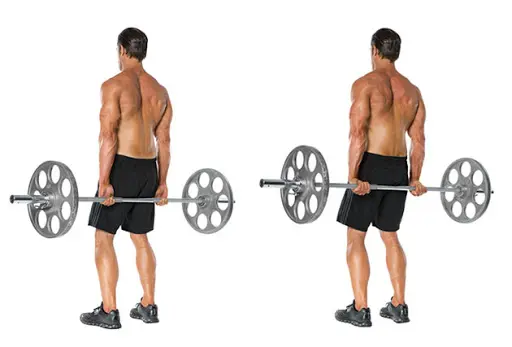
This exercise is designed to load the wrist flexors. The movement is quite simple and easy to master at any level of training. Actually, a single session is usually enough to get things rolling.
The exercise is best executed by using a Barbell, which provides better stability compared to other forms of equipment like Dumbbells.
Position
- Standing position, with a Barbell held at the back. The palms should be facing backwards.
The Curl
- Let the Barbell slide to the tips of your fingers, then roll it back while curling the wrist and fingers until they get into a hook-like position.
- Steadily roll the weight back into the initial position before going for another rep.
Combining wrist and finger flexion allows for better muscle recruitment as both are primary functions of the flexors.
Note
Just like most strength training workouts, start with lower loads to master the technique before you start thinking about progressing to higher loads.
Standing Wrist Extensions
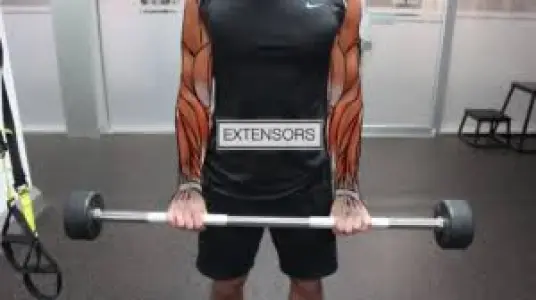
This is more of an opposite of the previous workout. It’s designed to isolate the wrist extensors located at the back of your forearm. The Barbell is held in front at mid-thigh level. Make sure you maintain an over-hand hand grip (Palms should be facing your thighs)
The Extension
With a firm grip, extend your wrists upwards. Be sure to limit movement to the wrist joint.
Note
- Avoid cheating through swinging your shoulders or bending the elbow.
- You can alternate extensions and curls sets. This is known as Super setting.
- Dumbbells can also be effective with the right technique.
Hammer Curls
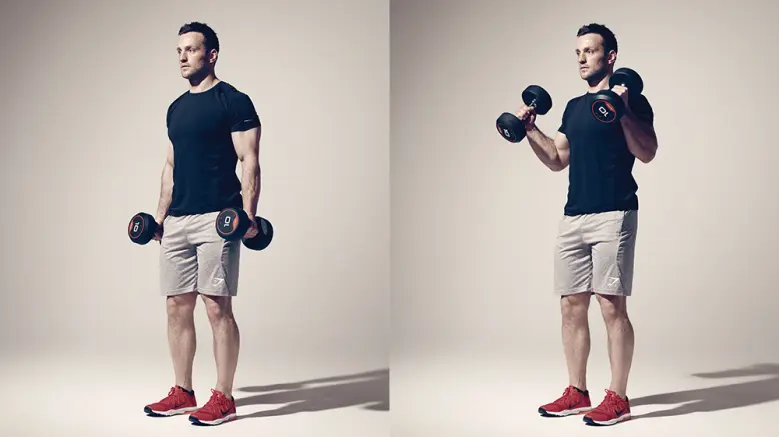
Though mostly known for key movers of the Elbow such as the Biceps, Hummer Curls are a great exercise for another prominent forearm muscle known as the Brachialradialis. This muscle can easily be felt or seen on the upper part of the forearm with simultaneous elbow flexion and extension.
- The exercise is mostly done using Dumbbells in sitting or standing positions.
- The movement involves maintenance of a neutral wrist position while curling the elbow upwards. The load and the involved forearm mimics a hummer’s movement in space, thus the peculiar name.
Note
- This exercise is best used as a supplement to the other more generalized curls of the forearm. A few more sets targeting the Brachialradialis should add on to the much needed definition and physique in the forearm.
- It’s important to know that wrist curls and extensions can be done in a variety of positions using different equipment. In addition to the Barbell, you can be creative around other equipment such as Pulley systems, Tubes and Resistance Bands, and still manage to load the muscles in a substantial way.






