
A report by Long hash recently revealed some amazing facts that would leave our jaws dropped.
It said the Bitcoin is comparatively more decentralized than Ethereum or Bitcoin Cash even though they were released after the Mother Coin.
There has always been the issue where mining pools that share a major stake in the market have a great deal of control on the network but when compared to its peers bitcoin has seen a shift to the decentralized nature after Bitmain lost 28% of its market share.
Ethereum
The bigger mining pools if working togather can systematically dismantle the digital signature authentication if the decide to do so. We already know the transaction needs to get verified by at least 51% of the network but
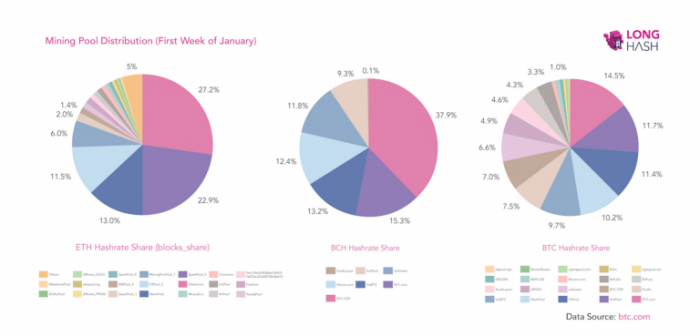
Ethermine and Sparkpool_3 control over 50% of the network according to Long Hash.
Bitcoin Cash
We are all well aware about all the drama that took over the crypto space January and late December when we saw the coin fork. But coming to the decentralised applications of this network we can observe that BCH is more centralised with the top pool for Bitcoin Cash being BTC.TOP and BTC.com control a staggering 53% of the hash rate.
Bitcoin
When you are different you face criticism. Bitcoin has been constantly questions to answer about it's legitimacy and it turns out to succeed again.
At the time of writing the top two pools only contribute to 29% of the hashrate. But looking back at the days when mining was all over, the all time high of the top two pools has been 41% and the real concern being bothered Antpool and BTC.com were owned by the same parent company Bitmain. This was around June of 2018.
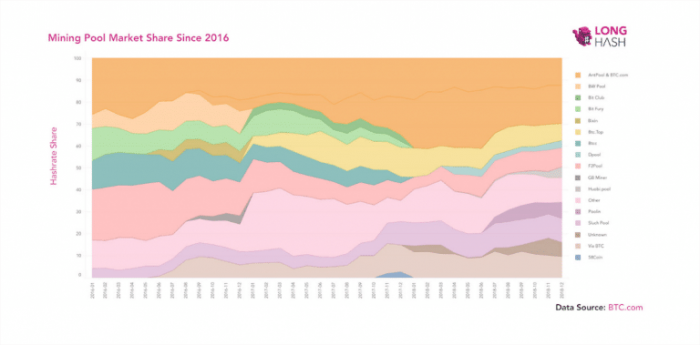
But with Bitmain losing a huge share in the hashrate we have come back to the good old days of decentralized currencies.
Now why do mining pools exist?
Let's assume mining to be like a jigsaw puzzle. Now this jigsaw puzzle has lots of pieces that need to fit in the right places to solve the puzzle. Similarly transactions are puzzles that need to be verified. The most popular encryption technique is the Secure Hash Algorithm 256 or SHA-256. This requires a huge amount of computing power to solve which one person single-handedly cannot offer. Thus they form communities. Pools are like groups of people solving the same puzzle just to reduce the amount of time taken to solve it.
How secure is the SHA-256?
Here is a crude explainaction. If all the supercomputers of the world were to get down on bruteforcing a private key and a public key. It would still take an eternity to break the security .
PS: Bruteforcing is just like a trial and error method.
For more updates and research Join t.me/hashedplutus





