
Reading Cabe Atwell’s article on the Z80 CP/M emulator running on Adafruit’s new Grand Central board made me feel nostalgic for my early days with computers. However, Atwell already covered a decent amount about CP/M. I could go into its derivatives used by Atari, and maybe one day I will, but this article is going to be about another blast from the past: the RCA 180x central processing unit family. I specifically worked with the 1802.
The CPU is the heart and soul of a computer, or perhaps just its brain. Arithmetic, memory management, control logic: it’s all pretty much done on the CPU. There are some variations in design, and GPUs also do a lot of the work these days, but it’s still the CPU that basically makes a computer compute. And while any CPU is technically capable of running any program that any other CPU can run, and can even emulate any other computer — a concept known as Turing Completeness — at a low level at least, a different CPU can vastly change how we might write such a program.
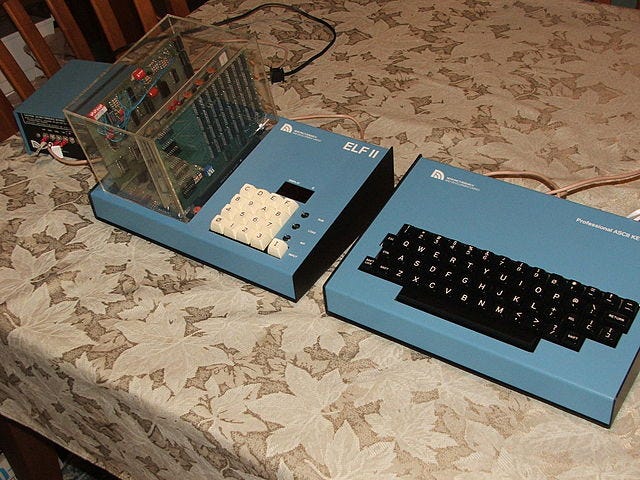
And because the RCA 180x series had a very unique architecture, it made programming rather interesting. One of the ways to mess around with this processor was with a mini computer kit known as the Netronics ELF II. It was a fun little device, though an odd thing to program. It had a HEX keyboard, a seven segment led, and a couple of flip switches, along with some other inputs and outputs. You would type in the hexadecimal machine code, one operation at a time, while the system was in program mode. If you made a mistake, you had to flip the switch and clear the memory. But if you managed to write the whole damn thing without error, then you could flip the run switch, and hopefully the unit did what you wanted it to. We’ve certainly come a long way with DIY tech, but hey, this thing was from the late 70s. Oldcomputers.net has a short article on the unit itself.
The unit did have a lot of add-ons though, not that I ever had them. Here’s a picture of the unit, enclosed in a case, along with a power supply and full keyboard.
The Elf II was nice, but that’s not what made the processor itself unique. And it’s not really why I remember the unit to this day. The most interesting feature of the CPU itself was that it used a general purpose register system, called scratchpad registers. There were sixteen 16-bit registers. There was no specific program counter or index register. Instead, there were 4 bit pointers which were used to assign one of the sixteen scratchpad registers to do the job.
This setup allowed you to do some really odd things, like store the location of different subroutines in different scratchpad registers, and then just set the PC pointer to the appropriate register. It’s partially for this reason that the 180x didn’t have a traditional CALL operation.
Radiation Hardening
Aside from the basic construction, there was also a radiation hardened version of the 180x. This feature, combined with the relatively low power consumption of the unit, made it great for use in space-faring equipment of the time. Variants were used in a number of satellites and other systems, including Galileo and Hubble.
Just Dreaming
I know it doesn’t make sense to do so, but I would love to see an updated version of this processor. With the amount of transistors you can fit on a die these days, I’m sure you could easily have a fair number of 32-bit scratchpad registers. The sane option would be to use 8-bit pointers and have 256 registers, but I’d really love to see upwards of a 16-bit pointer allowing for 65536 registers. That’s still only 256KB.
Again, there’s nothing that this CPU could do that any other CPU couldn’t, as all CPUs are essentially Turing Complete. But I do wonder if there would be some use-cases that would be well suited to the updated CPU. A lot of machine learning is being performed by special purpose systems like Intel’s Neural Compute Stick and Nvidia’s Jetson/Jetson Nano. But general purpose information processing and data processing may be something that this kind of processor would excel at performing.
Big Data
The amount and value of big data really does suggest that a processor with an architectural design like this one truly could be useful in the modern era. According to statistica, global IP traffic from cloud data centers in 2018 amounted to 10.6 zettabytes, and global big data and business analytics revenues in 2018 amounted to 166bn USD. And those figures are only going to continue to grow.
Originally published at Technology: Past, President, and Future on Medium
Image: Elf II with add-ons (CC BY-SA 3.0)







