
Every yield in crypto has a source. Once you know what it is, the numbers look very different.
I was comparing staking options and found Cosmos advertising a staking return around 15%. Ethereum was offering around 2.6%.
My first thought was the obvious one: why would anyone stake Ethereum? Then I asked a question I probably should have asked years earlier.
Where is the yield actually coming from?
Not "what's the APY?"
Not "is it safe?"
Just: Who is funding it, and what am I giving up to receive it?
That question changes the way you look at almost every crypto yield table.
The uncomfortable answer for staking
When you stake a token, the blockchain can create new tokens and distribute them to validators and delegators. On some networks, rewards also include transaction fees or other protocol revenue.
The important distinction is between those sources.
If the reward comes primarily from newly issued tokens, the network is expanding its supply to pay for security.
Nobody necessarily transferred £1,000 from their bank account to you.
The protocol created more tokens.
That doesn't make the reward fake. Staking provides a real service: securing the network.
But it does mean the headline APY isn't the whole economic picture.
The first number I now look at is yield after dilution.
Suppose a network has 1,000 tokens, of which 800 are staked and 200 are not.
The protocol issues 120 new tokens over a year. That is 12% more tokens than before (120 ÷ 1,000).
Those 120 tokens go to the stakers.
The nominal staking return is: 120 ÷ 800 = 15%
So a person staking 100 tokens receives 15 new tokens.
But total supply has increased from 1,000 to 1,120.
Before staking, your 100 tokens represented:
100 ÷ 1,000 = 10% of the network
After receiving your rewards, you have 115 tokens:
115 ÷ 1,120 = 10.27% of the network
Your share has increased by about 2.7%.
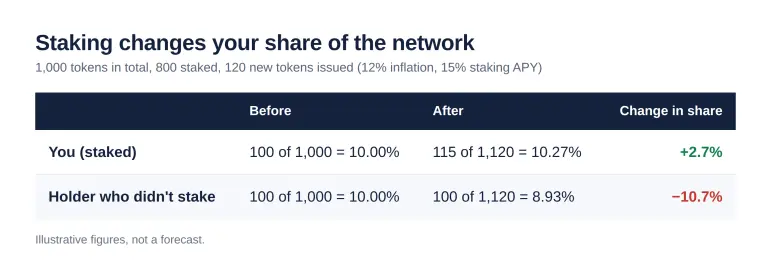
That's the important distinction.
Your token count grew by 15%. Total supply grew by 12%.
So your share of the network grew by only about 2.7%. I call that yield after dilution.
It is a useful way of thinking about staking economics.
It is not the same thing as real-world investment return.
If the token falls 40% against the pound, a 3% increase in your share of the token supply doesn't protect you.
What this looks like in practice
Take Cosmos.
Current network data puts ATOM inflation at about 10%, with staking rewards around 15.5% before validator commission. Cosmos has a variable inflation model with a 7% floor and 10% ceiling.
So the headline number looks like this:
~15.5% staking APR
versus
~10% token inflation
The gap is roughly 5.5 percentage points.
That doesn't mean you have earned 5.5% in pounds.
It means your staking reward is considerably larger than the rate at which the overall ATOM supply is currently expanding.
The distinction matters.
And there's another cost: Cosmos has a 21-day unbonding period. If you decide you want out, you don't simply press a button and sell the staked ATOM immediately.
Now compare that with Ethereum.
Ethereum's staking dashboard currently shows a validator APR of about 2.6%.
But ETH has a different economic structure.
Validators receive newly issued ETH, while Ethereum also burns part of transaction fees. The balance between issuance and burn determines whether total ETH supply is growing or shrinking.
So you shouldn't treat Ethereum as permanently "inflationary" or permanently "deflationary".
It depends on network activity.
When demand for block space is high, more ETH is burned.
When activity is lower, issuance can exceed burn.
That's why Ethereum's supply story is fundamentally different from a simple fixed inflation number.
The £1,000 test
Here's the comparison I actually find useful.
Not:
"Which token has the highest APY?"
But:
"How much of the return is coming from new token issuance, and how much is coming from economic activity?" 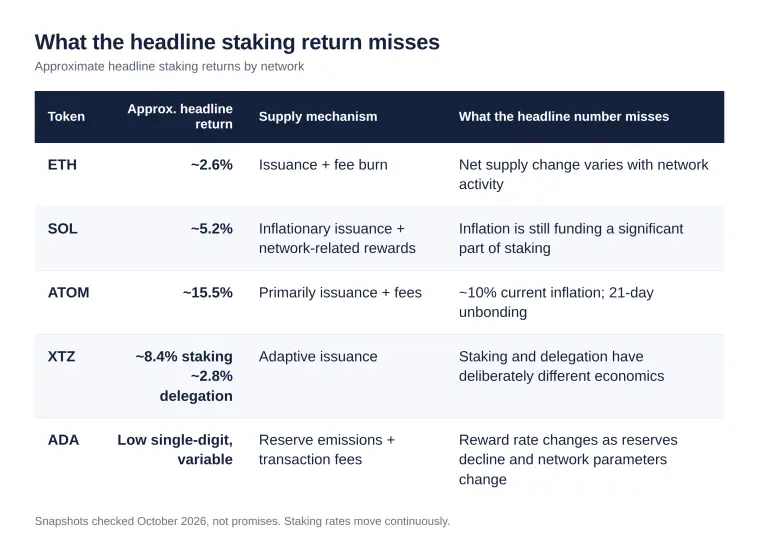
These are snapshots, not promises. Staking rates move continuously.
The key point is that the highest APY isn't automatically the highest economic return.
Solana is a good example
Solana's current staking return is around 5% before validator commission.
Its inflation rate is around 3.6% currently, and the protocol's original schedule started at 8%, decreases by 15% annually, and eventually reaches a 1.5% long-term inflation rate.
That means the headline 5% isn't five percentage points of completely independent income.
A substantial part of the reward comes from token issuance.
And the exact staking return changes with:
- The inflation rate
- The percentage of SOL staked
- Validator performance
- Validator commission
- and other network reward components
That's why comparing "5% SOL" with "2.6% ETH" without understanding the mechanisms can be misleading.
There is another interesting development here.
Solana's staking economics also include rewards connected with transaction activity and MEV. So not every component of the staking return is simply newly minted SOL.
That's a more complicated and more interesting economic model than a single APY number suggests.
Tezos shows the same thing from another angle
Tezos has deliberately separated delegation from staking.
Current network reporting puts staking rewards around 8.4% and delegation around 2.8%, while annual issuance has fallen below 3%.
The important thing isn't simply that one number is 8.4%.
It's why the protocol pays different rates.
Staked tez has greater weight in the network's consensus economics and comes with different conditions and risks.
Delegated tez remains liquid.
Tezos therefore gives us a useful reminder:
The yield isn't just a number. It is the price the protocol pays for a particular behaviour.
So which yields are actually funded by something?
Once you start asking "who is paying?", crypto yields split into several different categories.
Funded by new token supply
This is traditional inflationary staking.
The protocol creates new tokens and distributes them to validators and stakers.
The reward is economically meaningful because validators are providing network security.
But the cost is dilution.
Your number of tokens increases.
Your share of the network may increase by much less.
And the token's price can still fall dramatically.
Funded by network users
This is different.
Users pay transaction fees.
Protocols can use those fees in different ways:
- Pay validators
- Burn Tokens
- Send money to a treasury
- Distribute revenue
- Fund development
- or potentially buy tokens back.
Now there is identifiable economic activity behind the payment.
But even here, don't automatically assume the token holder receives the value.
A protocol generating £100 million of revenue does not necessarily mean token holders receive £100 million.
You still need to ask: Where does the money go?
Liquidity-pool fees
Liquidity providers earn a share of trading fees.
The source of the payment is straightforward: traders pay the fees.
That is much closer to a conventional fee-for-service business.
But the headline APY isn't your final return.
A stablecoin pool might reduce one major source of LP risk-price divergence between the two assets but it can still have:
- Smart-contract risk
- Stablecoin depeg risk
- Protocol risk
- Liquidity risk
- Governance risk
- and changing fee income
With a volatile token pair, you also have the classic problem of impermanent loss.
You can earn £200 in fees and still lose more than £200 because the relative prices of the assets changed.
Fee income and investment return are not the same thing. More on liquidity pool here.
Lending interest
Here the payer is easier to identify. Borrowers pay lenders.
Borrowers may be:
- Leveraged traders
- Market makers
- Investors who want liquidity without selling
- or other users of the protocol
If £1,000 is supplied to a lending market at an 8% annualised rate, the gross interest would be about £80 before protocol fees and changes in the rate.
If the protocol takes part of the interest, the lender receives less.
And the rate changes with utilisation.
High utilisation tends to push borrowing rates up.
Low utilisation pushes them down.
This is genuine supply-and-demand pricing for capital.
But it still comes with smart-contract, counterparty, liquidation and protocol risks.
MEV
MEV—maximal extractable value—is another source of staking-related rewards.
On networks such as Solana, validators and stakers can receive additional rewards associated with transaction ordering and trading activity.
JitoSOL, for example, incorporates staking rewards and MEV rewards into its economics.
That's real economic activity.
But it doesn't necessarily mean new economic value has been created.
MEV often represents value extracted from trading activity.
In simple terms: someone is paying because someone else wants a transaction executed, liquidated, arbitraged or ordered in a particular way.
That's very different from the protocol simply printing more tokens.
Buybacks and burns are another category
Suppose a protocol generates revenue and uses some of it to buy its own token.
The protocol then burns those tokens.
You don't receive cash.
Instead, the number of tokens in circulation falls.
That can create value for remaining holders if the mechanism is genuinely funded by sustainable revenue and the reduction in supply is economically meaningful.
But again, the question is:
Where did the money used for the buyback come from?
If it came from genuine protocol revenue, that's one thing.
If it came from issuing more tokens or borrowing money, the economics are very different.
The part nobody puts in the APY
Here's the thing that makes almost all of the above secondary.
Price movement dwarfs yield
A 4% yield on an asset that holds its value beats a 15% yield on an asset that halves.
Put £10,000 into two tokens.
Token A pays 4% and holds its price.
Token B pays 15% and halves in price.
Assume the rewards are paid in the same token. 
The 15% yield produced an extra £1,500 of tokens.
But the 50% price fall destroyed £5,000 of the original value.
You finish with £4,650 less.
That's why yield should rarely be the reason you buy a volatile token.
It is a tiebreaker between assets you already want to own.
Not a substitute for deciding whether you want to own the asset in the first place.
Three questions I now ask before staking anything
1. Where does the reward come from?
If the answer is - "The protocol issues new tokens," then understand the dilution.
If the answer is - "Traders, borrowers or users pay fees," then identify exactly where those fees go.
And if the answer is a mixture, work out the proportions.
2. What happens if I need to sell during a crash?
Check the exit mechanism. For example, Cosmos has a 21-day unbonding period. Ethereum has a rate-limited exit queue for validators, although rewards can be withdrawn without exiting.
Can you sell immediately?
Is there an unbonding period?
Is there an exit queue?
Can the staking provider impose its own redemption queue?
What happens during extreme network congestion?
The yield table doesn't answer these questions.
3. Would I hold the token at 0% yield?
This is the question I find most useful.
If the answer is no, ask yourself why you're buying it.
If the only reason is the 15% APY, you may not actually want the token.
You're buying the yield.
And the yield is being paid in the thing you're reluctant to own.
The conclusion - TLDR;
I still think 15% is an impressive number. I just no longer think it means what I initially assumed it meant. A crypto yield number is not an answer. It's the beginning of the investigation.
Ask:
Who pays?
Where does the money or token come from?
Who bears the cost?
How much new supply is being created?
How much value actually reaches the token holder?
And what happens to the asset's price while I'm earning the yield?
Once you ask those questions, the crypto yield table looks very different.
The highest APY isn't necessarily the best yield.
Sometimes it's compensation for dilution.
Sometimes it's payment for providing capital.
Sometimes it's payment for providing liquidity.
Sometimes it's a share of genuine protocol activity.
And sometimes it's a mixture of all four.
The important thing isn't the number at the top of the staking dashboard.
It's understanding who is funding it.
If you're interested in earning from crypto
If you're just getting started and want to explore some ways of earning a little money from crypto-related opportunities, you can also take a look at EarnList.
It's an optional resource, not a recommendation to invest. As with any crypto platform or earning opportunity, understand how it works and the risks involved before putting any money in.
References
- Ethereum Foundation — Staking Launchpad / current validator statistics and APR
- Ethereum Foundation — How The Merge impacted ETH supply
- Ethereum Foundation — Staking withdrawals
- Cosmos Hub / Cosmos ecosystem — ATOM tokenomics and staking parameters
- Solana Foundation — Staking and Inflation documentation
- Cardano — Treasury and Monetary Policy documentation
- Cardano — Staking Calculator
- Tezos — Two Years of Adaptive Issuance
- Tezos — Official staking documentation
- Jito Foundation — MEV and JitoSOL documentation
Staking rates, inflation, validator commissions and network parameters change continuously. Figures in this article are snapshots checked in October 2026, not guaranteed returns. Crypto assets are volatile and staking carries risks including price loss, smart-contract risk, validator risk, slashing where applicable, liquidity restrictions and total loss.
Nothing here is financial advice.






