
Hyperliquid is a decentralized exchange (DEX) dedicated to trading cryptos, offering perpetual contracts and a spot market. With the objective of competing with centralized platforms (CEX).
This platform offers a spot market and a derivatives market, especially perpetual contracts. The latter allow traders to bet on the up (long) or down (short) of a hundred cryptocurrencies with a leverage of up to x50. All these transactions are free of gas. Since its creation in 2022, Hyperliquid has rapidly developed to improve its decentralization and technology, offering a product with 100% of its on-chain components and a dedicated DEX layer 1. Unlike CEX, Hyperliquid offers a fully transparent order book and transactions as well as access for users to participate in the market making and liquidation process. Also, since Hyperliquid is a DEX, there is no need to verify your identity (KYC) to start trading, which can prove useful for those who are concerned about their privacy.
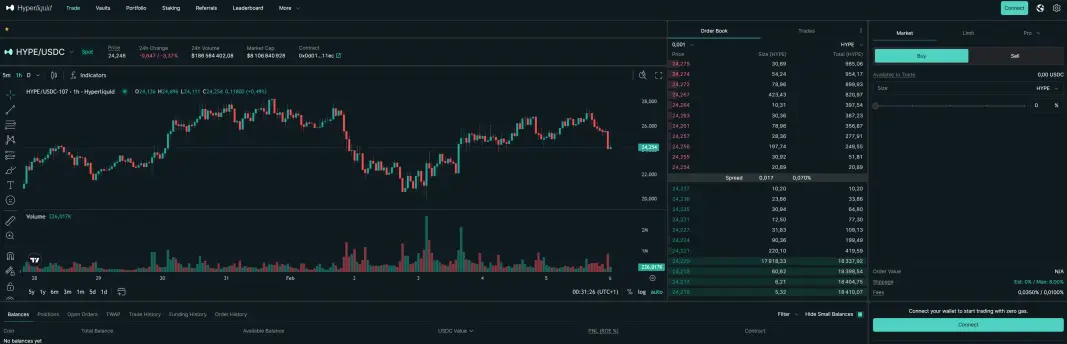
Hyperliquid has been noted for its airdrop that distributed to its users nearly $ 8 billion of HYPE (Hyperliquid). The project is indeed very focused on these users, via UX. Airdrop has made a lot of noise in the crypto community. This Airdrop marks the launch of Hyperliquid L1, which is the blockchain dedicated to the Hyperliquid application. Specially designed for it, this layer 1 has a special architecture to meet the demanding needs of the exchange. Previously deployed with the Cosmos SDK as dYdX, Hyperliquid L1 has been revamped and is now developed from scratch promising theoretical performance of up to 200,000 transactions per second and a latency of less than 1 second. Hyperliquid L1 consists of 3 main blocks on which it is possible to develop applications: the Native Components, the HyperEVM, and the HyperBFT consensus algorithm.
How do the main components of the Hyperliquid blockchain work?
Native Components are the set of components necessary for the operation of the Hyperliquid trading platform. For example, order books (spot and perpetual), oracles to display prices, and vaults to copy trading strategies. These applications are developed natively within blockchain to make the most of the performance of Hiperliquid L1.

HyperEVM is the component that integrates the Ethereum Virtual Machine (EVM) into the Hyperliquid blockchain. Thanks to this, all EVM-compatible applications can be deployed on Hyperliquid L1. Attention because for now, the HyperEVM is only available in testnet, and will be deployed on the mainnet of Hyperliquid L1 once its development is completed. The dates of this deployment are not yet known.
HyperBFT is the new consensus algorithm based on Proof of Stake. The protocol was inspired by Hotstuff. It is responsible for agreeing the network of nodes on the status of all applications (Native Components or HyperEVM). According to the project team, HyperBFT would be able to process several million orders per second. Attention, it is important to note that the performance of a blockchain does not depend only on the consensus mechanism, but also on the network’s ability to execute the different transactions. This is why Hyperliquid L1 is limited to 200,000 transactions per second. This performance remains one of the best in the crypto ecosystem.
Why did they launch HYPE token?
The HYPE token, a native cryptocurrency of Hyperliquid, was created with the aim of decentralizing the protocol’s blockchain. Therefore, it is used as a staking token to secure the network under the HyperBFT consensus algorithm. To ensure the decentralization of stacking, HYPE will be distributed up to 75% to the community and its users. Today less than 40% have been distributed which means that one or more distributions will still take place. For the moment, the schedules are not known. Rumours speak of an airdrop of 10 million token on November 25, 2025.
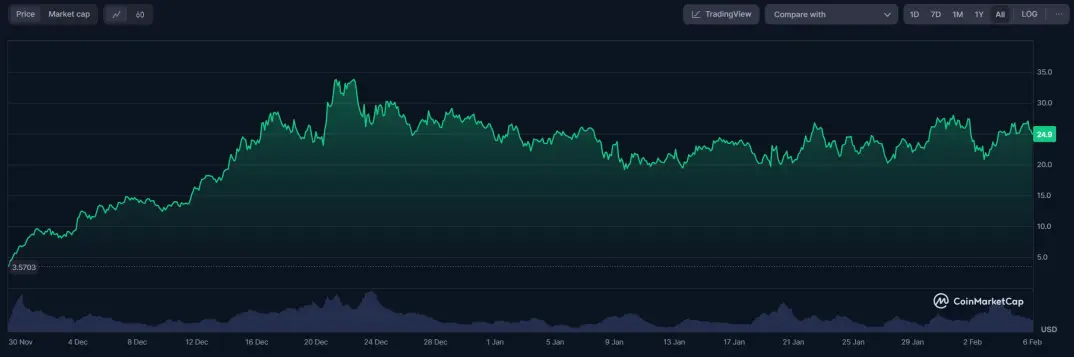
the HYPE will act as the “gas” for applications running on HyperEVM (when this service is deployed). Each interaction, whether it is deploying a smart contract or performing a transaction, will use this token as a payment unit, giving the token concrete utility. Some of the gas costs will be burned via a burn mechanism. The evolution of this feature is not yet known.
Who is behind the founders of Hyperliquid?
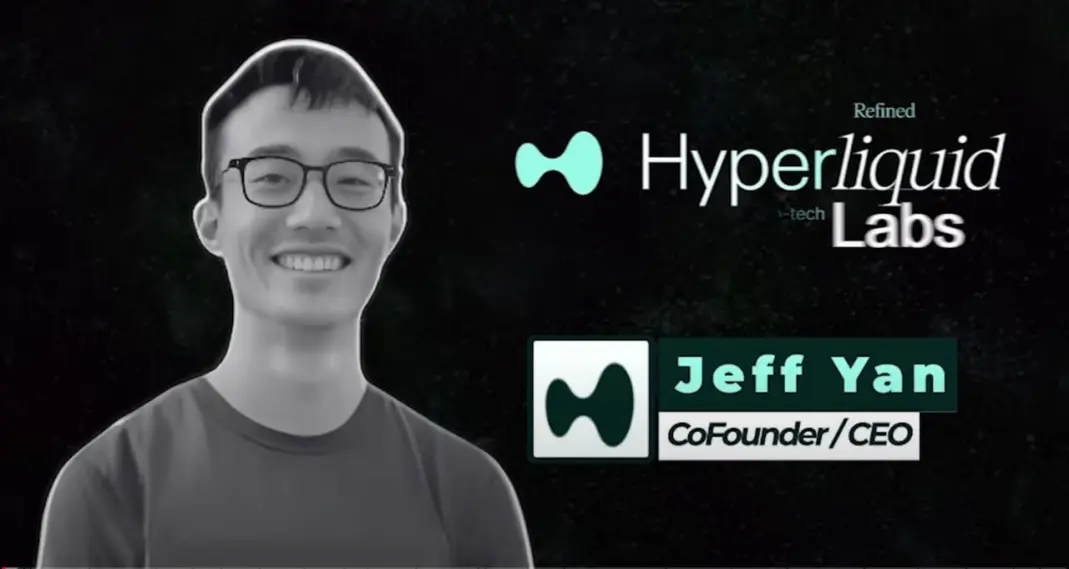
Hyperliquid and its layer 1 are developed by Hyperliquid Labs, an entity led by two former Harvard students: Jeff Yan and Iliensic. These are the main figures of the project. The other members of the team come from companies such as Citadel, Hudson River Trading or Airtable. The team is unique in being 100% self-financed, a phenomenon very rare today.
The platform is currently experiencing strong growth in its daily number of users and this is particularly noticeable in the trade volumes on the platform.
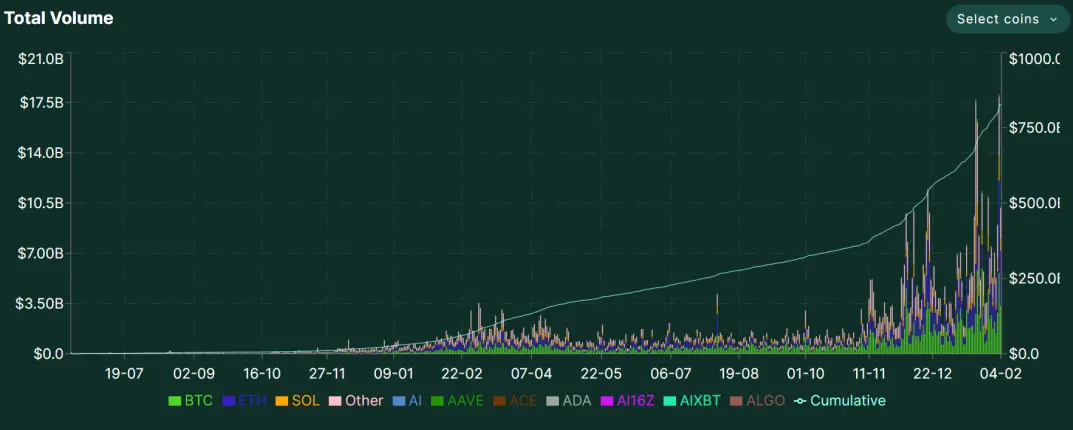
The platform is currently experiencing strong growth. The project is ambitious and brings major improvements to the challenge in a new area. DEX is also a very serious competitor to many EXCs. If the project succeeds in integrating L1 and EMV functions, the token could see strong growth. But all these announcements have yet to materialize. No hurry, but it is certain that this is a project that will need to be closely monitored.




