
The latest Fire Emblem has promised that many things will be in a series of others. And it wasn't just a change of platform from handhelds and trumpets to return to a large "living room" console. Switch is the ideal choice and I will not hide the initial enthusiasm and later establishment - this is a game where I charge the console every day and wipe it out of power and long hours. The aforementioned differences pay off, but they will be more impressive to players willing to scalp into other genres than to tact on heavy maps and click dialogues. There are a lot more new features, borrowed styles and gaming mechanisms, and they fit together perfectly.
Fire Emblem: Three Houses will flood you in the first hour and you are not surprised at what it brings. There are also familiar elements in the tangle: you can choose and name the hero / heroine, complete the first acquaintance with the characters, and get into the role of the son / daughter of a well-known mercenary. You hit the first characters, you get the first choice, but after an hour you come to a huge monastery and everything changes. Your hero will become a professor and later choose one of the three classes to lead. The monastery resembles a huge castle and three classes of faction from Harry Potter, prepare for the blue, red and yellow colors. Everything is elaborated in detail: each class maps a part of the kingdom and a group of students represents a line. You can look at the history of the world of Fodlan and you will certainly be able to meet later events.
For the first few hours, you aren't fighting much. The game spews about 30 characters, both boys and girls, and adds a few professors, the green-haired Archbishop Rheu and her adjutant, it's too much. Occasionally someone keeps you in your memory, but you do not really identify with the characters until you concentrate on a dozen in your class. You need to know this group absolutely at school and in combat to appreciate their quality, nature and consistency with others. This is a more realistic way, and after about 15 hours I mapped my pipe well - from Dimitri to Mercedes to Annette. The game is literally packed with a plot background - with each line gradually changing over their parents or genera, everything is as intriguing as in a soap opera, but in a good direction. No character will go out and the color of the whole dynasty and region will stick together beautifully.
Other names will fix you throughout the monastery throughout the monasteries: among the main missions, everyone has a lot to say about the topic, whether it is a fight with thieves, a political plot, treachery or a lost student. This will cause a fairly good tangle of false or guaranteed tips. You can always see who you didn't say on the map and suddenly, after a possible charge, you must return to the character where you were once to reveal the alibi to you. The story is tough and takes time, after 20 hours there are still other motivations, characters or suspicions. If you're already accustomed to the Fire Emblem series and its plot twists, you'll always be on your toes and guess who's going to turn the coat over for a sharp change and what it will mean for future development.
The structure of the game uses a calendar system, similar to Persona, just not necessarily something happening every day. Rather, the Three Houses focus on the week of the lesson (they get a little experience and can give them assignments), the students have a birthday (you can send flowers or invite them for tea), or smaller story sequences, like someone coming to you advice. How quickly you find out the top things and decisions are taking place on Sunday. That's when you get a huge selection and you can choose how you spend it. You do not even have to be active - you can order rest and get more motivation. Or it is possible to attend a seminar and gain some skills. In terms of teaching, it happens manually, when you determine what students want to do, or automatically, when the system selects a few of them for you and gives them pieces of experience over time. Interesting are the common tasks where you pair students for a certain purpose and if they are compatible, they will strengthen their bond and get good subjects.
Most of the players will go out on the activities of Explore and Battle during their free days. The discovery of the monastery is obligatory once a month because of the plot role, but also on any Sunday it will bring a lot of interesting possibilities and accompanying activities. Sites open gradually, which makes the monastery extensive and the map is perfectly processed. You can see who you haven't spoken yet, and the fact that the monastery is divided into rooms or locations also makes it easier to navigate. You can move around freely (as there are different objects, sometimes it is nice to walk on your own), later you will also appreciate the possibility of jumps and fast travel. Sometimes characters wait in the same places (Bernadetta), often change their position themselves and need to be searched for. Several parts offer a host of side activities such as shared meals, fishing, arena training, choral singing, gardening and more. Some minigames are rather passive, others require to work with buttons at the right time (fish), elsewhere you use a logical procedure - in the garden you first need to sow something, then cultivate, on another day to harvest. Possibility is X, between missions there is no problem to spend an hour wandering in the monastery. Because the game has a large mission at the end of the month, at least one visit unlocks new dialogues, observations, and the monastery lives by what is about to happen - whether it's a celebration or an attack on the fortress. Every activity, however, eats points, at the beginning you have 1-2, then the number will increase, which means the opportunity to catch much more in one day - both lunch and training of one fighter (can get money and gun) and professor training.
The non-combat components include a visit to the market where you can buy / sell weapons and items, repair and upgrade weapons (only to have sufficient materials and crack) and recruiting the battalions. Switch's powerful hardware directly invites units to carry helpers, or even a whole battalion that can rush to the enemy. He is not always successful and can often make a good glade - but they don't fight for free. Therefore, it is necessary to invest in them and choose whom to allocate.
Linking the school with students as fighters is also used in the professions and so-called. certification. Your ward may engage in a certain occupation and re-enact at others (by their own nature, by command or by their own request). A change of profession requires a test where he has to demonstrate a series of knowledge and a degree of ability: for example, if he wants to be a great bowman, he needs to have Archery at least for D, etc. That you have many professions to choose from is fine and not everyone fits everything. The occupations have four levels according to the level, and in order to take the exam to the next level, you need to have a seal in addition to the skills. There is a shortage of them, so it may happen that you will not get everybody to the second level, even though they have the level to ...
If you choose to fight on a free day in the battle calendar, the Battle menu will display a list of available battles. Some smaller ones do not require activity points, so theoretically you can repeat them and grind the formation to higher levels. But more fundamentally, they already ask the point, so you may only go through one in one day and you have to wait for the next. Each battle has a recommended level, you can guess whether to go to it or wait for it, and later Paralogues also appear. These are battles with a plot background where you can learn about the character's past or get into a certain conflict with her personal interest. Sometimes you have to watch out for time limits, some Paralogue are only available until a fixed date and disappear if you don't. The choice of battles is an art in itself - you can grind into disgust on the same maps, which over time will lose the hallmark of fun, or carefully choose which mission you turn on this Sunday.
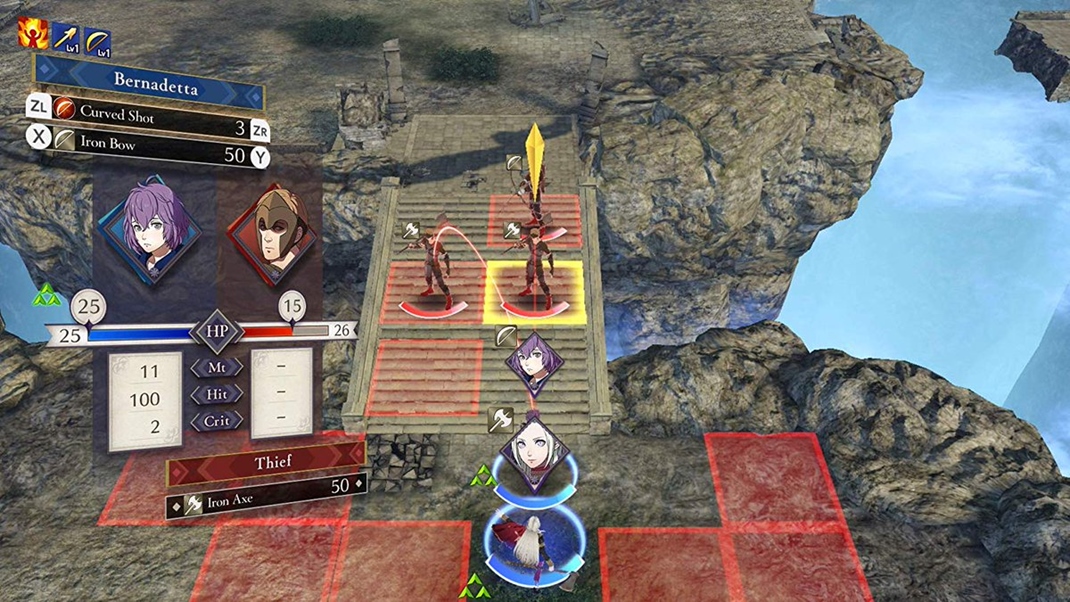
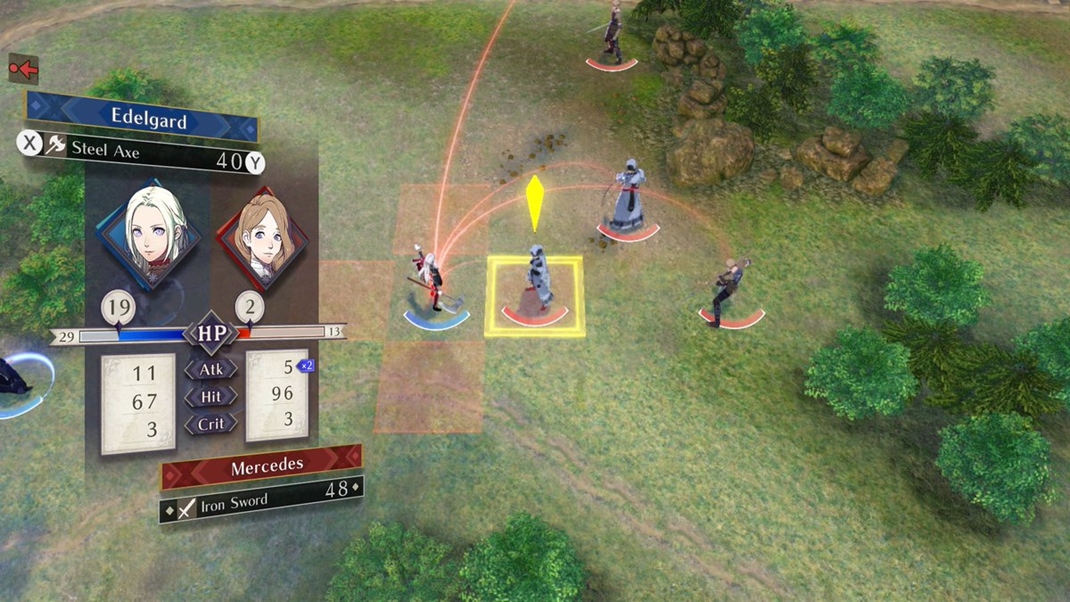
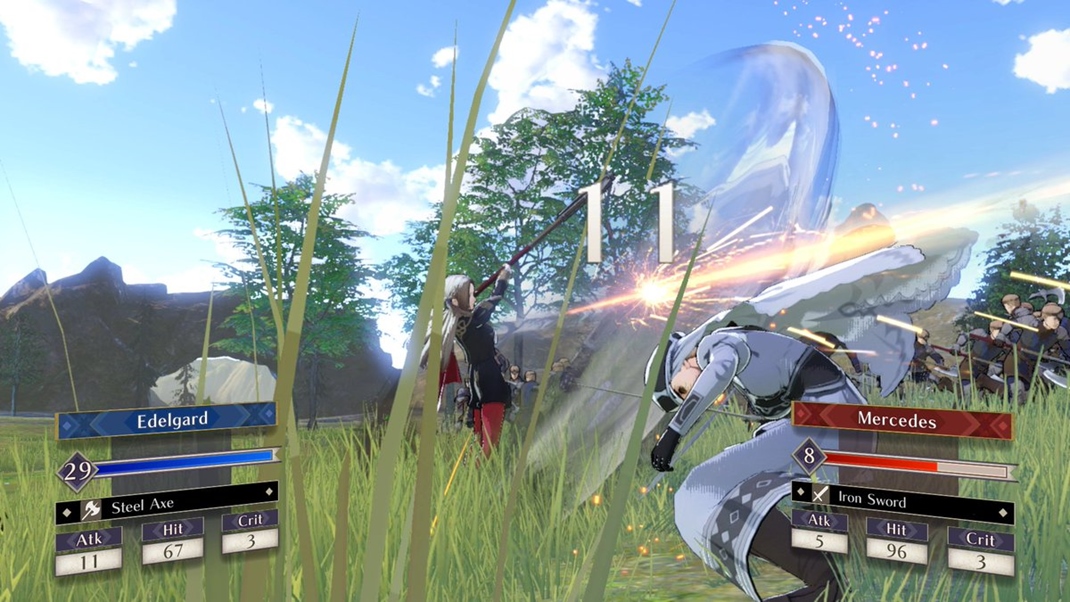
What's new in the battlefield, where the authors promised a bunch of changes? First of all, it feels like Fire Emblem is moving to a higher level thanks to the Switch hardware and thus the overall feeling on the battlefield. Although the basic view is still from a height and isometric angle, with the moves and character movements alone, the camera switches almost into the third person's view, making you fully involved in the fight. This is a great effect, and when wide battalions and battalion units are involved, you will understand how the Koei Tecmo of the Musou series in particular has been able to give the Fire Emblem a new breath of life.
Many of the attributes from the previous part of the series have remained and you can rely on them. There are dozens of professions, weapons are their specialty and you get training in them gradually. Every activity is valued by the portion of experience gained - even a small treatment is suitable for Mercedes, so that it does not just stand by and can move forward. Strong punches are not only help, but also a big deal in tough fights, and you get more points for the attacking and defeating units, which means to tact not only at the beginning, but especially at the end of battles or at low HP opponents. Each unit has different movement options, a different range of weapons or special strikes and can help each other if they take a good position. Of course, the relationships we need to work on are also valued.
How you proceed and what difficulty you set up is up to you. Hardcore players will definitely choose permadeath and cry out after every bitter dead warrior - there is a chance to rewind time, although limited, but it can be won for those who don't want to give up the tough procedure. I have turned off permadeath and although I sometimes grind, there are still battles where one or two units will fall and I'm glad I won't lose them for good because I need to move forward. Unlike some FE episodes, there is a chance to boost units a few levels higher than the recommended battle, which is just a plus.
In the tactical layout of units you have to count with everything. If you like, in the first half of the game, you can borrow a student from another class for a month and use it as a shield in front of your units - although he does not have experience, but each unit meets, as you mostly fight nine to ten. Every move in battle is valued as well as a position - who to put forward (tanks with strong HP), who will be more in the back and serve as a support, where to give archers or healers and how to work with units on horses, which have more movement. There is strength in unity, and it is not good to have many units apart, but sometimes the battle will turn out, especially when you get a limited number of moves. Although the 15 or 25 laps may be enough, you sometimes hurry to keep the limit. You never know what happens in combat - and that's the beauty of the game. Sometimes other units come out from the side, sometimes from behind and the course and tempo of the battle change. Other times, you can take time and move forward two or three times, a defensive approach is not futile.
Combat is defined by several rules. The established triangle of weapons (swords-spears-bows) has fallen, but other regimes still apply: thugs are not very resistant to magic, clashes in the front line are dangerous, archers can rise to the murder level, but even the enemy and girls with magic do not grow as fast as fellows with spears in front. More importantly, your weapons are worn out and destroyed, which you then need to be repaired or even upgraded, but besides the money, the blacksmith's stones must be scared away. Faster destruction of weapons also takes place in special moves (Combat Arts), but they are much more effective. So dilemmas, dilemmas, what ever to use - yet playing gives a preview of what numbers you will hit such an HP and weapon, plus the same with the enemy. The aforementioned battalion novelty offers the advantage of major hits, but needs to be repaid.
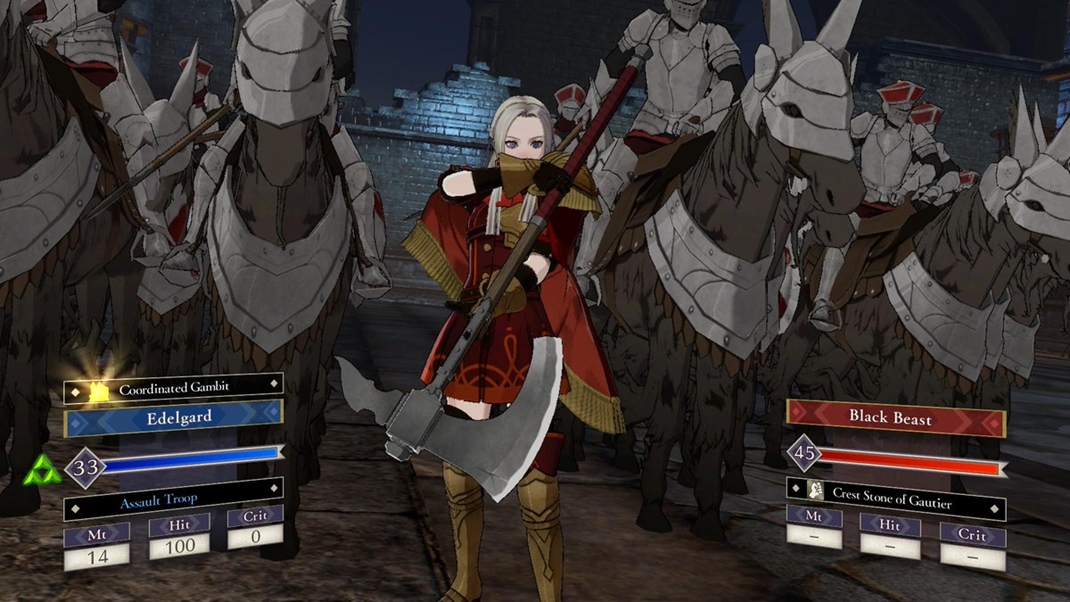
And there are also tough fights with bosses or even monsters that have different rules - several HP scales and mass hits, you have to be very careful about what applies to them, but at the same time do not load fights. Easier difficulty may tempt you to sacrifice some units in favor of a stronger attack, but they will not reach experience, which is a pity, because it is a gold mine for leveling.
Finally, one thing to acknowledge - Fire Emblem: Three Houses is a huge game. The basic chapters plus side missions on a single line take up to 80 hours or more, with three houses and therefore more lines. This is a mammoth title, but is still entertaining, because it has so many possibilities that it does not thrust.
Is it the victory and the next move in the series? Partly yes. New hardware, more studios, more ideas, but at the same time the same game, which has expanded mainly to non-combat capabilities, which has the advantage of better match your hero and the chosen student house. Expansion Pass will bring more missions, battles and even pieces of the story, everything will be served until April 2020.






