
Introduction
The world of decentralized finance (DeFi) offers unprecedented opportunities for yield farming and asset growth. Among the various blockchain platforms, Algorand stands out for its innovative approach and robust infrastructure. In this article, we'll explore how the Algorand Foundation's initiatives, particularly through its Governance Program and Targeted DeFi Rewards (TDR), create a fertile ground for maximizing returns, for ALGO native users as well as for using coming from other blockchains. We'll delve into the revolutionary Lending Pools by Folks Finance, Pact, and Tinyman, providing you with the insights needed to capitalize on these opportunities effectively.
Disclaimer
I am not a member of Folks Finance and I am not paid by them. I am a member of the Folks Finance Alpha program which is a team of dedicated community members who love Folks Finance and help promote it. Thus, I have a privileged relationship with the team members. However, all the views expressed here are my own. I have implemented the strategies presented here with my bag since the launch of Lending Pools. This article constitutes an invitation to explore Lending Pools and the Folks Finance ecosystem, not financial advice nor an invitation to purchase crypto assets.
The Algorand Foundation: Fueling Growth and Innovation
The Algorand Foundation fosters the adoption of Algorand among developers, companies, and communities. Holding a significant portion of the fixed ALGO supply minted during the genesis block, the Foundation uses this treasury to fund developers, organize events and marketing campaigns, and, more recently, incentivize specific on-chain behaviours.
The Foundation distributes ALGO rewards through two primary programs:
- Governance Program: Governors lock ALGO for three months and participate in governance votes, shaping the future of the Algorand Foundation.
- Targeted DeFi Rewards (TDR): The Foundation incentivizes certain DeFi platforms to distribute rewards through farming programs.
These incentives, coupled with Algorand's superior blockchain infrastructure, make Algorand highly attractive for yield farming.
Maximizing Returns with Lending Pools
ALGO can only be locked for Governance during a specific period between governance quarters. The one for G12 closed on July 15, 2024. If you missed it, fear not: the most attractive yield comes from TDR rather than Governance. In this article, I will present Lending Pool options by Folks Finance, Pact, and Tinyman to maximize your returns even if you missed the Governance commitment period.
Warning: Do Not Forget to Stake in Farms
All these strategies involve first depositing liquidity in a Lending Pool and then staking the LP tokens in the associated farm. Do not forget to stake the LP token in the farming program, otherwise your returns might severely decrease.
Lending Pools: A Revolutionary Product
Folks Finance, in collaboration with Pact and Tinyman, recently launched a revolutionary product: Lending Pools. Lending Pools are decentralized Liquidity Pools of assets lent on Folks Finance. Liquidity Providers deposit assets in a standard Liquidity Pool, allowing traders to swap assets and providers to earn swap fees. Rather than sitting idly in the pool between trades, the assets are also lent on Folks Finance, earning Lending APR simultaneously. This innovative design enhances the capital efficiency of your DeFi investments and is a great source of yield, especially when combined with TDR.
Tinyman's ALGO / gALGO Lending Pool
Tinyman's ALGO / gALGO Lending Pool is a great option. Since gALGO is an ALGO derivative and can be redeemed 1:1 at the end of each governance period, the risk of impermanent loss is null. You earn trading fees from people swapping between ALGO and gALGO, Lending APR on ALGO (since gALGO cannot be borrowed), and TDR. Another significant advantage is the ability to withdraw from the pool at any time without risking the loss of rewards. The expected annualized rate for this low-risk strategy ranges from 5% to 12%, with a current rate of around 7%. This strategy is perfect for both new and experienced users who are accumulating ALGO and looking to increase their ALGO holdings: they receive DeFi rewards while minimizing risk and guaranteeing their ALGO capital is preserved.

Even if you missed gALGO minting, you can still obtain gALGO by swapping a portion of your ALGO in these pools and then depositing it for the rewards. gALGO typically trades at a discount compared to the redemption price, making the swap generally advantageous. However, be aware that obtaining gALGO through swapping does not entitle you to governance rewards.
ALGO / Stablecoin Lending Pools
Other favorites are the ALGO / Stablecoin Lending Pools. Stablecoins are on-chain collateralized representations of fiat money. The most important on Algorand are Circle's USDc, pegged to US Dollars, and Stasis EURs, pegged to Euros. There are ALGO / USDc Lending Pools on Tinyman and Pact, and an ALGO / EURs pool on Pact only. These pools are important since people can use them to enter or exit ALGO on-chain. The more the price fluctuates, the more trades occur, ensuring liquidity providers benefit from market volatility regardless of price direction. Providers also enjoy high lending rates for stablecoins, as they are used to leverage in anticipation of bull markets, and a lending rate of typically around 5% for ALGO. Moreover, the TDR for these pools is generous. In the ALGO / USDc pools, users can expect an annualized return ranging from 30% to 60%, depending on market conditions, with a current rate of around 38%. Meanwhile, the ALGO / EURs pool, which typically has a lower TVL, can offer an annualized return of 60% to 100%, with a current rate of around 87%. This strategy is ideal for users who aim to earn yield regardless of market conditions, are less concerned about the quantity of ALGO they hold, and want to be exposed to ALGO and Euro or US Dollar. The substantial DeFi rewards, paid in ALGO, largely compensate for impermanent loss.
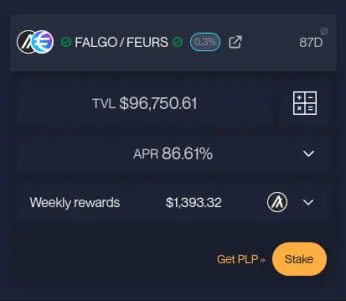
A slight variation of this strategy consists of depositing in the gALGO / USDc pool on Tinyman. Since there is no Lending APR on gALGO and the TDR is less significant, the returns are likely to be lower than in the ALGO / USDc Pools. However, if one already holds some gALGO, farming this pool is an interesting strategy.
Bitcoin & Ethereum Lending Pools
Algorand offers opportunities for non-ALGO holders, hosting bridged versions of the two largest cryptocurrencies: goBTC and goETH by Algomint, and wBTC and wETH by Wormhole. Users can bridge their holdings to Algorand, benefiting from enhanced security, lower fees, and a vibrant DeFi ecosystem. There are Lending Pools that pair ALGO with these bridged assets on Pact (wBTC, goBTC, wETH & goETH) and Tinyman (wBTC, goBTC, wETH & goETH), with Tinyman additionally offering USDc/wBTC and USDc/wETH pairs.
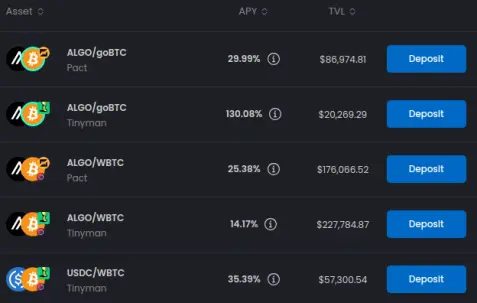
Liquidity providers in these pools enjoy all the advantages of Lending Pools. While lending rates and swap fees are typically low for such pools, except under extraordinary market conditions, most of the yield comes from the TDR. Expect returns of around 25-50% in these pools. This strategy is highly recommended for BTC or ETH holders curious about the Algorand ecosystem and willing to try it out while benefiting from much higher yields than those available on native chains. This strategy could also appeal to ALGO users looking to diversify into the two largest cryptocurrencies.
Other Lending Pools
Additionally, other pairings are available for Lending Pools. Once familiar with the three main options presented above, explore other options to fine-tune your portfolio and strategy. Notable Lending Pools include pairings with real-world assets such as gold (with USDc or ALGO on Pact), and silver (with USDc or ALGO on Pact) tokenized by Meld Gold, and pairings with AVAX, another major cryptocurrency, with ALGO on Pact and USDc on Tinyman. A complete list of existing Lending Pools can be found on the Folks Finance website.
Risks Involved
While Algorand's DeFi ecosystem offers lucrative opportunities, it's crucial to be aware of the associated risks.
Smart contract risks can pose a significant threat, as bugs or vulnerabilities in the code can lead to loss of funds. The code for Lending Pools has not been audited yet. However, thanks to Algorand built-in security exploits are unlikely.
Wallet hacks are another concern; if a user's private keys are compromised, their assets can be stolen with no possibility of them being recovered. Users should be careful about managing their private keys.
Depeg means that the price of a collateralized token becomes uncorrelated with the asset it represents. This can happen if the collateral gets stolen or if the liquidity mechanism is poorly designed.
Impermanent loss occurs when the value of deposited assets in liquidity pools fluctuates, potentially leading to a loss compared to simply holding the assets. The high TDR as well as trading fees usually compensate for such risks.
Additionally, while bridging assets like BTC or ETH to Algorand, there's always a risk associated with the bridge's security. Users must practice robust security measures, stay informed about platform updates, and consider the potential downsides before committing their assets to DeFi protocols.





