
Update made on thursday, November 16 :
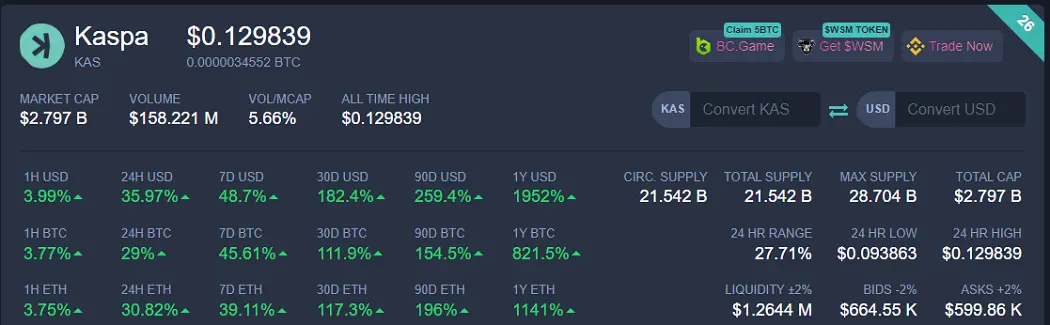
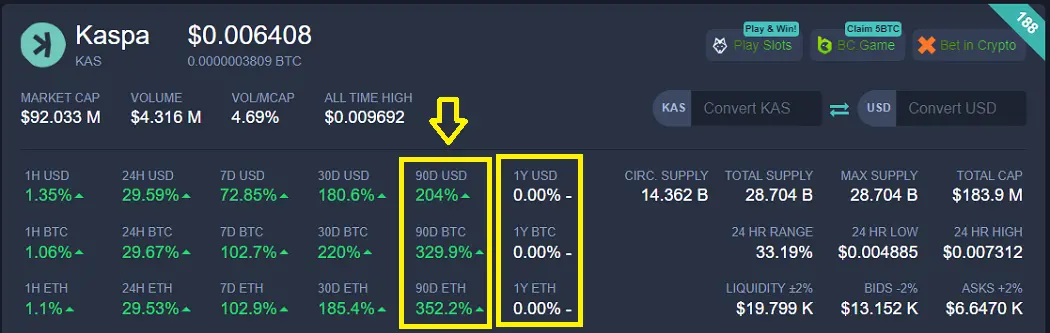
There can be observed quite a spectacular grow in Kaspa(KAS) since November 15 2022!
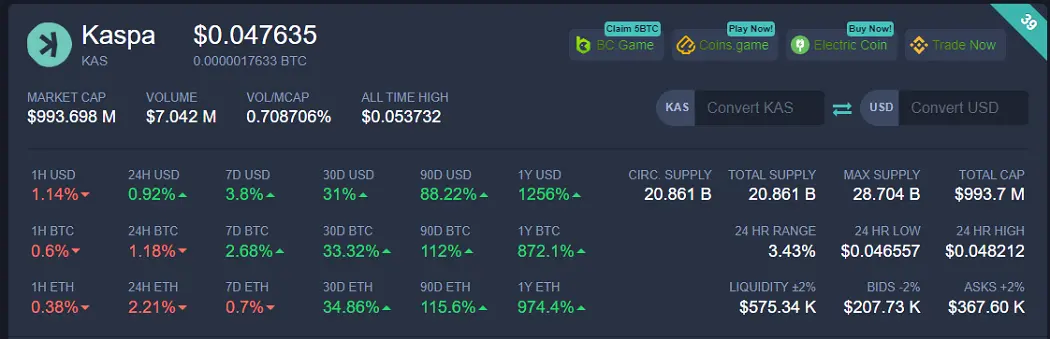
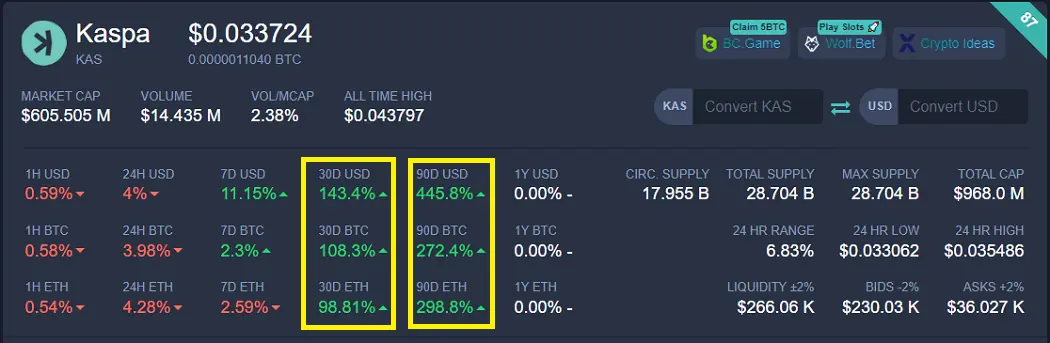
- In six months from $0.006408(tuesday, november 15 2022 at 10:48 am UTC) to $0.033724(Sunday, April 16 2023 at 8:32 am UTC), representing a more then 500% rise in $value of 1 KAS!
- Since april 16 and until today November 16 at 6:51am UTC, we see a further booming KASP, from $0.033724 to $0.129839
- From $92,039M Market Cap(tuesday, november 15 2022 at 10:48 am UTC) to $605,505M Market Cap(Sunday, April 16 at 8:32 am UTC) to
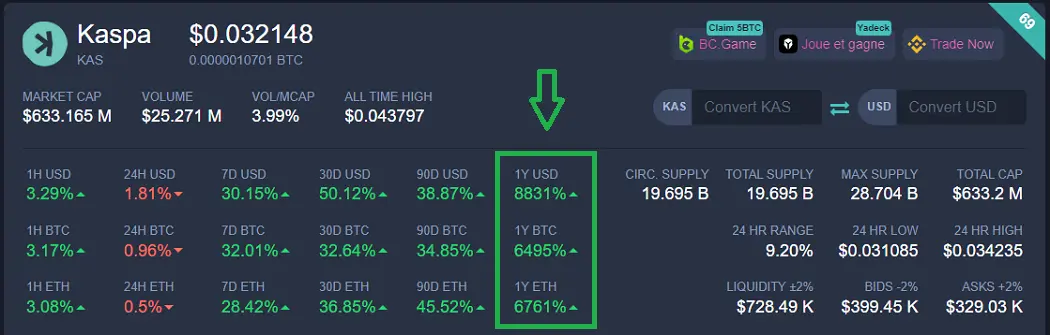
$633,165(tuesday, July 18 at ca 9:13 am UTC) to $2.797B(thursday, November 16 at 6:51am UTC).
- From rank 188 (In LivecoinWatch) to rank 87(Sunday, April 16 at 8:32 am UTC) to rank 69(tuesday, July 18 at ca 9:13 am UTC)to rank 26(thursday, November 16 at 6:51am UTC) !
Question:
What can be the reason for this extra-ordinary grow?
In traditional blockchain systems using Proof of Work (PoW) consensus, there is a trade-off between security and transaction throughput. The longer it takes to confirm a block (increasing security), the slower the network becomes due to longer confirmation times. Conversely, faster block confirmation times result in reduced security, as the network has less time to agree on the correct block. The GHOST protocol was designed to address this trade-off by redefining how consensus is achieved.
The Ghost protocol.
At the Financial Cryptography and Data Security Conference in 2013. Yonatan Sompolinsky and Aviv Zohar, both computer scientists and researchers who were studying various aspects of blockchain technology, including its scalability and security challenges, a paper was presented.
Their paper introduced the GHOST protocol as a potential solution to the trade-off between security and transaction throughput in blockchain networks. The protocol's novel approach to including orphaned blocks and assigning them weight in the consensus process aimed to enhance the overall efficiency and security of the network.
In a way, The Ghost protocol solves this problem by using a DAG, which allows for multiple transactions to be processed in parallel.
What is a DAG?
A directed acyclic graph or DAG is a data modeling or structuring tool typically used in cryptocurrencies.
Unlike a blockchain, which consists of blocks, directed acyclic graphs have vertices and edges. Thus, crypto transactions are recorded as vertices. These transactions are then recorded on top of one another. Similar to a blockchain, however, transactions are also submitted to the DAG via nodes. Proof-of-work (PoW) tasks are required of nodes to submit a transaction.
Simply put, whereas a blockchain system looks like a chain, DAG’s system looks more like a graph.
From Ghost protocol to the GhostDAG protocol.
In 2018, Yonatan Sompolinsky and Aviv Zohar proposed a new version of the Ghost protocol called #GhostDAG. GhostDAG addressed the security limitations of the original Ghost protocol by using a new consensus mechanism called PoW-Vote. PoW-Vote is a hybrid consensus mechanism that combines the security of Proof-of-Work (PoW) with the efficiency of Proof-of-Stake (PoS). This made GhostDAG more secure and efficient than the original Ghost protocol or any other blockchain protocol. Later Yonatan Sompolinsky, Aviv Zohar, and Shai Wyborski co-authored the paper PHANTOM GHOSTDAG: A Scalable Generalization of Nakamoto Consensus.
From GhostDAG to #DAGKNIGHT.
Dag Knight ===== The #DAGKNIGHT Protocol, written by Michael Sutton and Yonatan Sompolinsky, is a three-year work of genius and consensus upgrade for Kaspa’s PHANTOM GHOSTDAG Protocol. KNIGHT was set in motion with the goal of resisting 50% attacks without knowing the network latency ahead of time.
DAGKnight is a permissionless, parameterless DAG-based consensus protocol that is designed to be secure against any attacker with less than 50% of the computational power in the network.
DAG KNIGHT is a protocol designed to address network delay and security vulnerabilities in blockchain networks, particularly focusing on the challenges posed by 50% or 51% attacks. It aims to dynamically adjust block confirmation times based on real-time network conditions, allowing for more adaptive and secure blockchain operations.
The protocol continually seeks the lowest latency valid k-cluster that covers at least 50% of the network. This dynamic adjustment ensures that block confirmations are optimized for the current network conditions, enhancing security without sacrificing efficiency when the network is healthy.
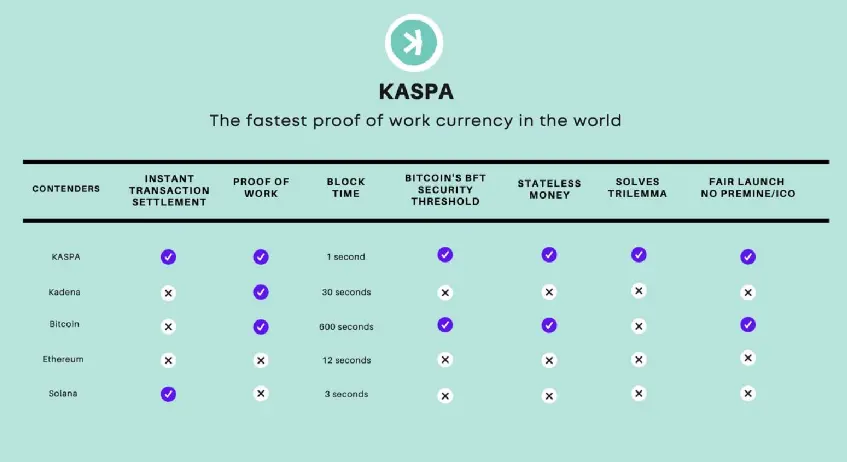
Update made on thursday, November 16 at ca 6:51am UTC.
Update made on friday, November 10 at ca 19:50 UTC.
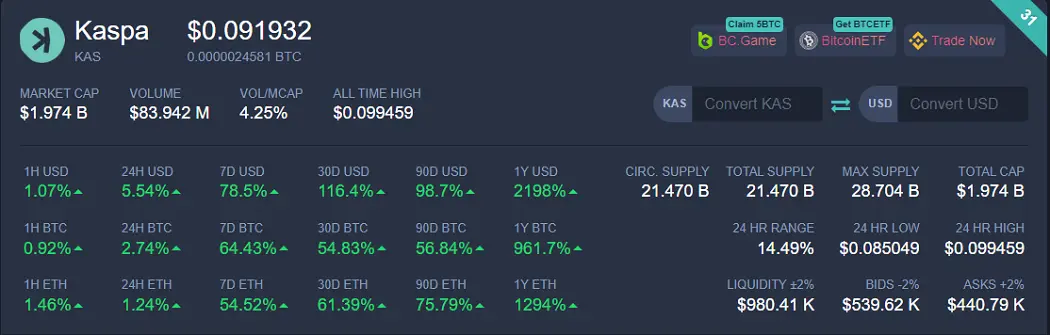
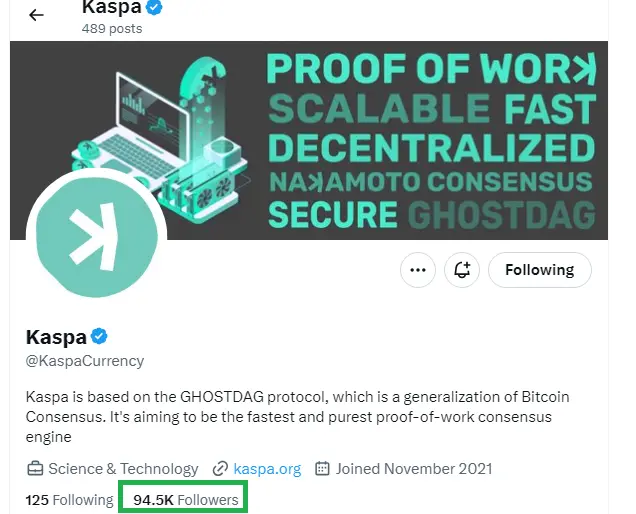
Update made on friday, September 29 at ca 9:01 am UTC.
What preceded:
Excelencia started this series after noticing that there can be a lot of difference between the position of a token against $, BTC and ETH.
Noticing for the first time this difference in AMPl, Excelencia got curious to see these different positions in other tokens.

Kaspa(KAS)
What was motivating today to highlight "Kaspa(KAS)"in Excelencia's TheCryptoComparisonSeries, is what Excelencia was saying in the musing question at the end of part six of this series:
When one follows the 1 Year price evolution of AMPL, one might well ask which token could best compete with it…as what concerns the 1 Year price evolution.
When Excelencia was noticing that Kaspa(KAS) was within Livecoinwatch's Biggest Winners list at 10:18 am UTC today tuesday, November 15 2022,
Excelencia felt the urge to become more informed about Kaspa(KAS):
see it for yourself in the screenshots below, taken in a few minutes span from each other:
Screenshot taken on tuesday, november 15 2022 at 10:48 am UTC :
Click in the picture to enlarge the image.
Screenshot taken on Sunday, April 16 at 8:32 am UTC :
Screenshot taken on tuesday, July 18 2023 at 9:14 am UTC :
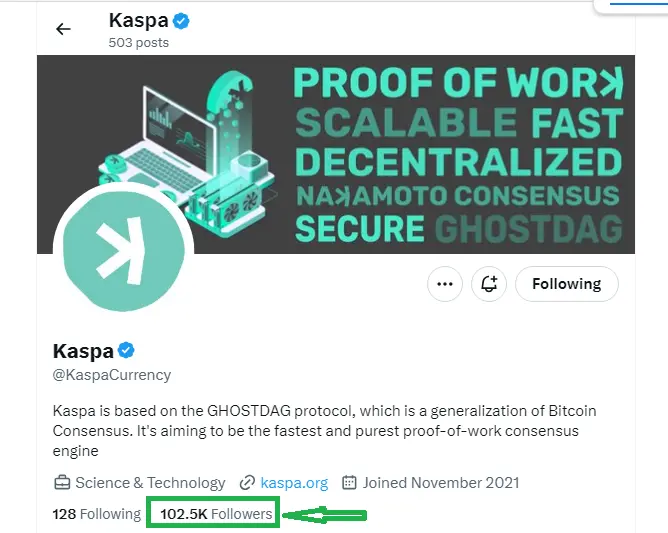
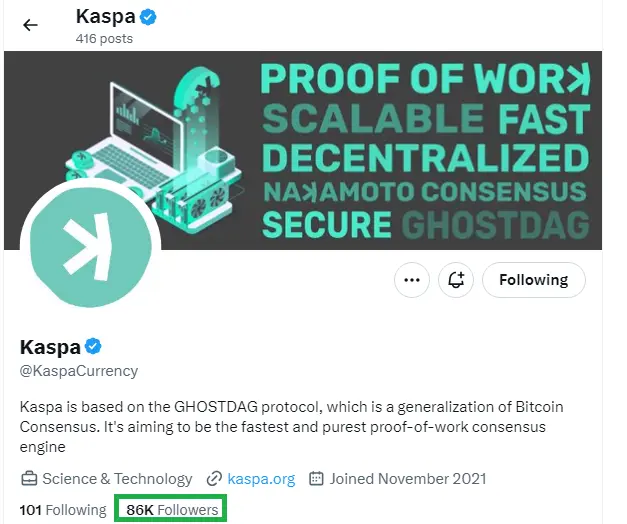
After noticing that Kaspa(KAS) hadn't any 1Y information, Excelencia went to the twitter account of Kaspa(KAS) to see how long this token is running already, and saw this message in a tweet:
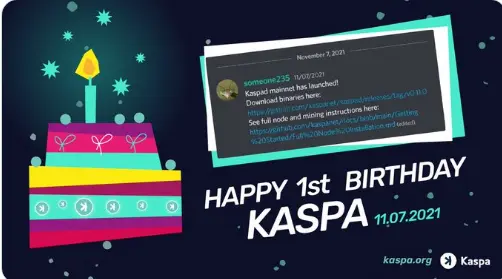
It was surprising for Excelencia to see that after one year, this token was already at rank 188 in MarketCapitalization(92M) on the Livecoinwatch website,which sharpened his curiosity to know more about this token...
Here's how
Kaspa(KAS)
introduces itself on the website:
Kaspa is the fastest and most scalable instant confirmation transaction layer ever built on a proof-of-work engine. Transactions sent to miners can be included immediately in the ledger, which is structured as a revolutionary blockDAG. Kaspa is based on the GhostDAG/PHANTOM protocol, a scalable generalization of the Nakamoto Consensus (Bitcoin consensus). Its design is faithful to the principles Satoshi embedded into Bitcoin — proof-of-work mining, UTXO-formed isolated state, deflationary monetary policy, no premine, and no central governance. Kaspa is unique in its ability to support high block rates while maintaining the level of security offered by the most secure proof-of-work environments. Kaspa’s current mainnet operates with one block per second. After the ongoing rust language rewrite, the core developers goal is to increase the number of blocks per second substantially, attracting the development of smart contracts and DeFi.
Reading these quoted lines above, Excelencia felt very impressed.
Click in the picture to enlarge the image.
Stay alert for upcoming token position comparisons and for possible uploads in each of the CryptoComparisonPosts , as Excelencia's exploring of the tokens is increasing.
Follow Excelencia's the TipsForPublishersSeries
Follow Excelencia's TheCryptoComparisonSeries
Follow Excelencia's TheExperimentsSeries
Folow Excelencia's TheDailyStatsSeries
Follow Excelencia's TheEarningsReportingUsersSeries
Follow Excelencia's ThePredictionSeries
Have a nice continuing of your day.
See all episodes from Excelencia's TheCryptoComparisonSeries:
AMPL against the $, BTC and ETH.
SOL against the $, BTC and ETH.
MONERO(XMR) against the $, BTC and ETH.
TETHER(USDT) against the $, BTC, ETH and AMPL.
Stellar(XLM) against the $, BTC, ETH and AMPL
Decentraland(MANA) against the $, BTC, ETH and AMPL.
The Sandbox(SAND) against the $, BTC, ETH and AMPL.
Frax(FRAX) against the $, BTC, ETH and AMPL.
TE-FOOD(TONE) against the $, BTC, ETH and AMPL.
Rocket Pool(RPL) against the $, BTC, ETH and AMPL.
PivX(PIVX) against the $, BTC, ETH and AMPL.
Gatechain Token(GT) against the $, BTC, ETH and AMPL.
VITE (VITE) against the $, BTC, ETH and AMPL.
:Polygon(MATIC) against the $, BTC, ETH and AMPL.
Trust Wallet Token(TWT) against the $, BTC, ETH and AMPL.
This article was published on tuesday, november 15 2022
Thumbnail Image by Kier... in Sight on Unsplash






