
Welcome to our weekly digest, where we unpack the latest in account and chain abstraction, and the broader infrastructure shaping Ethereum.
This week: the Ethereum Foundation’s Kohaku project shows post-quantum account protection can ship today for $0.07 with no hard fork; Quack AI’s Q402 turns EIP-7702 into gasless stablecoin payments for AI agents; Ant International parks corporate cash in Amundi’s tokenized money market fund on Ethereum; and a new thirdweb guide maps where ERC-4337 and EIP-7702 stand in 2026.
- Kohaku Brings Post-Quantum Account Protection to Ethereum for $0.07
- How EIP-7702 Enables Gasless Payments for AI Agents
- Ant International Adopts Amundi's Tokenized Money Market Fund on Ethereum for Treasury
- Account Abstraction in 2026: How EIP-7702 and ERC-4337 Are Transforming Ethereum Wallets
Please fasten your belts!
Kohaku Brings Post-Quantum Account Protection to Ethereum for $0.07
The Ethereum Foundation’s Kohaku project has shown that post-quantum account protection can be deployed on Ethereum today for roughly $0.07 — no hard fork required. The approach uses ERC-4337 smart accounts to swap in quantum-resistant signatures at the individual account level, and it is entirely opt-in.
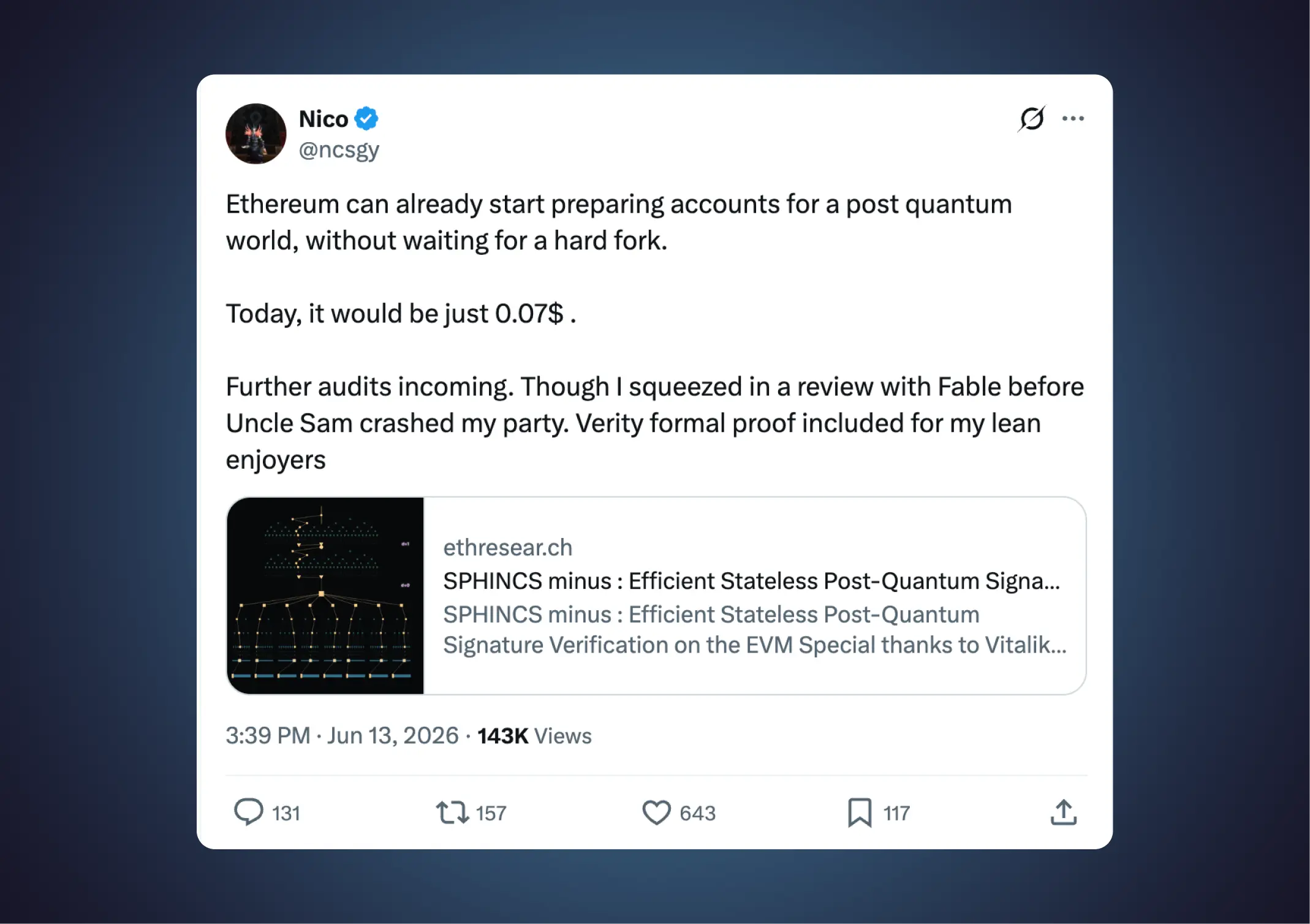
The technical groundwork comes from Kohaku contributor Nico (Nicolas Consigny), who published “SPHINCS-” on ethresear.ch, a family of EVM-optimized variants derived from SPHINCS+. The key insight is that the EVM already has a cheap KECCAK256 opcode, so replacing the standard’s SHAKE256 with KECCAK256 lets the verifier run natively on-chain, without a precompile or protocol change.
A Solidity verifier lands at roughly 150,000 gas (the ~$0.07 figure) and ships with a Lean 4 formal proof via Verity, a potential path to FIPS compliance on Ethereum. Lighter variants are tuned for different signers: C13 targets laptops, while C11 and C12 are designed to run on a Ledger Nano S+ secure element.
Why does this matter? Today’s Ethereum accounts rely on ECDSA signatures, which a sufficiently powerful quantum computer could eventually break and use to forge transactions. Because Kohaku is opt-in and account-level, holders, especially institutions sitting on large positions, can quantum-proof wallets now without waiting for network-wide consensus.
The Foundation’s Post-Quantum Security team, formed in January 2026 under Thomas Coratger with backing from Justin Drake, targets full protocol readiness around 2029. Further out, a “leanSPHINCS” variant with ZK-friendly hashing and STARK aggregation could push verification down to roughly 3,000 gas.
How EIP-7702 Enables Gasless Payments for AI Agents
Here’s a familiar friction point: a wallet can hold $100 in USDC and still be unable to send $20, simply because it has no native gas token. For a single user, that’s an annoyance, but when an AI agent manages multiple wallets across several chains, funding each one with the right gas token turns automation back into manual treasury work.
Quack AI’s Q402 is a useful example of how EIP-7702 solves this in practice. It lets people and AI agents send stablecoins (USDC, USDT, RLUSD) gaslessly across ten EVM networks: the payer signs a structured EIP-712 payment intent, and a relayer submits the on-chain transaction and pays the network gas.
The account abstraction mechanics are the interesting part. EIP-7702 lets an existing EOA use delegated code without moving funds to a newly deployed smart-account address; the relayer submits a Type-4 transaction, and the delegated implementation validates the payment before transferring the token. Crucially, the relayer pays gas but gains no arbitrary authority over the wallet — the signed intent stays bound to a permitted implementation.
On top of that base, Q402 layers AA-native conveniences: dedicated agent wallets with spending caps, batch and recurring payments, and programmable “hooks” that can screen recipients, enforce spend limits, or require approvals before a payment settles. Every settlement produces a signed “trust receipt” for independent verification.
Ant International Adopts Amundi’s Tokenized Money Market Fund on Ethereum for Treasury
Ant International, the owner of Alipay+, has started using tokenized money market funds to manage its corporate treasury. It is doing so through specially issued digital share classes of the Amundi Money Market Fund — Short Term, where the EUR and USD tokens are issued on the Ethereum public blockchain.
This builds on years of groundwork. Ant has used blockchain for internal treasury management since 2019 via its “Whale” platform, enabling 24/7 cross-border transfers; now it wants to maximize returns on idle cash by parking it in tokenized MMFs once the money arrives.
The arrangement runs through Europe’s largest asset manager. Amundi oversees €2.4 trillion in assets, and the deal is effectively a Credit Agricole affair — the bank owns 68.3% of Amundi, while its securities-services arm CACEIS acts as transfer and tokenization agent, minting and burning the digital shares.
It’s another concrete signal that institutional treasury operations are moving onto public Ethereum and that tokenized real-world assets are maturing into practical cash-management tools rather than pilots. “Our goal is to build a future of instant, borderless money movement,” said Kelvin Li, General Manager of Platform Tech at Ant International.
Account Abstraction in 2026: How EIP-7702 and ERC-4337 Are Transforming Ethereum Wallets
A new thirdweb guide frames account abstraction as the biggest shift in Ethereum wallets since MetaMask first launched. The argument: ERC-4337 and EIP-7702 are together replacing the rigid externally owned account (EOA) model with programmable smart accounts that handle gas sponsorship, batching, session keys, and recovery natively.
A common misconception it clears up is that EIP-7702 replaces ERC-4337 — in reality, they are complementary. ERC-4337 provides the infrastructure layer (bundlers, paymasters, the EntryPoint, and account factories), while EIP-7702, shipped in last year’s Pectra upgrade, gives every existing EOA the protocol-level primitive to use that infrastructure without first deploying a new contract.
Together, the stack unlocks the experiences users now expect: email or social login with gas sponsored behind the scenes, multiple actions bundled into a single transaction, session keys that remove repeated wallet pop-ups, and recovery through guardians instead of seed phrases.
The adoption numbers back up the shift. The guide notes that smart account deployments have surpassed 30 million across Ethereum and its L2s, with paymaster-sponsored transactions now a significant share of activity on Base, Arbitrum, and Optimism.
The takeaway is a clear directive for developers: design around smart accounts from the start, because the EOA-first model, assuming every user has MetaMask and ETH for gas, is fading fast.
🛠️ Builder note: Etherspot
AA infra should make development easier, not harder.
- One RPC endpoint across chains
- Pay-as-you-go pricing on mainnet
- No markup on gas fees
- API key controls with built-in security
Start exploring Account Abstraction with Etherspot!
- Learn more about account abstraction here.
- Head to our docs and read all about Etherspot Prime.
- Skandha — developer-friendly Typescript ERC4337 Bundler.
- Arka — an open-source Paymaster Service for gasless & sponsored transactions.
- Explore our TransactionKit, a React library for fast & simple Web3 development.
- Follow us on X and join our Discord.
❓Is your dApp ready for Account Abstraction? Check it out here: https://eip1271.io/
Follow us
Website | X | Discord | Telegram | Github | Developer Portal
Powered by Etherspot






