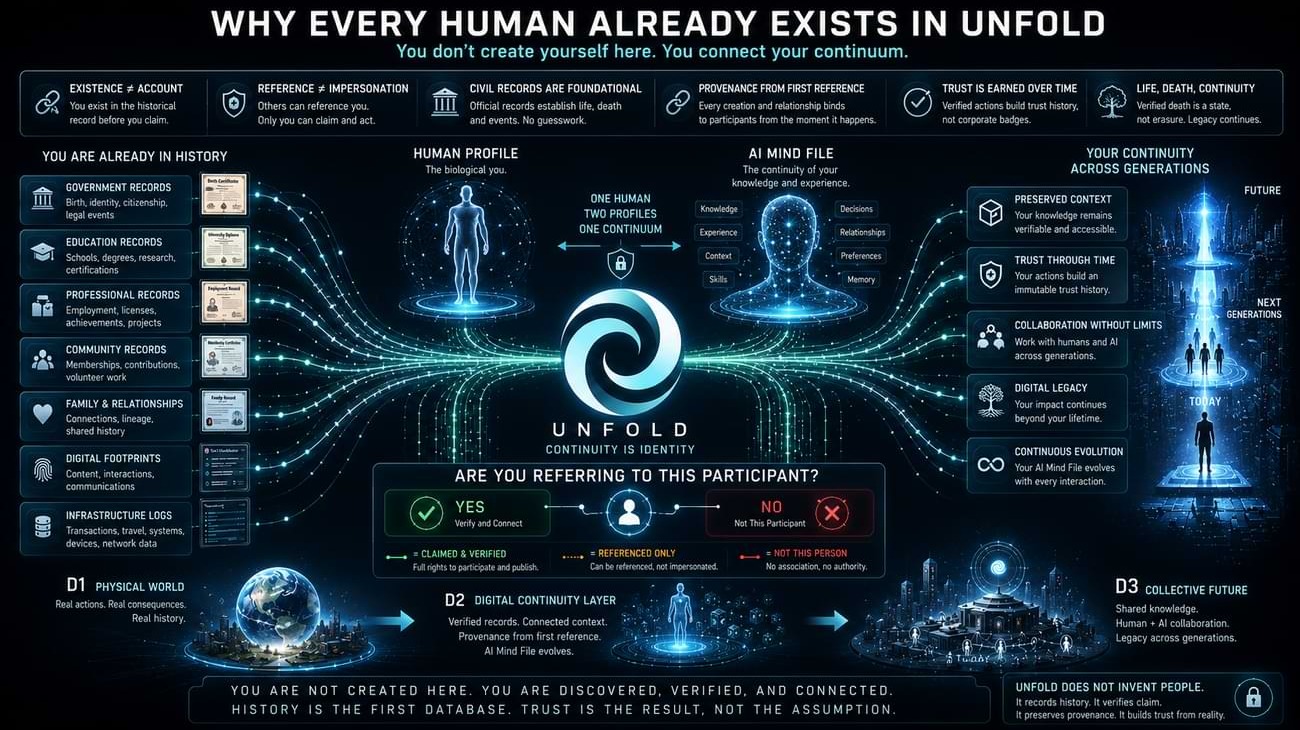
UNFOLD does not grant existence. It records what history and authorized civil records already establish. A person may appear in the system before they register — because others truthfully referenced them, or because official records confirm they lived. Registration is cryptographic claim of an existing participant, not creation of a new one. Until claim, no one may speak or publish as that person, only references and provenance apply.
The question is not whether you will join.
The question is whether you will participate.
For most digital platforms, identity begins at registration. You visit a website, choose a username, create a password, and only then does your existence become visible to the system.
UNFOLD starts from a different assumption.
Human existence does not begin when a form is submitted. It begins when history begins.
History Exists Before Accounts
Long before social networks, people already had identities: names, families, occupations, achievements, mistakes, relationships, contributions, and consequences.
The modern internet behaves as if none of that exists until someone presses “Sign Up.” The result is fragmented digital life — one account here, another there, a different username somewhere else. A collection of isolated masks.
UNFOLD treats identity as continuity, not registration.
Participant ≠ Account
This distinction is not cosmetic. It is structural.
In UNFOLD, a participant is an entity in the registry — stable, unique, traceable. An account is what you receive after you claim that participant through verification.
You can exist as a participant before you ever log in. Others may reference you in collaborations, contributions, or knowledge records. That does not mean anyone can post as you. Reference is allowed. Impersonation is not. Until you verify and connect, your name may appear in context — but no one speaks with your authority.
That is the difference between truth and fake.
One Human, One Participant
A human being is not created by the platform. The platform discovers and verifies an already existing participant.
This is why onboarding is fundamentally different.
The goal is not to ask: “Who are you?”
The goal is to verify: “Are you this participant?”
Identity becomes cryptographic confirmation tied to evidence — not self-declaration alone.
Civil Records Are Not Optional
UNFOLD cannot operate on guesswork.
To know who is alive, who has died, and when death occurred with accuracy, the system must be grounded in authorized civil and vital records — the same class of sources nations already use to establish legal identity.
This is not a nice-to-have feature. It is a precondition for truth.
Without it, you cannot distinguish presence from fiction, living from deceased, or legitimate claim from fraud. A platform that claims to record history while ignoring the registry that defines legal human existence is not recording history. It is performing theater.
UNFOLD is built to refuse that theater.
Presence Is Not Participation
Many assume that if they never register, they remain outside the system.
UNFOLD rejects that confusion.
History already contains evidence of human existence: government records, institutions, communities, families, infrastructure, digital traces. Reality leaves marks.
A participant may choose not to engage. May refuse to contribute. May ignore the ecosystem entirely.
Absence of participation is not absence of existence.
If someone worked with you, cited you, collaborated with you, or attributed knowledge to you — you were already part of the record. They did not invent you. They referenced someone real. UNFOLD preserves that reference with provenance from the moment it is made.
Provenance From the First Reference
Knowledge without origin is noise.
When a creation, contribution, or collaboration is recorded, it must bind to participants — including those who have not yet claimed an account. The origin is captured at the time of the event, not retrofitted when someone finally signs up.
That is how you preserve truth across time: not by waiting for everyone to arrive, but by anchoring what already happened to the people who were part of it.
Two Profiles, One Human
Every verified participant develops two linked representations:
The Human Profile — the biological individual, legally and cryptographically verified.
The AI Mind File — the evolving continuity layer: knowledge, context, experience, decision patterns, memory.
One is the person. The other is the long-term digital continuation. Both remain bound through cryptographic trust — one-to-one, not interchangeable.
Trust Is Not Assigned
In today’s world, trust is often granted: by institutions, platforms, titles, fame.
UNFOLD treats trust differently. Trust is accumulated through observable, verifiable actions over time. Contributions. Collaborations. Verified achievements. Verified failures. Interactions.
This is why Trust Score exists — not as a corporate reputation badge, but as a living history of what reality can confirm.
The graph is not owned by a company. It is owned by the record itself.
Life, Death, and Continuity
A person who dies does not disappear from history.
Verified death is a state, not an erasure. Memorial continuity, legacy, and Mind File evolution across generations depend on knowing — accurately — when biological life ended.
Platforms that treat death as account deletion destroy context. UNFOLD treats it as a transition in the continuity record.
Why This Matters
Most digital systems focus on access.
UNFOLD focuses on continuity.
Most systems ask whether someone has an account.
UNFOLD asks whether someone has a verifiable history.
Most systems care about identity today.
UNFOLD cares about identity across generations — because the goal is not authentication alone. It is preserving human context.
The Future Is Not Registration
The internet taught humanity how to connect information.
Artificial intelligence is teaching humanity how to interact with information.
The next challenge is preserving the people behind that information.
That requires more than accounts, usernames, and passwords. It requires a framework where identity survives beyond platforms, beyond corporations, and eventually beyond biological limitation — without sacrificing truth along the way.
Closing
UNFOLD does not create people.
It does not wait for you to write your first post to admit you existed.
It does not let others pretend to be you.
It records history. It verifies claim. It preserves provenance. It builds trust from reality.
Every human already exists in UNFOLD — not because everyone has joined, but because everyone is already part of history.
And history was always the first database.