
This Article is translated by DeepL Translator. The original Post in German can be found here.
I recently made a video that explores the issue of loss of purchasing power in long-term savings contracts.
As basic assumptions I used the following values:
Savings amount: 1200.- p.A. which equals 100.- p.M.
Loss of purchasing power: 2% p.a. which corresponds to about 2.1% inflation
The savings amount remains constant over the entire term.
Loss of purchasing power vs. inflation:
To make it easier to calculate, I have assumed a 2% loss of purchasing power. If you calculate with the target inflation of the central banks of 2%, the loss of purchasing power would be 1.961%, which is a bit laborious to calculate.
The reason for this percentage difference is that inflation of a value x 2% is added. This 2% inflation, however, when subtracted from the value x, results in a loss of purchasing power of 1.961%.
In the following table we now see the following:
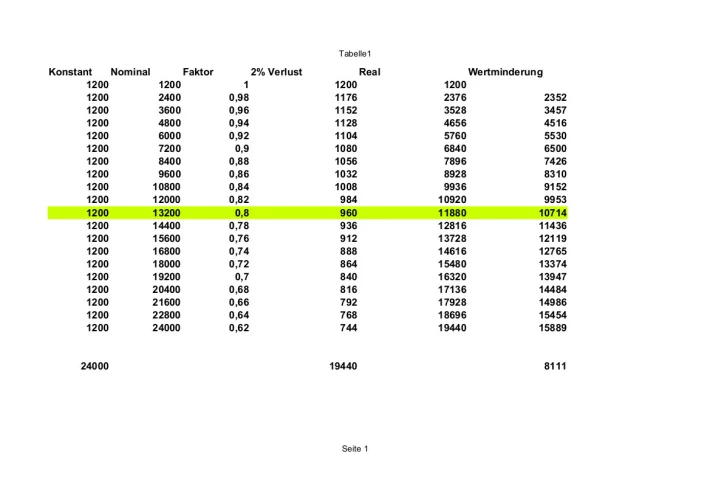
In the first column, the constants are deposits of 1200.-.
In the second column, the amount saved, which increases by 1200.- every year.
The first two columns show the figures that banks and insurance companies show to the customer. In addition they add the interest which increases the 24000.- accordingly.
In the third column we see the factor with which the annual additional payment including loss of purchasing power is calculated. Always minus 2% compared to the previous year.
In the fourth column we see the real adjusted amount that is added annually.
In the fifth column we see the adjusted saved amount.
We see that only the loss of purchasing power of the installments makes about 4500.- disappear.
But now that our saved assets are also losing 2% of their purchasing power every year, it looks even more bitter.
In the last column you can see the saved assets with the included loss of purchasing power.
We can also see that a total of 8111.- is gone.
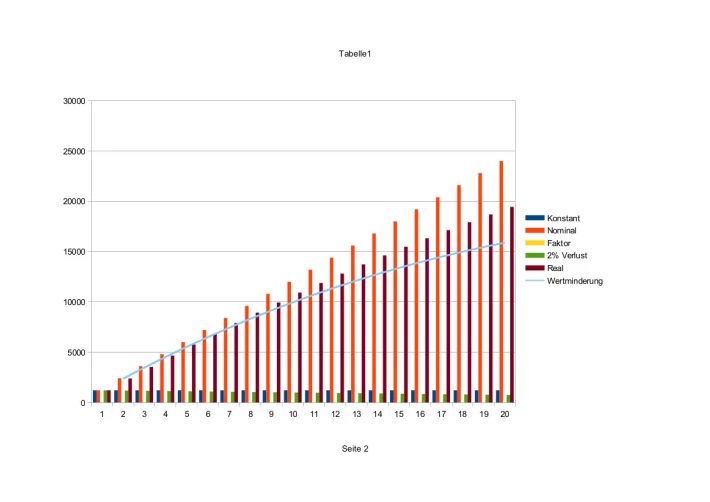
Purely in terms of inflation, it makes little sense to conclude long-term savings contracts.
Let us now take a look at what happens when we add interest.
First of all, we see that interest rates can only influence the last column, as rates are still subject to inflation.
Assuming that the contract promises 2% interest, this means that you will still only get the level of the instalments paid in real terms 19440.-.
If there is less interest, the real amount will be somewhere between 15889.- and 19440.-
If the interest rates are higher, which is unlikely for newer contracts after 2008, you would end up somewhere between 19440 and 24000.
In this example I have not considered the compound interest effects, because these effects work both ways.
This means: If you generate 2% interest annually, the 2% will be subject to 2% interest again next year, because the 2% from the previous year will be added to your savings balance.
As an example: You have 100 and earn 2% in the first year, this means that the new amount is 102.- and the interest in the second year is 2% from 102.-.
But if you subtract 2% from 100.- in the previous year, the new amount will be 98 and 2% will be subtracted from this 98.- in the next year.
So it is obvious that this compound interest works in both directions.
What can we take away from this example.
In a currency system based on the annual devaluation of purchasing power, one should consider very carefully whether it makes sense to conclude long-term savings contracts.
One can be sceptical about the guaranteed payouts of the insurance companies and banks, because these figures do not take into account the loss of purchasing power.
Another reason to think about it is the fact that the Euro, since its introduction about 20 years ago, has already lost more than 30% of its purchasing power, according to official figures.
What also needs to be taken into account in this context is the official inflation rate, which is not correct. The real inflation rate is at least twice as high.
This is shown in the table below:
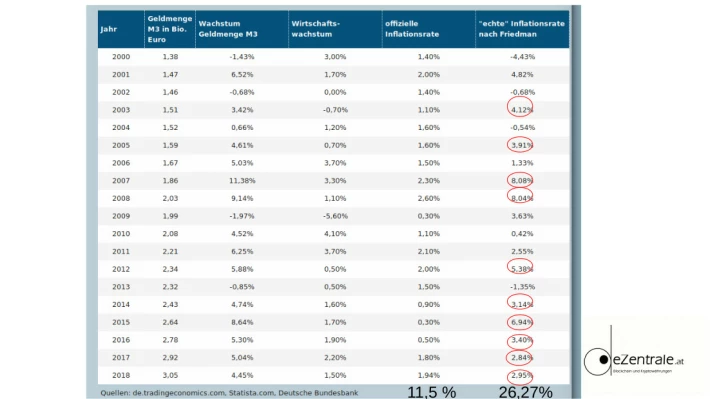
Explanation:
If economic output increases by 2% in one year and the currency, in our case the euro, also increases by 2%, prices remain stable and inflation is zero.
If the amount of currency rises more than the economic performance, we have inflation and thus a loss of purchasing power which results in rising prices.
I hope I was able to give you an understanding of the connections. Criticism and suggestions, as always, expressly desired.
In this sense
Tschüss Euch
Here are two more videos on the subject:
Inflation after Milton Friedman
Interest and compound interest
both Videos are in German Language
Translated with www.DeepL.com/Translator (free version)






