
As the sun sets on centuries-old financial institutions, a new era of global payments is quietly rising. While the world has long relied on slow, trust-based systems and complex cross-border cash reserves, XRP is positioning itself as the crown jewel of financial innovation. Gone are the days when banks struggled with outdated messaging networks or kept mountains of physical currency in circulation to process international payments. Today, a single protocol — fast, transparent, and scalable — promises to redefine how money moves, putting XRP firmly at the center of the next generation of global finance.
As legacy systems fade and transaction friction becomes intolerable, XRP is emerging as a serious contender for global settlement at scale.
In what some see as a bold shift in U.S. monetary philosophy, President Trump — currently serving as the 64th President of the United States — signed legislation signaling that the dollar standard might evolve in the future, with the possibility of incorporating gold-backed accountability — a perspective that, in my opinion, could reshape global finance. Meanwhile, the SWIFT messaging system — the backbone of international banking for decades — continues to process tens of millions of messages per day, yet a portion of these transactions still fail, creating delayed settlements, stranded funds, and operational risks that ripple across the financial ecosystem. To facilitate cross-border transfers, banks have historically maintained massive reserves of physical cash, locking liquidity that could otherwise drive economic activity.
XRP, while not officially replacing SWIFT at this time, has been increasingly adopted by financial institutions and payment platforms for faster, low-cost settlement — a system that, in my speculative view, could one day serve as a global payments backbone. By moving global payments onto XRP, trillions of dollars currently tied up in trust-based cash reserves could theoretically be freed, streamlining liquidity across borders. Today, more than 200 banks, dozens of cross-border payment providers, and countless businesses are actively experimenting with or implementing XRP-based solutions. Imagine a world where every card swipe, online transaction, money transfer, and global remittance flows seamlessly through Ripple — a vision I propose as the new standard #XrpTheStandard
The most profound improvement XRP could introduce is liquidity liberation: transforming how capital moves across borders and enabling the global economy to operate faster, more efficiently, and with unprecedented certainty
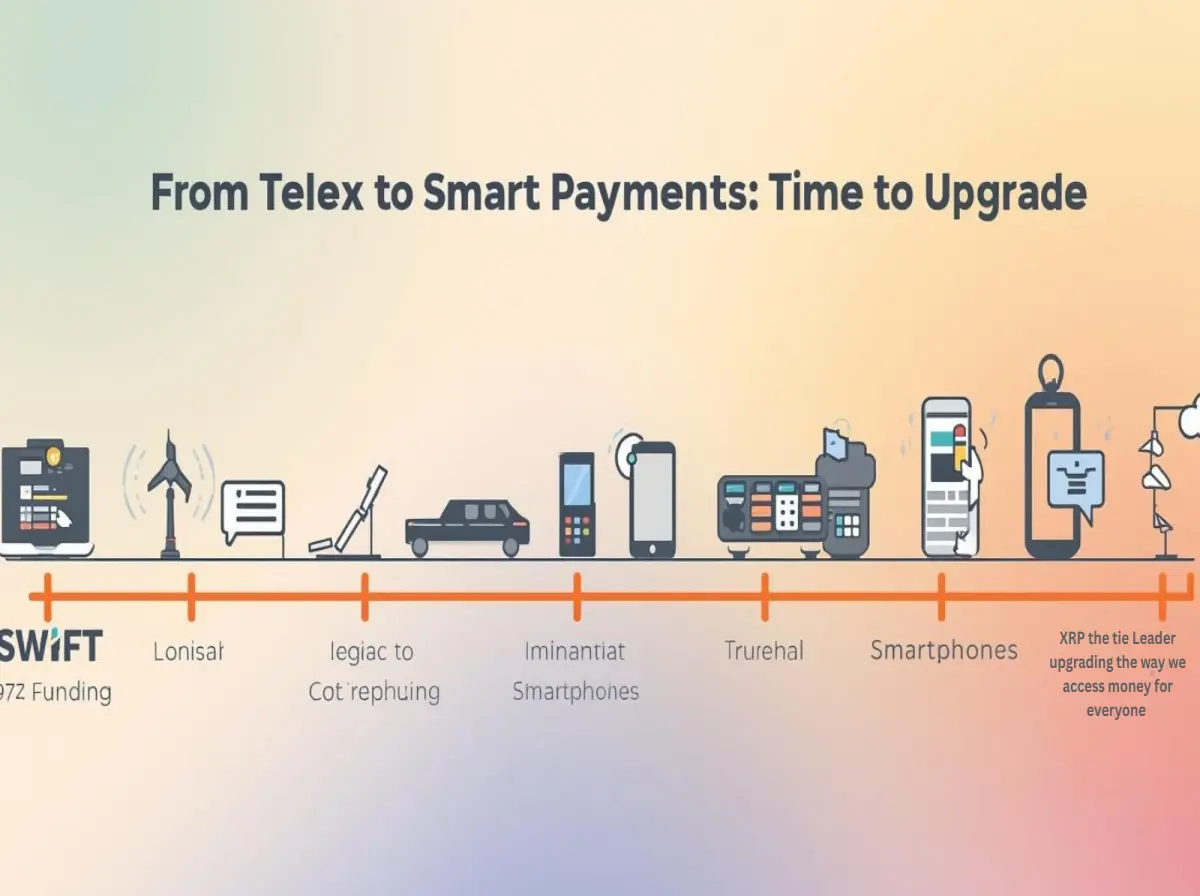
This isn’t about price speculation — it’s about infrastructure, velocity, and why the banking world is quietly paying attention.
The Society for Worldwide Interbank Financial Telecommunication (SWIFT) has dominated cross-border messaging since it was founded in Brussels on 3 May 1973, replacing slow, error-prone telex systems with a secure, standardised protocol that connected banks globally. Despite decades of incremental upgrades and recent moves toward ISO 20022 compliance to modernise its data formats, the core mechanism of SWIFT remains rooted in legacy infrastructure designed long before the internet age. Today it handles tens of millions of messages daily and facilitates roughly $23.5 trillion in annual transaction volume — a testament to its global role but also an indicator of how deeply entangled it is with traditional banking systems rather than real-time economic flows.
By contrast, XRP — the native asset of the XRP Ledger launched in 2012 — is built for fast, low-cost settlement, with transactions completing in seconds and throughput that supports scalable global payment activity. As of late 2025, XRP’s market capitalisation sits in the hundreds of billions (with estimates around $116–$136 billion), reflecting deepening institutional interest and growing adoption.
If we look beyond raw market capitalisation to the frictional costs, liquidity demands, and inefficiencies of legacy cross-border payments, the difference between the systems becomes even more stark. SWIFT’s model requires correspondent banking relationships, pre-funded accounts in multiple currencies, and manual compliance checks — all of which slow settlement, trap liquidity, and inflate costs for businesses and individuals. XRP’s protocol, by contrast, allows settlement to happen natively on the ledger, reducing the need for pre-funded cash reserves and unlocking liquidity that today sits trapped in trust-based networks.
History teaches us that technological breakthroughs often arrive long before legacy systems disappear. Consider the mobile phone: initially introduced for voice communication only, it evolved rapidly into SMS, mobile internet, cameras, and today’s all-powerful smart devices that handle banking, commerce, social interaction, navigation, and global communication all in a pocket-sized hub. In the past 50 years — the same period SWIFT has been operational — our ways of shopping, communicating, and interacting with the world have transformed completely. As humanity has leapfrogged from basic telephony to fully connected, smart technology ecosystems, living in a smart world while relying on analog money rails is increasingly unacceptable, undeniable, and unsustainable. In my speculative view, XRP represents the kind of system that aligns with our modern, instant, and digitally connected life — a vision I propose as the new standard #XrpTheStandard
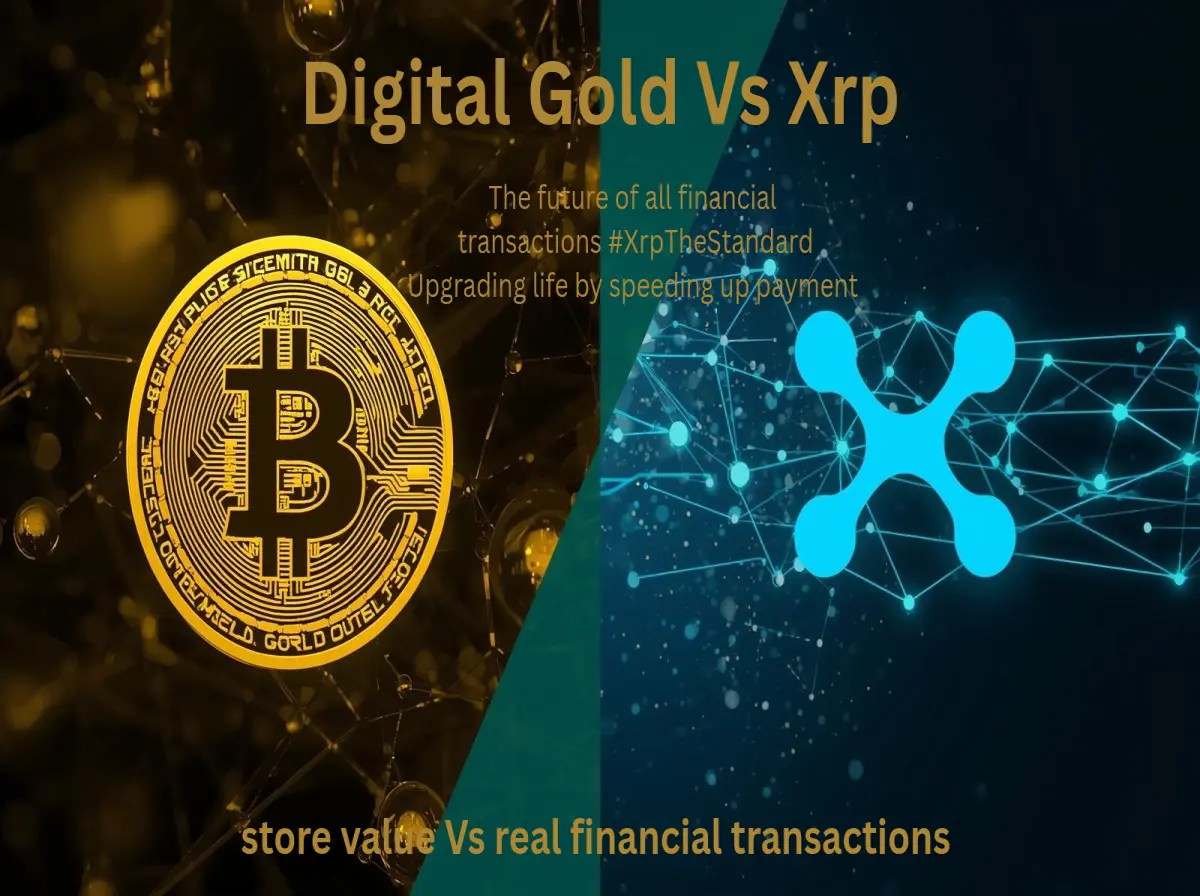
Bitcoin changed history, but history alone doesn’t move trillions across borders in seconds.
Bitcoin, often hailed as the “grandfather of digital currency,” transformed the way the world thinks about money when it emerged in 2009. Its decentralised design and store-of-value characteristics created a new paradigm, giving individuals and institutions an alternative to fiat currency and traditional banking. Yet, for all its innovation, Bitcoin was never optimised for speed, low transaction costs, or high-frequency global settlements. Transactions can take minutes to hours, fees fluctuate widely, and its ledger is not designed to scale for real-time, multi-trillion-dollar flows between banks or cross-border payment providers.
XRP, in contrast, was built with the explicit purpose of enabling instant settlement of cross-border payments. Where Bitcoin focuses on security and decentralised scarcity, XRP prioritises liquidity, speed, and interoperability, allowing banks, payment providers, and even businesses to move large sums efficiently. Today, a growing number of institutions are experimenting with XRP for remittances, instant settlements, and on-demand liquidity — a move that, in my view, signals a fundamental shift in how global finance could operate, supplementing Bitcoin’s role as a digital asset rather than a transactional backbone.
Imagine a world where Bitcoin remains the digital gold — a store of wealth — while XRP powers the actual movement of money across continents. Every card swipe, online transfer, and global remittance could occur in real time, with minimal friction and vastly reduced costs, creating a liquidity liberation that was impossible under the legacy and Bitcoin-only systems. By aligning payment rails with the speed of modern commerce and the expectations of digitally connected societies, XRP offers a practical path for financial infrastructure to catch up with humanity’s technological evolution.
What happens when speed, liquidity, and regulation finally align?
The ultimate promise of XRP lies not just in faster payments, but in the complete transformation of global money movement. Imagine a world where every cross-border transfer, card swipe, online purchase, and even ATM withdrawal is settled almost instantly on a transparent, trustless ledger. While this vision is speculative, the combination of XRP’s speed, low cost, and scalability positions it as a real contender to power a future where financial transactions are frictionless, reliable, and universally accessible — a shift I propose as the new #XrpTheStandard.
As governments, central banks, and financial institutions increasingly explore blockchain solutions, the potential for XRP to unify disparate systems grows. Today, early adoption is visible in remittance corridors, international settlements, and enterprise liquidity networks. In the coming years, wider implementation could liberate trillions in locked-up capital, drastically reducing operational costs and improving efficiency for businesses and individuals alike.
Humans have evolved our technology at unprecedented speed — from simple telephony to powerful smart devices that manage our lives in ways unimaginable 50 years ago. Our economy, however, still relies on analog money rails built decades ago. This disconnect is undeniable. The question now becomes: will the world embrace a financial system as intelligent, fast, and connected as our modern life? XRP offers a pathway — not just a promise of faster payments, but the potential for a truly smart, frictionless global economy
I need to know how do you feel.
What do you think? Are you as convinced as I am that XRP has the potential to redefine the future of global finance? Which cryptocurrency would you like me to explore next — the one you want real insight on, not hype? Drop your thoughts in the comments below and let’s continue this conversation together. Your feedback could even shape my next article.
Disclaimer:
I am not a financial advisor. Nothing in this article should be taken as financial advice. Always do your own research and consult a qualified financial professional before investing in any company, system, or cryptocurrency. Your own diligence is the most important factor in protecting your wealth.
That’s all from me derbycuzxrp
Till next time
tttttttooooooo ttttttthhhhhheeeeee mmmmmmooooooonnnnnnn llllllaaaaaammmmmbbbbboooooo






