
On October 9, 2026, Tether blacklisted four THORChain vault addresses on the Tron network, freezing roughly 1.45 million USDT. The action halted Tron-based swaps and liquidity operations on the decentralized cross-chain protocol with no prior warning. THORChain co-founder Chad Barraford publicly noted the lack of communication and called the move unprecedented for DeFi infrastructure.
Here is the tweet capturing the moment:
It appears that USDT has chosen to blacklist THORChain vaults of USDT on the TRON blockchain. This is unprecedented in our industry and raises questions for all DeFi protocols about the safety of this asset.
We don't know why this choice was made and have had no comms with USDT before this action and are actively reaching out to have a conversation. We hope that this was made in error / misunderstanding.
— Chad Barraford (@CBarraford)
This incident is not an anomaly. It is a feature of how the dominant stablecoins operate.
The Centralization Problem with Tether and Circle
Tether (USDT) and Circle (USDC) control the vast majority of the stablecoin market. Their tokens function as the primary on-ramps, off-ramps, and settlement layers for crypto. Yet both issuers retain the technical ability to freeze, blacklist, or restrict addresses at the contract level. Tether has used this power extensively, freezing billions across thousands of wallets, often without court orders. Circle typically acts on legal requests but still holds the same unilateral authority.
This creates a fundamental contradiction. Crypto was designed so that no single entity could seize or censor funds. When the most widely used dollars in crypto can be immobilized by a company decision—or by pressure from governments or exchanges—the system reverts to the traditional financial model it claimed to replace. Users do not truly own the stablecoins; they hold claims that a central issuer can invalidate.
The risks compound. Reserves sit in traditional banks and securities, exposing holders to banking failures (as seen with Circle’s Silicon Valley Bank exposure in 2023). Issuers capture the yield on those reserves while users bear the counterparty risk. Blacklisting can cascade into DeFi protocols: when vaults or liquidity pools are frozen, ordinary users lose access through no fault of their own. Permissionless protocols become dependent on the goodwill of centralized issuers.
In short, Tether and Circle act as choke points. They enable rapid compliance with authorities but at the cost of decentralization. Their dominance concentrates power over the money supply of crypto into a handful of companies that can decide whose transactions are valid.
DigiDollar: A Protocol-Native, Issuer-Free Alternative
DigiDollar (DUSD) is a USD-pegged stablecoin built directly into the DigiByte blockchain’s consensus rules. It activated on mainnet in July 2026. There is no issuing company, no bank reserves, and no smart-contract admin keys. Minting, collateral management, and redemption are enforced by the protocol itself.
Users create DigiDollar by locking DigiByte (DGB) as collateral in time-locked Taproot vaults that remain under the user’s own keys. The protocol uses a decentralized oracle system (multiple signed price feeds with threshold signatures) to determine the DGB/USD rate. Over-collateralization is required, with ratios that vary by lock duration—typically ranging from 200% for multi-year locks up to 1000% for the shortest tiers. Longer locks require less collateral relative to the dollars minted, rewarding commitment while maintaining buffers against price volatility.
Importantly, there is no liquidation engine. Collateral is time-locked; positions cannot be force-sold during market swings. Additional safeguards include dynamic collateral adjustments under stress, emergency redemption rules that discourage panic exits, and temporary freezes during extreme volatility. The entire state—supply, locked DGB, collateral ratios, and vaults—is verifiable on-chain by any node.
DigiByte itself is a long-running, multi-algorithm proof-of-work UTXO chain with a fixed maximum supply of 21 billion DGB. Locking DGB for DigiDollar removes coins from circulating supply for the lock period, creating a scarcity feedback loop that benefits the network’s base asset while providing a stable unit of account.
Why This Model Better Serves Decentralization
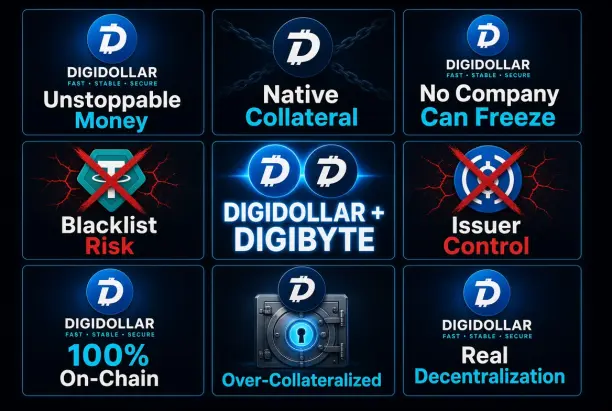
Because DigiDollar has no issuer, no one can blacklist a vault or freeze tokens by administrative action. Control stays with the private-key holders and the consensus rules. There is no bank-run exposure from commercial deposits or opaque reserves. Redemption simply requires burning DigiDollar to unlock the corresponding DGB after the lock expires (or under defined emergency conditions).
This design removes the single points of failure that Tether and Circle introduce. It aligns incentives: users who want stable value must lock scarce DGB, and the protocol cannot selectively censor. It demonstrates that a usable dollar-denominated asset can exist without recreating the surveillance and control structures of traditional finance.
The recent Tether action against THORChain vaults illustrates the stakes. When the dominant stablecoin issuer can unilaterally disable liquidity in a major DeFi protocol, the claim that crypto is “decentralized” becomes conditional on corporate and regulatory forbearance. Solutions like DigiDollar show a different path is technically possible: stable value backed by on-chain collateral, enforced by open-source consensus, and free from issuer blacklists.
Crypto’s long-term credibility depends on reducing, not expanding, reliance on entities that can freeze the money. DigiDollar is one concrete implementation of that principle.






