The action takes place in a small town in a textile factory. Reminded me of something old Soviet socialist-realistic films about working villages, but, of course, with a French accent.
The protagonist, named Vital, is a simple worker, course and, direct, playing a coach and a motivator of the factory rugby team.

In the central scene of the film (why, in my opinion, it is central, I will explain later), he reproaches his wife with all the proletarian directness... "… and we are not even fucking…"

A new face appears at the factory - a young 26-year-old girl Alix, the daughter of the factory owner, who studied at the university and returned to her dad for an internship. She has the certain medical knowledge to finds out how people are affected by stress at work.
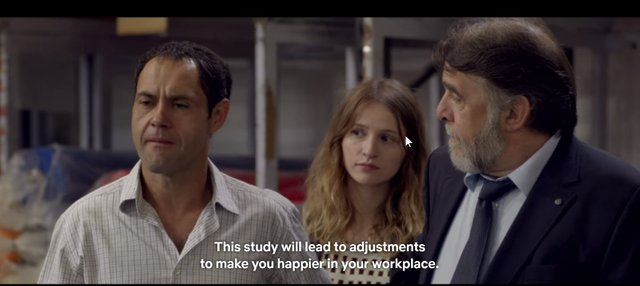
Apparently, the European Union is imposing some standards on enterprises, and it is necessary to follow their guidelines and file reports. She chooses Vital as her experimental guinea pig. According to her “at random.” Perhaps. However, judging by what happens between them next, not so random. In my opinion, Vital is handsome and masculine, and if splashing with testosterone.
During the semifinal match, which features the entire factory as fans, Alix, unexpectedly for herself, reacts very emotionally to the game.

Then, together with the players, she goes to the after-match party, where she drinks and dances with all the consequences that ensue from it.

On this note, the film pretty much ends. That is, some events are still happening. Vital is kicked out of the house by his wife, everyone in the factory condemns him. Not necessarily because of "what" he did, but "with whom." After all, Alix is perceived as a bloody capitalist, a class enemy who "collects data to get us all out of work."
Understandably, her dad, for his part, is also not happy. Is that why he busted his butt all his life? So that some worker would bang his daughter? With her education and money, she could have made a better choice.
Then the factory is getting sold. Workers go on strike and decide whether they should play the final rugby match representing the factory or not.
All this leads to nothing. They blew the final game. And at the end of the film, Vital takes Alix to go somewhere on his motorcycle. Probably to her place.

So what? What all that had to do with Alix?
Maybe there is some new-fashioned French socialistic theory that states that all life is nonsense or something. I don't know, I didn't read.
Now I will return to the beginning of the film, to that scene between Vital and his wife Madeleine, which I consider the most interesting in the entire movie. As a precursor to this scene, when Vital comes home after training, his wife is already asleep and shakes off his attempts for intimacy.
The next time, when Vital has already felt some interest in his person from Alix, (even before they hit it off) he asks Madeleine. "Are you actually happy with me?" She is somewhat puzzled by this question and begins to explain to him what they live like normal people, both work, raise their daughter, and so on. Then, with all proletarian directness, Vital asks her the question "Why don't we fuck?" What Madeleine says in response is the most interesting.
“I fuck only if you are nice, but you are only nice when you fuck.”
And so I was wondering, whether this phrase illustrates the eternal dissonance between the sexes. That is, excluding marginal cases, a woman in a relationship needs romance and emotional fullness, and then sex, and for a man, it is the other way around. Of course, at the beginning of the relationship, a man is also very romantic. He wants to give flowers, walk into the sunset and roam the streets, read poetry, and admire the architecture, buy his beloved chocolate and jewelry. However, after a few years of living together, coming from work, or like in Vital’s case from a rugby training session, a man just wants to have sex and go to sleep.
Perhaps this dissonance explains all these sexual wars and the waves of feminism. Nowadays there are gigantic movements of strata in this direction. Percentage-wise, more women receive university degrees and lead men in earnings. At the same time, they still want to marry someone who is even more successful and educated. In the final matrix, many men who are not exceptionally good looking or financially successful remain with nothing. That leads to an even greater and greater separation between the sexes and the war of hashtags.
I recall the novel SCAM by the Russian writer Pelevin, where the protag lives with a doll robot and adjusts her reactions to his sexual taste. During his conversation with the company technician, he asks "do robots have a soul?" To which the tech replies that it depends on what is understood by the soul. Because if a person is not able to distinguish a robot from a living person then why is this not a soul? Moreover, if you take a man like Vital, who comes home after a rugby match, and just needs to have sex, then at this moment, he is unlikely to be bothered by spiritual considerations.
Hm … I went on quite a tangent. Oh well…






