
Zero-Knowledge Proofs (ZKP) could be used to simplify KYC and confidential documents: essentially, to separate the person verifying your data from the person using it to authorize you, so the latter cannot see your personal information. This prevents the creation of large archives of personal data, which, if stolen, can lead to fraud and identity theft.
ISSUING ZKP PROOF
Imagine showing your real document to a trusted authority (which will then not retain your data). This authority verifies your age or geographic origin (for example) and that your data is indeed valid. It then generates a signed digital credential, which you can store on your device (wallet or app).
Credential (example):
- Issuer: XXX
- Attribute: "Age > 16"
- Digital Signature: ykz131
VERIFY DATA ON A WEBSITE
When a website or app asks for age/identity verification, you don't send your personal document (ID), but generate a cryptographic proof using a wallet with ZKP Generator that proves your credential is valid. The proof contains only the required information (e.g., "over 16 = true"), not your date of birth, name, or tax code. The website verifies the signature and accepts the proof. This demonstrates your compliance with a criterion, without revealing your identity (photo, name, or other sensitive information). No website receives your real data through this system. The system responds "true/false" in real time. The proofs are neither saved nor tracked. This credential can be used anywhere it is supported as a "cryptographic passport." The system is based on two key technical concepts:
A) "Blind signatures":
The authority can sign your credential without seeing the exact content (it is encrypted by your device), so it can guarantee its authenticity, but it doesn't know who it belongs to.
B) "Non-linkability":
Every time you use a proof, a unique token (new hash) is generated, so no one can link two uses of the same credential.
Site A and site B cannot determine that they are the same person.
When you log in to a site, you are asked for a ZKP. If you meet the criteria, the system allows you to enter, but no one knows who you are (the hash is always changing). The authority requesting authorization cannot follow or track you.

WHAT IS THE DIFFERENCE WITH DIGITAL IDENTITY SYSTEMS?
First, with ZKP, there's no central entity storing your data: the authority issues the "cryptographic proof" but doesn't store your documents (KYC). Many online digital identity systems profile and track your ID based on your activity. With ZKP, there's no tracking and no one knows what you're doing. Where implemented, the system simply responds "yes" or "no" to a given criterion (age, geographic origin, gender, etc.).
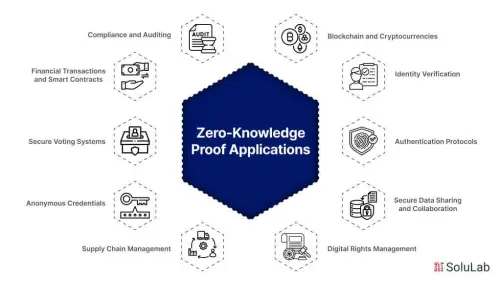
WHERE IS IT USED?
Real-world projects already using this principle are in the blockchain space, for example:
-Layer2: Zksync, Linea, Scroll, Taiko, Starknet, etc. (ZKPs are used to mathematically prove that a set of transactions is valid,
without having to execute them all on-chain. Instead of recording every single transaction on Ethereum, the rollup executes them off-chain, then generates a ZKP cryptographic proof that proves everything was done correctly. Ethereum validators only verify that proof, which is very quick to check. This reduces costs, increases speed, and maintains Ethereum's security.)
-Polygon ID (uses zk-SNARKs to create anonymous "proof of age" or "proof of membership").
-zkKYC (open-source project to prove KYC without sharing data).
-zkLogin: Aleo, Sui (login to social networks without revealing data).
Are you interested in ways to earn crypto bonus? Check it out here: Some Sites To Earn Crypto Bonus (Old & New)






