
The blockchain (distributed, anonymous and encrypted registry) that supports cryptocurrencies has some limitations. The first problem encountered by this technology concerns its slowness (few transactions per second).
This problem could be solved by increasing the size of the blocks containing the information; but increasing its size has the consequence that fewer nodes (users who use full node wallets) will have the computational power needed to mine, thus decreasing the decentralization which is one of the aspects that guarantees its security.
Other problems are energy consumption and therefore pollution (the proof of work protocol requires energy).
In the future, the blockchain could be replaced by ░H░a░s░h░g░r░a░p░h░, a distributed ledger characterized by greater speed (up to 300 thousand transactions per second), greater security and also lower energy consumption.
It is a distributed ledger technology developed by Leemon Baird, the co-founder and CTO of Swirlds (2016).
Hashgraph uses a random interrogation system called Gossip. Each node can send and receive signed information (called "events") on transactions from randomly selected users. These users will merge the information received to create a new event and then send it to other randomly chosen users. This process continues until all the nodes are aware of the information created or received at the beginning.
EXAMPLE
There are three nodes, A, B and X. Each member starts a Hashgraph by creating an in-memory data structure called an event. Each event is simply a container of zero or more transactions.
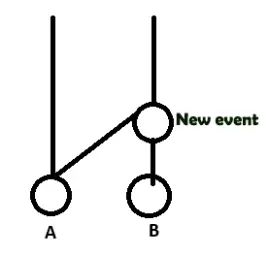
Next, A randomly selects B and sends details of all the events she knows: the member who created it and the date and time it was created. B creates a new event to record all the information provided by A. This new event is connected to both B and A.
This new event has two hashes of its two "parents". In this case, the autonomous parent is event B while the other parent is event A. In addition, this event has a timestamp of when it was created and therefore B digitally signs the event. When this event is sent via the gossip protocol, it contains five information:
-Standalone parent hash
-Hash of other parents
-Timestamp
-Transaction details
-Digital signature
Subsequently, B selects A to provide this information. Then, A will create an event to record this event and link it to the new event created by B and himself.
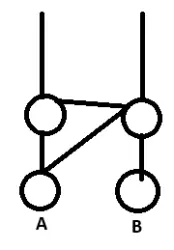
Then, suppose that A chooses X to send him all the information. Then, X creates another node to register this information. This pattern continues until an acyclical chart is created. Since this chart is connected via cryptographic hashes, it is called Hashgraph.
Hashgraph can therefore validate transactions much faster (there is no need for synchrony), also maintaining a significantly lighter register (Hashgraph would occupy a memory of 2 GB, unlike the Bitcoin blockchain: several hundred GB). Thanks to this feature, moreover, the computational power required is much lower, thus reducing energy consumption and also allowing a smartphone to act as a node.
One of the problems with the project is that it is not open source and this could slow down its growth: in fact, the company that created it patented its technology.
Furthermore, in order to act as a "node" it is necessary to obtain specific permits, which makes this register more similar to private blockchains such as Corda (which brings together the 40 largest banks in the world); systems that, unlike public ones, allow only certain users to become part of the network.
This feature, on the one hand, increases system protection by hindering access to malicious users; on the other hand, however, it makes Hashgraph a register that is only partially distributed and, ultimately, something completely different from the best-known blockchains.






