
Concentrated liquidity on Uniswap V3 is a feature introduced in April 2021. They are called concentrated liquidity market maker (CLMM) and improve capital efficiency use for LP, reducing slippage for swap. I will also give some hints about Raydium pools which use the same principle but are slightly different.
To understand what we are talking about, I will give a quick summary of how liquidity pools work. The engine of any AMM is liquidity so the user must have an incentive to provide it, otherwise trades could not take place. Basically I choose a pair (for example SOL/wETH or DAI/USDC) and provide it as liquidity. On this pair I will earn swap fees and in some cases the native token of the platform. This model adopted by almost all AMM is not well optimized because it works on price ranges from 0 to infinity (basically it pays swap fees on the whole range but the yield is lower than it could be). To this, there is also the impermanent loss when the two chosen tokens differ too much in price. Indeed I will deposit 50% of one token and 50% of the other. The pool balances itself when the two tokens vary in price with respect to each other, this divergence is known as Impermanent Loss and represents the difference between providing liquidity and simply holding these tokens in the wallet (to which, however, swap fees and farming must be added tokens).
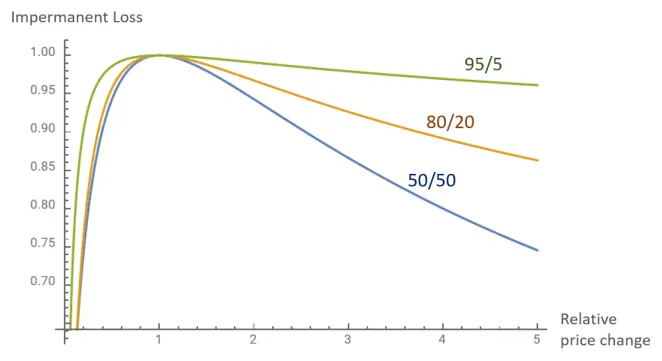
As you will have understood, the only pools without impermanent loss are those of stablecoins unless one of the two loses the peg. Impermament Loss is always temporary and continuously updates based on the volatility of the two tokens, however it becomes permanent when I withdraw. In general, you can simulate impermanent loss by setting initial and future prices to get an idea of the loss percentage: Impermanent Loss Calculator
CONCENTRATED LIQUIDITY AND STEPPED COMMISSIONS
Here is the revolution brought about by Uniswap which generates so much profit (therefore fee) that it does not need to provide its Uni token. Users only receive swap fees which are very high.
In fact, in Uniswap V3, users can provide liquidity to specific token pairs using a customized price "range".
In practice, users can specify a price range within which they wish to provide liquidity and can concentrate this liquidity in a particular area. This allows them to earn higher returns than providing liquidity over an indefinite price range (from 0 to infinity). In this case, all my capital will be concentrated in that range (and not arranged in an infinite range).
For example, let's say a user wants to provide liquidity for the wBTC/USDT pair and the current price is 23000 USDT per wBTC. The user could decide to provide liquidity only for the price range between 21,000 and 25,000 USDT per wBTC, thus focusing on that range. This means that if the price of wBTC were to fluctuate within that range, the user would earn a higher return than those who provide liquidity over an infinite (non-concentrated) range. The fees you receive depend on the amount of liquidity you provide, the trading volume and the price of the assets traded. When users provide liquidity with a specific asset pair, they receive LP in return representing their share of that pair's liquidity. Every time a trade takes place in that asset pair, a portion of the trading fees is taken from the protocol and a portion is distributed among the users providing liquidity in that pair, proportionally to the fee provided.
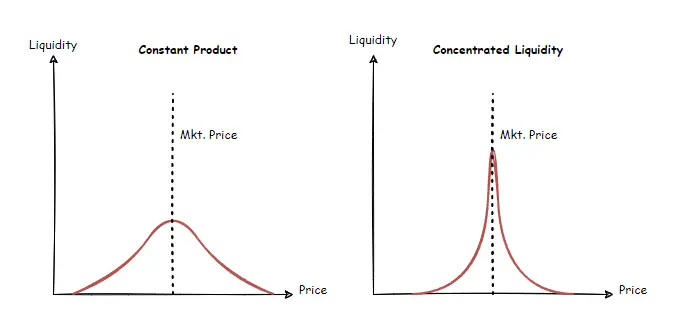
In practice, users who provide liquidity in a more "concentrated" part of the price range earn higher commissions than those who provide liquidity over a wider range of prices. Essentially this is a "stepped" commission model, where the commission rate varies based on the price range in which you provide liquidity. In general, more concentrated price zones tend to have higher gains than broader price zones. For example, choosing to provide liquidity for a pair of assets with a very wide price range, with the same pool (therefore of the 2 token chosen) they would get lower commissions than a user who provides liquidity with a more concentrated (narrower range).
CHOICE OF FEES
In Uniswap v3, users can also choose the level of fee rate they wish to apply to their pools, by selecting one of the four available "fee tiers":
1) 0.01% (recommended for stablecoin: USDC/USDT or DAI/USDC or FRAX/USDT)
2) 0.05% (you could use it for ETH/wBTC, high volume crypto and high market cap)
3) 0.3% (e.g. wETH/USDC, for most pools)
4) 1% (for exotic pools integrating tokens with very different market caps, such as wBTC/Shitcoin or Shitcoin/Shitcoin)
The choice of "fee tier" depends on the pair of assets and the type of token provided in liquidity (stablecoins or exotic tokens). In general, stablecoin pairs such as USDC/USDT or DAI/USDC should have lower fee tiers than token pairs such as ETH/UNI or wBTC/MAKER or worse between ETH and very low market cap tokens. However, the choice is up to the user, who forbids me to choose higher commissions? It is important to remember that higher fee tiers carry greater risk, as you are only providing liquidity in a narrower price zone and run the risk of not earning rewards or high (outside the range) impermanent loss. So higher fees mean a narrower range. A range for a stablecoin could be $0.99-$1.01.
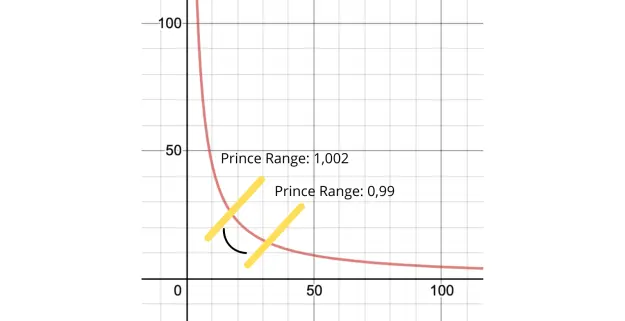
In particular, the price range in which users provide liquidity on Uniswap is defined by two parameters: "tick lower" and "tick upper". "Ticks" are positions on the logarithmic price scale to define the price range. In essence, each "tick" corresponds to a specific position on the price scale. So, for example, if you choose a 1% fee tier, the price range in which you provide liquidity will be narrower than a 0.03% fee tier, as the former implies a range of lower ticks and upper ticks narrower than the second. This means that the user who chooses the 1% fee tier will earn higher commissions on trades made within the given price zone, but will also be exposed to a greater risk of liquidity loss in case of price movements beyond outside the given price zone. You can ask Uniswap Fish to help you choose the fees based on your pool.
BASE TOKEN AND QUOTE TOKEN: COMPARISON OF RAYDIUM AND UNISWAP
On Raydium, CLMM pools obviously consist of two token: the base token and the quote token. The base token is traded against the quote token in the pool, for example, in the case of a wBTC/USDC trading pair, wBTC is the base token (the first to appear in the trading pair). The quote token, on the other hand, is the one that is used as a reference to determine the price of the base token in the pool and in this example it is USDC (second token of the pair).
In the CLMM pool, traders can trade the base token and quote token at a price determined by the amount of each token in the pool. Therefore, the base token is the one traded in the pool, while the quote token is the reference token used to determine the price of the base token.
Instead on Uniswap V3, the operation is slightly different compared to Raydium's CLMM pools.
Here the base token and quote token are determined based on the price range position in the pool. Specifically, the base token is the one at the bottom of the pool's price range, while the quote token is the token at the top of the pool's price range. For example, if we consider a Uniswap V3 pool for the ETH/USDC pair, the price range could be defined as $1200-$1700 for 1 ETH. If the price of 1 ETH is below $1200, then USDC would be the base token and ETH would be the quote token. Conversely, if the price of one ETH is above $1700, then ETH would be the base token and USDC would be the quote token. In essence, the base token and the quote token in Uniswap v3 depend on the position of the pool's price range relative to the current price of the traded token. This means that instead of having a continuous price range like in Uniswap V3, Raydium's CLMM pools have different price ranges defined by LP. Unlike Uniswap V3, the base token and quote token are not determined by the price range position in the pool but by the quantity of the base and quote tokens deposited in each price range.
In this case, Raydium uses price ranges defined by liquidity providers, while Uniswap V3 has a continuous price range determined by the current price of the token.
On Raydium the price of the token pair will change as the tokens are traded. If the price trades below the minimum position price, the position will consist of 100% base tokens. If the price trades above the price cap, the position will effectively sell the base token and thus consist of 100% of the quote token. This is slightly different from Uniswap V3 and markedly different from a classic AMM, where the liquidity of all users is distributed along a curve from 0 to infinity. I hope this article clarified who had doubts between classic AMM/concentrated liquidity and how to improve the efficiency of these pools.
Are you interested in ways to earn crypto bonus? Check it out here: Some Sites To Earn Crypto Bonus (Old & New)





