
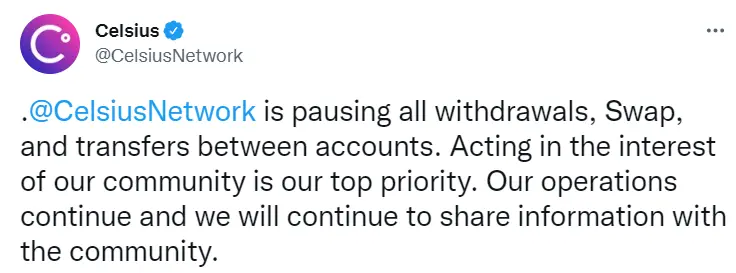
On Monday, June 13, 2022, the cryptocurrency market dropped below the $ 1 trillion mark, with crypto assets losing 15% to 25% in the previous 24 hours. Among the most important news of the day the problems of Celsius Network, among the major concerns those of bankruptcy and insolvency (default). The other major fear is that the cash held by Celsius will be sold. They have actually been transferred to FTX: 9500 WBTC, 54700 ETH, 375000 FTT, 260000 UNI, 2 million USDP and 300000 TUSD. The Lending platform reported in the morning that "all withdrawals, exchanges and transfers between accounts have been stopped". The justification would be adverse / extreme market circumstances.
Celsius: "We are taking this essential move for the good of our entire community to stabilize liquidity and operations as we take action to maintain and safeguard assets. Also, in line with our commitment to our subscribers, the customers will continue to accumulate rewards during the break"
It is speculated that Celsius may be bankrupt and speculation about the company's financial problems began long before the company went out of business. Celsius is one of the largest lending institutions in the cryptocurrency sector, with assets of $ 11.8 billion (up from $ 22 billion at the end of December 2021). The company operates by lending cryptocurrencies that users have deposited by offering them interest. Celsius also allows investors to borrow at low rates using cryptocurrencies as collateral. This model works well when markets are bullish and demand is high, but during bear markers, the whole system becomes unstable as fewer loans are being requested.
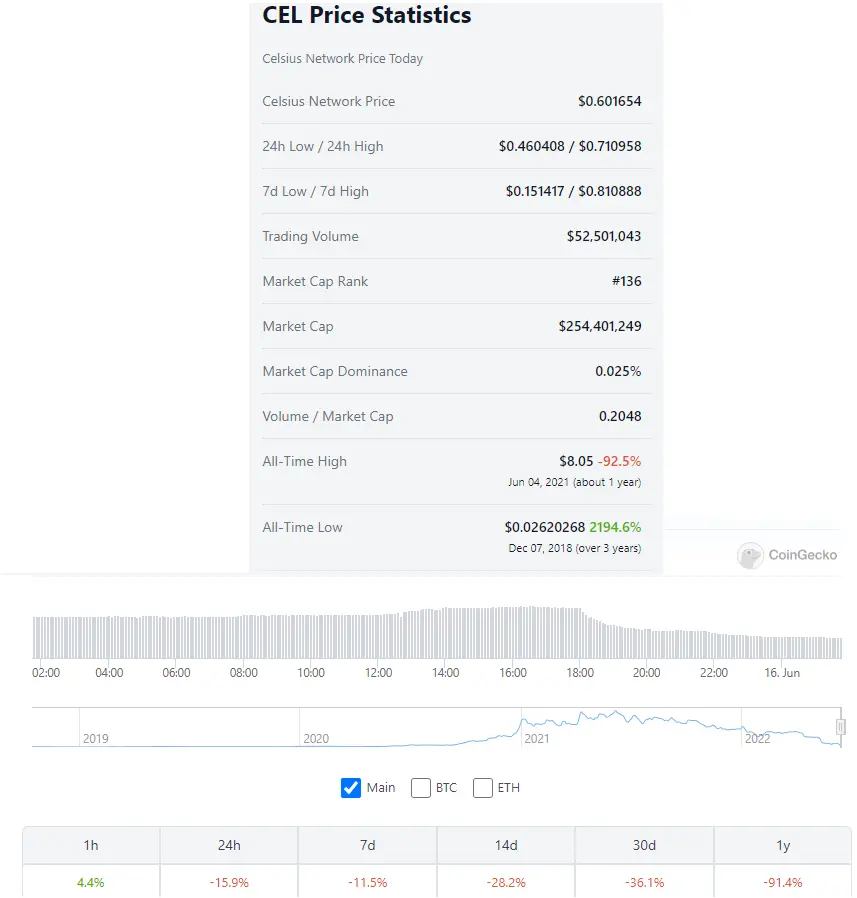
According to CoinGecko, the native token of the $ Cel platform, it has lost 91% over the past year and nearly 40% over the past 30 days. Among other things, the company found itself having to provide justifications for its actions as early as April, when the Texas and New Jersey authorities set their sights on it. Following the suspension of withdrawals, Nexo "rivals" offered to buy Celsius' qualifying assets. This action could bring more liquidity to Celsius allowing the rehabilitation of withdrawals. In short, Nexo buys restricted liquidity (debts) at a discount and in exchange Celsius receives liquidity to pay users.
OLD AND NEW RED FLAGS
The Celsius business model is the classic of lending platforms: users deposit liquidity and receive interest. Who pays this interest? Who borrows this liquidity. These platforms suffer in the bear markets, as fewer loans are requested so the APY drop. Indeed, Celsius had lowered interest rates on both stablecoins (which went from 9/10 to 7%) and on BTC and ETH for months now. The interests were quite in line with those of the other centralized platforms, apart from the boost provided by receiving interest in the native CEL token.
Celsius is known for guaranteeing all free withdrawals (not bad, if we think of the expensive fees of ETH and Erc20) and for its generous bonus (50 dollars in BTC upon registration, for deposits of at least 400 dollars; plus any bonuses by depositing a certain amount of stablecoins or volatile assets). According to research firm Nansen ( On-Chain Forensics: Demystifying TerraUSD De-peg ), Celsius Network was one of the main entities involved in the depegging of TerraUSD. The removal of funds from Anchor would have been carried out to reduce risk and exposure. During the Luna implosion, it was also reported that Celsius-controlled wallets had sent over 260,000 ETH to Anchor Protocol in the past five months. Celsius reportedly withdrew all funds during the general panic.
 As pointed out by Dirty Bubble Media ( Celsius Network And "That Hogeg Guy" ), Celsius also has a rather shady past. Describing aspects of the company as "questionable and potentially fraudulent," the site drew attention to the arrest of Yaron Shalem (CFO of Celsius Network). The CFO was arrested along with eight people, including venture capitalist leader Moshe Hogeg, in Israel for fraud.
Alex Mashinsky, CEO of Celsius, also has some skeletons in the closet according to Dirty Bubble Media. His first Arbinet start-up was reportedly going to be a dapp pump and dump.
Mashinsky also served as a consultant for two cryptocurrency-related companies: MicroMoney ($ AMM) and Sirin Labs ($ SRN) both of which ended in a rug pull. According to calculations by Dirty Bubble Media, Celsius faces an annual deficit of $ 86 million in interest payments to depositors.
The network uses these deposits as collateral to borrow stablecoins, which they lend to institutional clients. Even with 11% APY on stablecoins lent, Celsius would have an annualized loss of $ 34 million. To break even, Celsius Network should receive 16% APY on lent stablecoins.
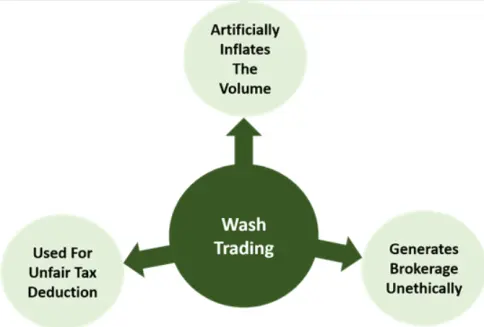
Celsius Network's CEL token traded primarily on Uniswap, of which more than 59% of the token's volume would have been caused by wash trading (illegal market manipulation) according to Dirty Bubble Media. According to the same report, nearly half of the CEL / WETH swaps would be executed by Wintermute (Market Maker). Wintermute regularly trades CEL in and out of the dex to create the appearance of demand, which is wash trading ( Anatomy Of A (Fake) Market ).
Dirty Bubble Media: "Wintermute trades CEL on Uniswap, shortly thereafter trades the same amount. Based on these data, we conclude that at least 59% of the CEL / WETH volume on Uniswap from 21/3 to 26/3/22 was wash trading . Almost half of the total volume came from a single "market maker" with an additional 12% generated by other wash-trading wallet"
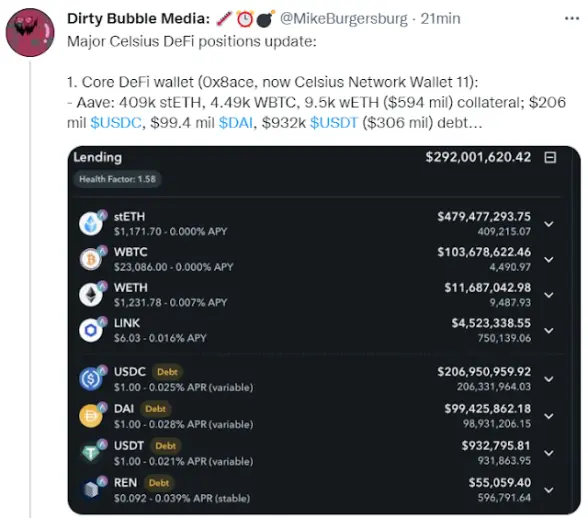
Celsius confirmed at the end of December 2021 that it had also lost 54 million dollars, due to the BadgerDAO hack. The other reg flag was the deviation of stETH (liquid derivative of ETH issued by the Lido platform) from the price of ETH. Many people, in the past few days, perhaps even fearful of the ETH update that will take place in the coming months (merge: the transition from Proof Of Work to Proof Of Stake) are selling stETH for ETH and then eventually giving them to the market. This has brought the price of stETH lower and lower. The stETHs will be redeemable 1: 1 with ETH approximately 6 months after the merge so if someone wants to exit the position, the only way is to convert them at a loss to ETH and sell them. The variance in prices unbalanced the stETH / ETH Curve pool, making stETH worth less and less. It is well known that Celsius has a large position in stETH with ETH annuities and given the continuous withdrawals of users, in the last few weeks, it was forced to sell stETH for ETH at a loss, due to the bank run. In these cases we speak of "liquidity crunch" (ie the liquidity is on loan or staking so it is not possible to withdraw). Swissborg would also have the same problem. The other aggravating were the liquidations on Aave where a loop is performed that sees ETH being staking for stETH on Lido Finance, then the latter is entered as collateral to borrow ETH, redeposit it on Lido, take new stETH to deposit on Aave to get more ETH and so on. This creates an open position in leverage, where if the stETH collateral is liquidated, this triggers further dumps.
Brad Mills (analyst): "If customers start withdrawing from Celsius, they will have to sell their stETH. Celsius has a deficit of 1 million ETH. So, 288,000 are inaccessible to merge, about 30,000 are lost, 445,000 are stETH and 268,000 are liquid"
 Two days ago, someone opened a 17,919 WBTC position on Maker to borrow 278 million DAI. It is suspected that the address that opened this location is that of Celsius. Maker issues the DAI stablecoin precisely in the form of over-collateralized loans. In fact, to borrow 278 million DAI, equivalent to 278 million dollars, it was necessary to block 17,919 WBTC as collateral, equal to over 420 million dollars.
It is unclear whether it was actually Celsius who opened that position. If so, if it gets liquidated it would be another big problem. On June 14, rumors circulated that a large hedge fund "Three Arrows Capital" would be insolvent. These funds interact with crypto lenders and negative rumors about contacts with Celsius and USDT immediately circulated.
Are you interested in ways to earn crypto bonus? Check it out here: Some Sites To Earn Crypto Bonus (Old & New)






