
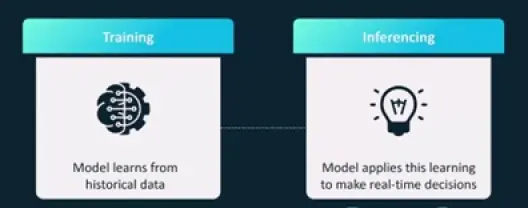
Have you ever heard of the Inference Capital Market? Inference is the moment an AI model is put into action. For example, ask ChatGPT or Grok to write a text, generate an image with Flux, and have Whisper transcribe an audio.
Each request requires:
- GPU.
- electricity.
- memory.
- bandwidth.
This is inference. Training happens once in a while; inference happens billions of times every day. Today, almost all inference goes through companies like OpenAI, Anthropic, Google, and xAI. They own the servers and set the prices. With open-source models (Llama, Qwen, DeepSeek, Mistral, etc.) becoming increasingly competitive, anyone with a GPU can offer inference. From these foundations, the market is born.
INFERENCE CAPITAL MARKET
Today on Ethereum, you have: validators, users, fees, staking, and markets.
Inference could become something very similar, with GPU owners, buyers, and resellers, creators of exchange markets, and tokenizers of computational capacity.
In this market, you could have: inference credits, GPU capacity futures, tokens representing future production, AI infrastructure staking, and secondary markets for buying and selling computational capacity. A basic protocol (similar to Layer 1) could unite GPUs, models, APIs, and users. A user buys the GPU used by the AI from a marketplace. Other protocols will emerge on top: inference aggregators, routers, payment systems, marketplaces, insurance, etc. For example, if you own 50 NVIDIA H100 GPUs, today you can rent them to OpenAI or keep them idle. Tomorrow, you could connect them to a decentralized network. Each AI request generates commissions, and those fees are distributed to GPU owners. Imagine producing 10 million inference tokens that you can sell, lend, use as collateral, create LPs, earn a yield, etc. Inference becomes a financial asset.
WHAT INVESTORS ARE WATCHING TODAY
Almost all investors are watching: GPU networks, data centers, and AI agents. However, if a similar market were to be created, the greatest value could accrue to the protocols that economically organize inference, not necessarily to those who own the hardware.
The value lies not only in GPUs but also in the economic layer built on top of inference: marketplaces (which allow you to buy/sell them), settlement protocols, reference pricing, credit tokenization, hardware financing, and related financial instruments.
Think about what DeFi is today and let's try to draw parallels with this market:
- Compute ≈ Bitcoin miners.
- Inference network ≈ Ethereum.
- Inference marketplace ≈ Uniswap.
- AI credit lending ≈ Aave.
- GPU capacity derivatives ≈ Hyperliquid.
- Reference pricing/inference oracles ≈ Chainlink.
All this, of course, if inference becomes a fully-fledged tradable asset class (GPU, Inference, Inference Credits, Tokenization: LP, Lending, Yield, Perps Trading).
VENICE
The Venice AI was one of the first examples of inference tokenization. Venice is a privacy-based, censorship-free AI. The idea is: stake the token, earn inference credits, and those credits have monetary value and can be used or traded. Venice is quite unique as a protocol because the token not only pays the AI, but represents a share of the network's inference capacity. By staking $VVV, you gain ongoing access to the inference and can also mine the "compute," or $DIEM (economic right to the AI's computational capacity), an ERC-20 token representing $1/day of perpetual, freely transferable, and tradable AI credit. The protocol generates revenue (paying users and API sales), which leads to the "buyback and burn" of $VVV. Clearly, game theory relies on the use of this AI (Venice) and the successful tokenization of the inference ($DIEM): $DIEM generates AI credits that can be held, used, or sold.
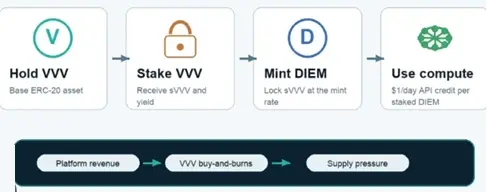
Recap: Staking $VVV (you can also get the Venice Pro version), you receive staking rewards, and based on a collateralization ratio (to prevent the system from becoming insolvent), you can mine computational capacity called $DIEM (which you can speculate on the price, sell, or use for chat/API credits). This system separates network capital ($VVV) from computing capacity ($DIEM).
When you deposit $BTC or $ETH on Aave, you borrow liquidity to do things with. Here, you stake $VVV and borrow computing capacity (AI energy) that you can use to pay AI agents, APIs, inferences, or sell to an AI developer. Venice aims to become the collateral that funds an AI capacity market.
Please note, this is not financial advice. I find Venice AI an interesting model, but if you decide to buy $VVV or $DIEM, you should do your research first (DYOR).
Article always updated with all the possibilities of on-chain farming (airdrop): Some Sites To Earn Crypto Bonus (Old & New)






