
Over the past 9 months we have seen congestion problems on the Solana network several times. Proof Of History is so scalable that it allows for inexpensive DoS and spam attacks. Sometimes it is gaming or token sales (IDOs) with bots that spam transactions. Basically, this blockchain fails to withstand the high TPS it should guarantee. Is Solana really decentralized? There is not a minimum to staking, however to create a validator node, huge hardware resources and very expensive machinery are required. There are over 1000 nodes but in reality a small part of these validate transactions.
When the network becomes congested, the validators stop the blockchain and restart it. The chain has often gone off for several hours and in the meantime the necessary updates are performed or is reset. If the blockchain is not stopped, there could be serious security problems. However this has brought to light the problems of centralization (there is someone who decides what to do in situations of this type). In recent days, another big problem has emerged regarding the Lending Solend platform. Also on Juno (layer 1 on Cosmos) something conceptually similar had happened.
WHAT IS SOLEND?
The functioning of Solend is similar to the classic Lending platforms in DeFi, you can:
1) Deposit crypto and earn interest
2) Borrow crypto and pay interest
To incentivize the lending of certain assets, Solend distributes the SLND token to borrowers. In some cases, you are paid to apply for the loan.
The borrowers pays an annual APY but receives the SLND token. If I pay 10% for the loan but receive 11% in SLND tokens, I get paid to borrow the liquidity.
LIQUIDATE WHALE BY MODIFYING THE SMART CONTRACT
This is how the platform works, however a dangerous situation has emerged in recent days. A whale that manages a large part of the liquidity on the platform (about 25% of TVL) would be at risk of liquidation: this is a position of approximately 203 million dollars (5 million SOL) with a loan received of approximately 108 million USDC . About 95% of the SOL on the platform were deposited by the whale, similarly 106 million USDC out of the 120 million total on Solend was taken by this entity (88%).
Liquidation price is $ 22.30 and in this case the whale would be liquidated for 20% of the loan taken ($ 21 million). For the liquidation the USDC would be repaid and the liquidator gets the collateral.
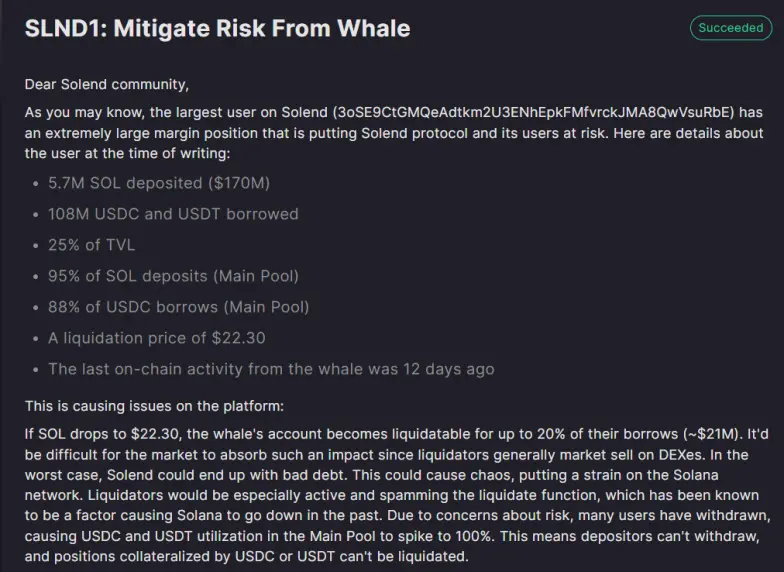
The big problem is that on chain, there is not the necessary liquidity in SOL (21 million dollars) so for the swaps there would be a very high slippage (I would get about 35/40% less, compared to what I am entitled to). In short, the liquidation would not be convenient and if it is not convenient, the loan would become under-collateralized. The result of this is that whoever deposited USDC fails to withdraw (all USDC has been loaned out). It is also impossible to liquidate all those positions using USDC because collateral is not available.
The solution proposed in the governance was to take control of the whale's account by updating the smart contract and liquidate it in an OTC (off-chain) transaction avoiding huge slippage and preventing congestion of the Solana network. "Over The Counter" transactions do not affect the market price because they take place off-chain and from exchanges, to simplify as much as possible it is like a P2P exchange (two parties find an agreement and there is a third party that acts as an escrow). The migration of funds to smart contracts is something that should never happen, otherwise any concept of decentralization is missing. The proposal made on Solend passed, however after a few hours the uproar broke out on Twitter and in the community a counter-proposal was launched that invalidated the first.

Indeed, it would have been unethical to modify the smart contract and act in this way. The question we would have asked ourselves is: can devs do this all the time? Funds deposited on the platform and credibility would be at risk.
A few hours later, a new proposal was launched, as users are not yet able to withdraw the USDC and it is not possible to liquidate those positions so there is a systemic risk.
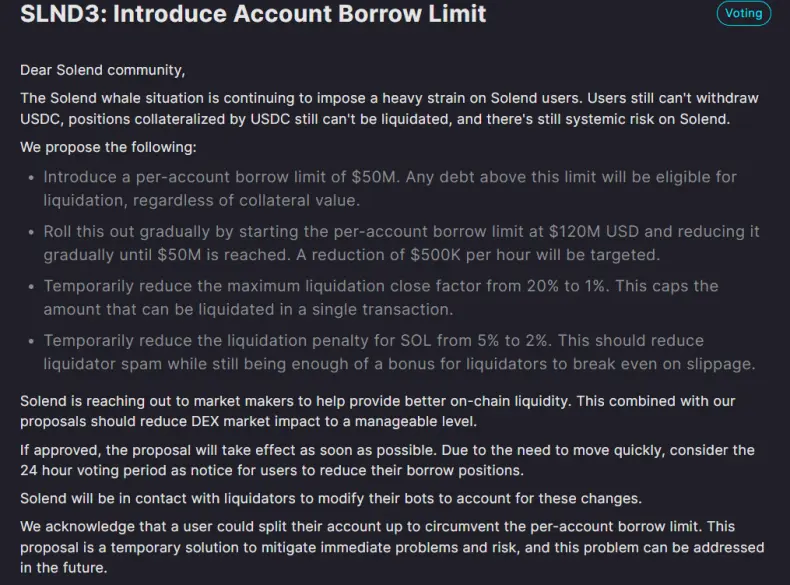
The new proposal 3 asks:
- loan limit of $ 50 million (above this threshold, any position can be liquidated, regardless of the value of the collateral)
- limit set at 120 million dollars per account and decreases, starting from the activation of the proposal, by 500,000 dollars per hour, up to 50 million dollars
-reduce liquidation in a single transaction from 20% to 1%
-reduce the settlement fees of SOL from 5 to 2%, avoiding spam from the liquidators (which could also congest the network), allowing at least equalization of the slippage, if there was any
Solend advises users to close their loans and claimed to have contacted several market makers to try to increase the amount of liquidity in the chain, reducing the impact of slippage. Clearly this is a temporary solution due to the really critical situation, as the limit is easily circumvented by creating multiple accounts. Meanwhile, the whale that put Solend at risk began to pay off the loan.
Are you interested in ways to earn crypto bonus? Check it out here: Some Sites To Earn Crypto Bonus (Old & New)






