
Can you recognize a financial bubble? If it were easy to recognize "speculative bubbles", they simply wouldn't exist. However, there are some signs that help more accurately identify an overheated market:
- High prices (hyperextended candlesticks) combined with high volatility and high trading volumes.
- Collective obsession with that market. If that market (cryptocurrencies, stocks, metals, etc.) is talked about in the supermarket, on TV, at school, or at the gym, it's a warning sign.
- When supporters of a "hot" asset stop praising it and start attacking its critics, a bubble is likely already forming. This happened in late 1999 with internet stocks. In these cases, supporters of these assets railed against skeptics just days before the crash.
- A wave of new listings. In 2017 and 2021, the market was flooded with new stocks (IPO) and altcoins (ICO).
The main sign of a speculative bubble is the pursuit of growth at all costs: an asset rises in value because it's being purchased, investors see its growth potential and buy even more. In recent months, however, the opposite has happened in the stock market: investors have continued to buy shares despite bad news about wars, tariffs, inflation, unemployment, and rising oil prices. This is counterintuitive behavior in the stock market, not simply trend-chasing. The cryptocurrency market, on the other hand, has proven more cautious.
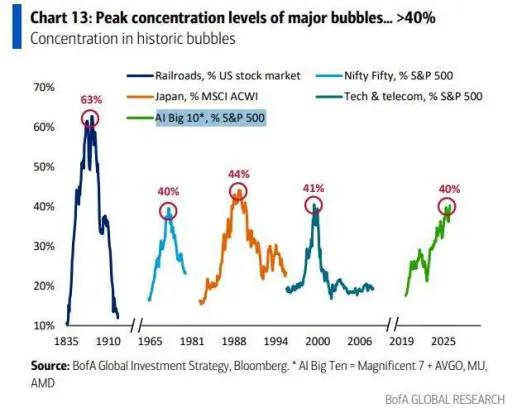
Historically, asset bubbles have been defined not only by excessive valuations, but also by extreme concentration in a handful of "can't-miss" stocks that investors believed could only continue to rise (a red flag is when at least 40% of the S&P 500 is represented by just a few companies, which increases systemic risk). Below are some of the most notable companies that dominated each cycle and what happened to them after the bubble burst.
Railroad Bubbles (1860-1873):
The US railroad boom transformed the American economy and became the dominant investment theme of the 19th century. Investors poured capital into companies such as the Pennsylvania Railroad, the Union Pacific Railroad, the Central Pacific Railroad, and the Northern Pacific Railway. Many railroad companies were financed with enormous amounts of debt and speculative bonds. When the investment bank Jay Cooke & Company collapsed in 1873 due to its exposure to the railroad sector, panic spread throughout the financial system. Hundreds of railroad companies failed or filed for bankruptcy, unemployment soared, and the crisis turned into the "Long Depression," which lasted several years. It's important to note, however, that the bubble burst, but the railroad infrastructure remained: a pattern reminiscent of the current boom in artificial intelligence infrastructure.

The "Nifty Fifty" Bubble (late 1960s–1973):
The "Nifty Fifty" were considered untouchable blue-chip stocks, which investors believed could be bought at any valuation due to their perceived perennial growth. Among the most famous names were IBM, Coca-Cola, McDonald's, Walt Disney Company, Polaroid, Avon Products, and Xerox. Some of these companies traded at absurd multiples: Polaroid traded at over 90 times earnings, McDonald's traded at over 70 times earnings and Xerox became one of the most traded stocks on Wall Street. When inflation accelerated and the Federal Reserve tightened monetary policy, the bubble burst. Polaroid subsequently went bankrupt, Xerox lost its market dominance, Avon suffered a decades-long decline, and IBM underperformed for many years. However, some companies, like Coca-Cola and McDonald's, eventually recovered and became global giants again. This demonstrates an important lesson: even exceptional companies can suffer massive declines if purchased at extreme valuations.

Japanese Speculative Bubbles (1980s-1990s):
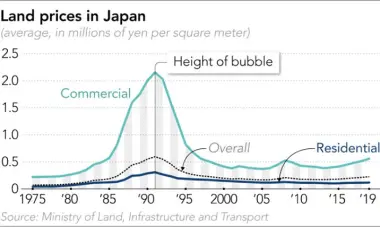
During the Japanese economic boom, Japanese stocks and real estate became the center of global finance. Major companies included Toyota, Sony, Hitachi, Mitsubishi, Sumitomo Mitsui Banking Corporation, and Nomura Holdings. Japan accounted for nearly half of global stock market capitalization.
At the time, the land on which the Tokyo Imperial Palace stood was said to be worth more than all the real estate in California combined. After the Bank of Japan raised interest rates, the bubble burst violently: the Nikkei 225 index lost more than 80%, Japanese banks entered a decades-long crisis, and real estate prices collapsed for years. Many Japanese stocks never returned to their 1989 highs.
Dot-com Bubbles (1995-2000):
The Internet revolution created a massive speculative mania around technology and telecommunications companies. Dominant stocks included Cisco, Intel, Qualcomm, Yahoo!, Nokia, AOL and Pets.com.
Following the bubble burst, Cisco lost approximately 80% of its value and took nearly 20 years to return to all-time highs, Intel significantly underperformed for decades, Yahoo virtually disappeared from the tech landscape, and AOL collapsed after its merger with Time Warner. Thousands of internet startups failed. Amazon lost over 90% of its value during the crisis, but subsequently became one of the most valuable companies ever.
Microsoft survived and entered another long growth cycle. The internet itself ultimately transformed the economy, although speculative valuations were unsustainable.

AI/Magnificent Seven Bubbles? (2020s):
Current market concentration centers on the so-called "Magnificent Seven": NVIDIA, Microsoft, Apple, Amazon, Meta Platforms, Alphabet and Tesla. Additional AI-related beneficiaries include Broadcom, Taiwan Semiconductor Manufacturing Company, Super Micro Computer, and Advanced Micro Devices.

A recurring theme in all speculative bubbles is that, paradoxically, the narrative usually begins with a genuine technological revolution:
- Railroads transformed transportation.
- Consumer brands globalized consumption.
- Japan symbolized industrial supremacy.
- The Internet reshaped communication.
- Artificial intelligence could reshape automation and productivity.
Technology is often real. The bubble usually forms when investors begin extrapolating infinite growth and stop worrying about valuations, liquidity risks, or macroeconomic conditions. Another similarity is that market peaks are often accompanied by rapid participation by retail investors, heavy use of leverage (rapid asset increases), fear of missing out (FOMO), and passive capital flows that concentrate the most profitable companies. It's as if there's a belief that traditional valuation metrics are no longer relevant.
HOW WILL THE BITCOIN AND CRYPTO MARKET BEHAVE?
Regarding cryptocurrencies, Bitcoin remains an unusual variable compared to previous cycles because it did not exist during previous stock market bubbles. Many now increasingly view Bitcoin as: digital gold, a hedge against currency devaluation, an alternative to traditional financial systems, and a rare commodity in an era of rising sovereign debt. However, historical cryptocurrency cycles suggest caution. Each post-halving cycle (2013, 2017, 2021, 2025) has so far experienced severe corrections:
- Bear market in 2014 (caused by the collapse of the Mt. Gox exchange).
- Crash in 2018 after the ICO bubble.
- Crash in 2022 following various bankruptcies (Terra, Celsius, BlockFi, Voyager, Genesis, FTX), excessive debt and a liquidity crunch.
Therefore, while a rotation of capital from overly concentrated equities into cryptocurrencies or real assets is possible, it would still represent a deviation from previous historical patterns.
How are you behaving? Are you buying the dip because you expect a recovery in Bitcoin and the cryptocurrency market, or are you waiting for further declines?
Are you interested in ways to earn crypto bonus? Check it out here: Some Sites To Earn Crypto Bonus (Old & New)






