
Today we are talking about traditional options which are conceptually similar to binary options, even if there are some differences (especially with deadlines and with the order execution method). Unlike Trading where you can set market orders (buy at the best price) or limit (set a buy or sell price), options are financial contracts that grant their buyer the right, but not the obligation, to buy (call option) or sell (put option) a certain asset, often a stock (or cryptocurrency), at a specific price within a pre-established expiry date (therefore future price movement).
CALL (BUY)
If you buy a "call option" on a specific asset, you will gain the right to buy that asset at an agreed upon price, known as the "strike price". This right is valid until the expiration date of the option. If the market price of the stock rises above the strike price by expiration, you can exercise the option and buy the stock at that price. If the market price remains below the strike price, you can simply choose not to exercise the option, and you will only lose the initial cost of purchasing the option (premium).
PUT (SELL)
With a put option on a specific asset, you will gain the right to sell that stock at the agreed upon strike price until the expiration date. If the market price of the stock falls below the strike price, you can exercise the option and sell the stock at the strike price, making a profit. If the market price remains above the strike price, you can simply choose not to exercise the option, and you will only lose the initial cost of purchasing the option.
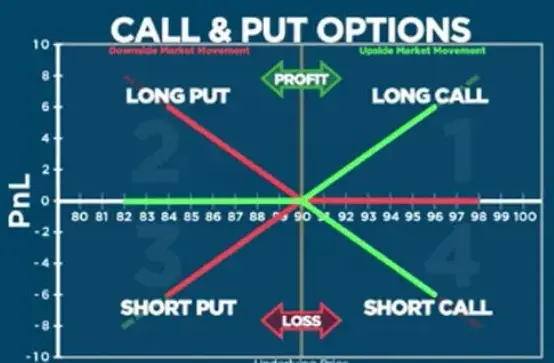
EXAMPLE: CALLS ON BITCOIN
Let's say that at the moment, the price of BTC is $20,000 per BTC, but you think it can rise in the next three months. You decide to buy a call option on 1 BTC with a strike price of $25,000 and a cost (premium) of $200. This option has a three-month expiry date.
Scenario 1 (Bull Market):
After three months, the price reaches $30,000 per BTC. In this case, you can exercise your call option, buy 1 BTC at $25,000 (the strike price), and then immediately sell 1 BTC at $30,000 in the market. You would earn $5,000 ($30,000 - $25,000) minus the initial cost of the option ($200), so your profit would be $4,800.
Scenario 2 (Bear Market):
If the price of BTC remains below $30,000, you do not exercise the option and only lose the initial cost of the option ($200).
EXAMPLE: PUT ON ETHEREUM
Let's assume that ETH is trading at $2,000 per token. You decide to buy a put option with a strike price of $1,500 and a cost of $100. Your option has a four-month expiry date.
Scenario A (Bear Market):
After four months, the price of Ethereum drops to $1,000 per token. In this case, you can exercise your put option, sell your ETH at the strike price of $1,500 (higher than the market price), resulting in a profit of $500 for each ETH (minus the purchase premium).
Scenario B (Bullish or sideways market):
If the price of Ethereum remains above $1,500 per token, you can choose not to exercise the option and you will only lose the initial cost of the option ($100).
Are you interested in ways to earn crypto bonus? Check it out here: Some Sites To Earn Crypto Bonus (Old & New)






