
The world of cryptocurrencies is constantly evolving: after Yield Farming it was the turn of NFT's and Meme tokens. Then Binance also entered the DeFi world with its Binance Smart Chain.
🅳🅴🆇Token (DEXG) instead through the 𝔸𝕄𝕄 mechanism (already known with Uniswap) tries to limit the high voting rate of the market.
The history of the DexToken protocol began in 2018 when the Flowchain Foundation published the white paper "The Tokenized Hardware Whitepaper". But the real story begins with "Volatility effect on the adoption and valuation of tokenomics".
The project aims to bridge the gap between DEFI and the Internet Of Things.
We were talking about the 𝘼𝙪𝙩𝙤𝙢𝙖𝙩𝙚𝙙 𝙈𝙖𝙧𝙠𝙚𝙩 𝙈𝙖𝙠𝙚𝙧 (𝘼𝙈𝙈) which tries to eliminate traditional orders based on liquidity pools governed by a mathematical formula. Traders are able to make a transaction with the pool but each order will affect the price of the asset they are trading (slippage).
The mathematical formula defines how the price changes in response to the size of a particular order (arbitrage trading). In return, LP get trading fees paid by users. The difference to other protocols that use the AMM is the creation of a universal pricing model:
1) To limit speculation
2) To limit high volatility
3) Integrated off-chain computing technology for token and smart contract redemption (so the protocol can do without oracles: Chainlink for example)
Obviously, the system encourages you to hold the DEXG token (staking) to obtain part of the profit from the transactions of users who use the protocol. Staking is proportional to the DEXG's blocked. Rewards are distributed after 8 rounds (starting September 2020).
Staking Rounds:
1) Ignition (September 2020)
2) Moon (October 2020)
3) Calypso (November 2020)
4) Pandora (November 2020)
5) Prometheus (December 2020)
6) Hyperion (December 2020)
7) Dione (January 2020)
8) Titan (January 2021)
In addition to staking, you will also have voting rights (governance), furthermore DEXG can be placed in staking pools for further prizes.
The maximum supply of the token is 200,000 which should not be reached (it basically depends on the value of DEXG, according to the metrics the maximum supply should be around 70,000). The real supply will be known in 2021 when the 8 staking rounds will end (for example if it is 60,000, the remaining 140,000 tokens will be burned).
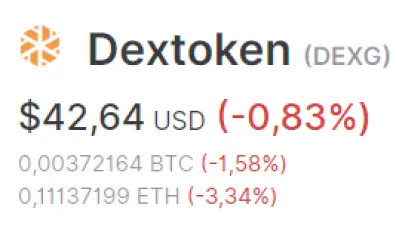
WHY CAN IT WORK?
As we know, one of the biggest problems of Uniswap and similar platforms is the 𝘪𝘮𝘱𝘦𝘳𝘮𝘢𝘯𝘦𝘯𝘵 𝘭𝘰𝘴𝘴 (if one of the two tokens entered in the liquidity pool increases / decreases a lot in value compared to the other, a temporary loss of tokens occurs because we know that the pool needs constant relationship).
Surely the liquidity pool with the use of the Balancer protocol is very interesting from this point of view (DEXG / USDC in a 90/10 ratio limits speculation for greater slippage and at the same time allows you to expose yourself on DEXG with less risk. In other words, the 𝖎̶𝖒̶𝖕̶𝖊̶𝖗̶𝖒̶𝖆̶𝖓̶𝖊̶𝖓̶𝖙̶ ̶𝖑̶𝖔̶𝖘̶𝖘̶ is reduced.).
The pool can be found here: Balancer Pool (DEXG/USDC)
For more info:
DexToken
DexToken (Twitter)
DexToken (Publish0x)
I made a nice Hologram 3D for DexToken, I recorded the projection with a smartphone but unfortunately the video is of bad quality. However I guarantee that seen live it makes it much better! :-D

▂▃▄▅▆▇█▓▒░[̲̲̅̅T̲̲̅̅h̲̲̅̅a̲̲̅̅n̲̲̅̅k̲̲̅̅ ̲̲̅̅Y̲̲̅̅o̲̲̅̅u̲̲̅̅ ̲̲̅̅F̲̲̅̅o̲̲̅̅r̲̲̅̅ ̲̲̅̅R̲̲̅̅e̲̲̅̅a̲̲̅̅d̲̲̅̅i̲̲̅̅n̲̲̅̅g̲̲̅̅]░▒▓█▇▆▅▄▃▂






