
Some people wonder whether a state or government could limit or ban the use of Bitcoin. Theoretically, they could (Bitcoin is known to be inconvenient for governments and central banks), but technically, it's much more difficult. Blocking Bitcoin through censorship is impossible, but it could be limited with ever-increasing taxes or with laws, threats and sanctions (bans), as has happened in China and some parts of Africa. However, Prohibitionism, throughout history, has often failed, with disastrous results: if demand remains high, supply becomes illegal but does not disappear. The greater the censorship, the greater the underground market. Let's look at the main cases.
1600-1700: TRADE MONOPOLY AND SMUGGLING
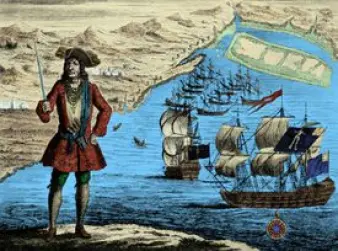
Colonial powers such as the British East India Company and the Dutch East India Company controlled the trade in spices, tea and textiles. Monopolies and high taxes led to enormous smuggling networks between colonies and independent merchants. The effect was the emergence of parallel economies in colonial ports and the spread of maritime piracy.
1720-1751: ALCOHOL PROHIBITIONS AND TAXES IN ENGLAND
During the Gin Craze (1720–1751), the English government attempted to limit alcohol consumption with heavy taxes and bans. The result was clandestine distilling and widespread illegal sales in London's working-class neighborhoods.
1839-1860: OPIUM PROHIBITIONS IN CHINA
The Qing Empire attempted to ban the trade in opium imported by the British. This contributed to the outbreak of the First Opium War (1839–1842) and the Second Opium War (1856–1860). Before the war, the ban had already created a massive international black market.
1914-1930: WAR ON DRUGS
The ban on drugs through the Harrison Narcotics Tax Act (1914) had the effect of shifting sales from pharmacies to clandestine networks, resulting in vastly higher prices on the black market. This is one of the first examples of what economists call a "crime tariff": the price increases because it incorporates the risk of criminal prosecution.
1920-1933: ALCOHOL PROHIBITION IN THE USA
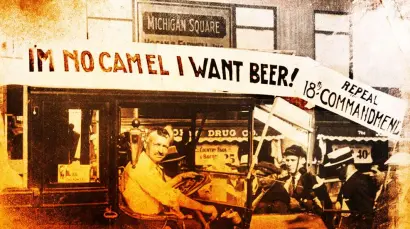
Through the Volstead Act, which implemented the Eighteenth Amendment to the United States Constitution, the United States attempted to reduce alcohol consumption and crime. In reality, it achieved the opposite effect: the emergence of a massive black market in alcohol (bootlegging and speakeasies), the growth of organized crime (Al Capone), increased gang violence, and widespread corruption among police and public officials. Furthermore, millions of citizens became "criminals" through consumption or sale. The illegal alcohol trade grew so large that approximately three-quarters of the contraband entering the US came from Detroit and Canada. Before the law, there were 15,000 bars in New York; within 10 years (when alcohol was outlawed), there were 32,000 speakeasies (hidden behind pharmacies, grocery stores, and butcher shops and accessible with passwords). Production centers had increased from 400 to 80,000. Alcohol production had increased from $190 million to $290 million in 1932, the black market was worth $3.6 billion a year, and Al Capone had built a fortune of $60 million.
1930-1970: PROHIBITION ON GAMBLING
Before widespread legalization, gambling was considered illegal and run by mafias and criminal organizations. Historical examples: illegal casinos in the US and Europe. When many states legalized gambling (Las Vegas in the 1930s and 1940s), part of the market returned to the legal economy.
1971: WAR ON DRUGS
Declared by Richard Nixon in 1971. Objectives: eliminate or reduce drug trafficking and consumption. The results were disastrous: enormous growth of criminal cartels, illegal global markets (Latin America, Afghanistan), and sky-high prices that encouraged trafficking and violence. Prohibition had increased profits because it reduced legal supply but not demand, making trafficking highly profitable. The global illegal drug market is now worth over $330 billion a year, and the real price of heroin on the black market has fallen from around $1,900 per gram in 1981 to $410 in 2011, with average purity increasing from 11% to 28%. More prohibition, more market. Lower prices. Increased availability.
1999-PRESENT: FILE SHARING AND DIGITAL PIRACY
This case is often cited in studies on regulation and the Internet. The symbolic event was the birth of Napster in 1999 (which allowed illegal music downloads). Lawsuits actually led to its closure in 2001. However, the effect was a migration to more decentralized systems: BitTorrent, eDonkey, Gnutella, and dozens of other P2P platforms. The closure of a centralized platform pushed traffic toward more distributed and difficult-to-control systems. This case is defined as "technological adaptation".

PROSTITUTION PROHIBITED
Nations and cities with strong prohibition have led to greater control by criminal organizations and less safety for "workers". For this reason, several countries have experimented with alternative models (legalization or regulation).
2010-PRESENT: BLACK MARKETS ON THE DARK WEB
Another interesting case is certainly that of black markets like Silk Road (2011). Drug prohibition favored anonymous platforms on the Dark Web using $BTC and anonymous cryptocurrencies like $XMR. This is a modern example of technological innovation born to circumvent a ban. Silk Road itself, after being shut down and founder Ross Ulbricht arrested, led to the spread of hundreds of other black markets on TOR.
SMUGGLING DUE TO HIGH TAXES
Historically, high taxes on tobacco consumption and fuel can be cited. Here too, prohibition developed the underground economy.
2013-PRESENT: BITCOIN BAN IN CHINA AND SOME AREAS OF AFRICA
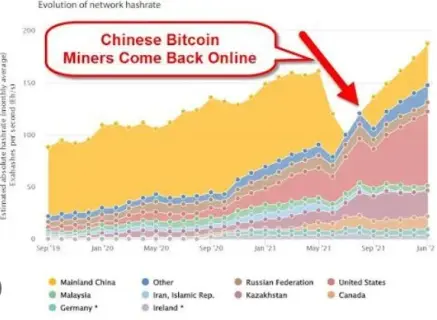
Finally, there are cases of Bitcoin mining bans in China and even illegal blockchain technology in Nigeria and other parts of Africa. In February 2021, the Central Bank of Nigeria banned regulated financial institutions from dealing in cryptocurrencies. In the three months following the ban, Bitcoin P2P trading volumes in Nigeria grew by 27% (from $80 million to $103 million). Today, according to Chainalysis, Nigeria is among the most active Bitcoin P2P markets in the world, with volumes exceeding $400 million. In September 2021, Beijing's central bank banned all cryptocurrency trading: any transaction was illegal. The Chinese hashrate disappeared from the radar for a few weeks, then resurfaced through VPNs and OTC networks. Today, China accounts for approximately 14% of the global Bitcoin hashrate, third in the world, in a country where owning Bitcoin is technically illegal. In 2024, according to Chainalysis, OTC cryptocurrency trading volume in China reached nearly $24 billion.
WHAT DOES PROHIBITION BRING?
I understand that all these bans can't be compared: drugs are indeed harmful, as is heavy alcohol consumption. Bitcoin and blockchain are legal technologies and alternative payment systems that have nothing to do with illegality (if you're referring to money laundering, the purchase of illegal goods, tax evasion, etc., know that all of these things have always existed, and even today, the largest percentage of these crimes are committed with fiat currency). However, when attempts were made to ban a new technology or something governments didn't like, the pattern is always the same: demand remains stable, legal supply disappears, risk leads to higher prices, huge profits for illegal operators and the emergence of criminal organizations. In short: prohibition + demand = black market.
Are you interested in ways to earn crypto bonus? Check it out here: Some Sites To Earn Crypto Bonus (Old & New)






