
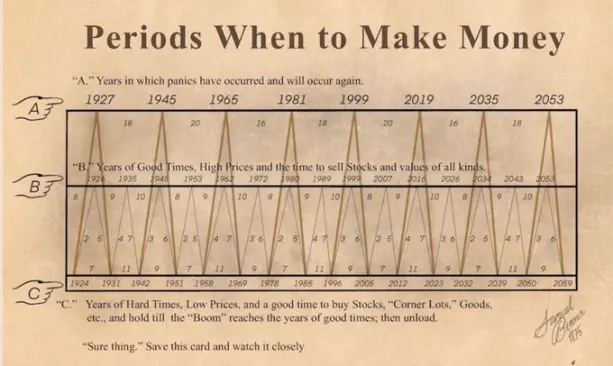
Samuel Benner was an Ohio farmer/hog breeder who in 1875 published a famous chart now known as the "Benner Cycle" useful for evaluating economic macrocycles. His study was empirical and stemmed from his direct experience as an agricultural producer affected by the economic crises of the 19th century. All these patterns were transcribed in "Benner's Prophecies of Future Ups and Downs in Prices" (1875).
PARAMETERS TAKEN INTO ACCOUNT
1) Historical price data (especially pig iron/crude iron).
Benner analyzed historical price series that were readily available at the time, specifically: pig iron prices in the United States, agricultural prices (wheat, livestock), and periods of crisis and financial panic. Pig iron was central because it was then the key indicator of industrialization (today, oil and semiconductors are used).
2) Observation of economic cycles (study of data from 1815 to 1873). Benner noted that economic crises seemed to recur at regular intervals, and price lows and highs tended to follow cyclical patterns. Agriculture and industry were not synchronized, but alternated.
3) His central theory was based on overproduction and scarcity.
Benner concluded that cycles resulted from:
- Overproduction: low prices leading to bankruptcies and crises.
- Scarcity: high prices leading to excessive investment and new overproduction.
According to him, this mechanism was intrinsic to human behavior, not random events.
4) From his empirical study, he identified three main cycles:
- 11 year cycle: years of high prices.
- 9 year cycle: years of recovery.
- 7 year cycle: years of low prices and panic.
The famous 1875 chart shows these waves overlapping and projected into the future.
INTERPRETATIONS
Benner's chart is based on:
- Historical price analysis (especially cast iron).
- Empirical observation of economic crises.
- Cyclical theory of overproduction/scarcity.
What did he predict? The severe US crisis (Panic of 1893), the global banking panic of 1907, the severe post-war deflation of 1921,
the Great Depression (predicted low) of 1931-1933, the global recession (oil crisis) of 1974-1975, the crisis of 1999 (Internet bubble), and the global financial crisis of 2008-2009.
The obvious limitations are its imprecise timing (1-3 years) and its erroneous magnitude (it fails to distinguish a mild recession from a systemic collapse). It does not take into account:
- monetary policies.
- government intervention.
- globalization.
- technology.
APPLICATION TO BITCOIN AND CRYPTO
Bitcoin and the crypto sector are similar to the agricultural world of the 19th century, being an emerging technology. Benner describes a system:
- poorly regulated.
- dominated by cycles of scarcity/overproduction.
- driven by human psychology with violent shocks.
Exactly what Bitcoin (from 2009 to today) and the altcoin sector have been. The modern economy, however, is overly driven by central banks. Although Bitcoin is losing its cyclical regularity, it has worked very well in the past:
- Halving: reduction in supply.
- Bull market: euphoria, leverage.
- Top: overproduction of risk.
- Bear market: panic, cleanup.
- Accumulation: the cycle restarts.
Essentially, altcoins are pure overproduction (excess supply, cyclical hype, destruction >95%). Benner explains altcoins better than Bitcoin: boom (overproduction), bust (cleanup), very few altcoins survive. Bitcoin, on the other hand, is structural scarcity, so it always rebounds and continues to grow over the years (with demand remaining constant, due to decreasing inflation from halving to halving). Deleveraging will lead to corrections for Bitcoin (narrative: "Bitcoin is finished," "Bitcoin is old," etc., all things we've seen and heard before in 2014, 2018, and 2022), and that's when the wise investor buys (meanwhile, 95% of altcoins will disappear and there will be more in the next cycle).
JUGLAR CYCLES
A "scientific" version (of Benner's model) based on investment and credit expansion is Juglar's (macro analysis). This is the "classic" medium-term economic cycle (7–11 years). Companies overinvest: excess capacity and profits decline.
Credit tightens, leading to recession and bankruptcies. This is followed by a cleansing phase and then a new expansion. This is the cycle best observed in macroeconomic data and explains industrial booms and busts well.
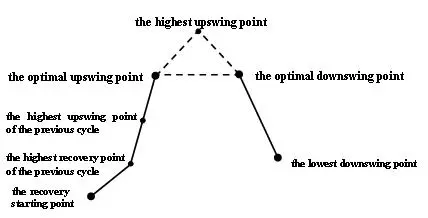
Applying these cycles to Bitcoin and the crypto sector, we can say that BTC follows a 4-year investment and credit cycle (halving + leverage). Expansion, for example (last cycle): ETF, lending, derivatives, etc. Contraction leads to liquidations and bankruptcies, which leads to a bear market. Juglar explains why BTC experiences regular booms and busts.
KONDRATIEV'S LONG WAVES
Kondratiev also drew inspiration, but significantly broadened his horizons (40-60 years), studying debt/technology (steam, electricity, IT, etc.) and systemic risks. Each wave has a spring, summer, autumn, and winter. It involves debt, demographics, and geopolitics. It doesn't have precise dates, but historical phases. It's obviously useful for understanding structural changes, not for market timing (trading).
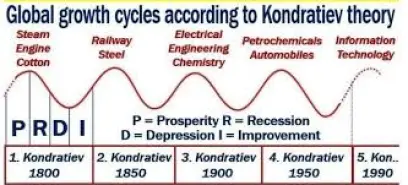
Bitcoin is part of the digital financial technology wave that began in 1980. It's still in the adoption phase, not maturity. It benefits from fiat system crises (when the dollar weakens, BTC rises in value). It's not the dominant cycle, but an emerging asset within the wave. Kondratiev explains well why BTC tends to survive and grow in the long term.
MINSKY'S FINANCIAL INSTABILITY
Minsky exploits the same principles, focusing on debt and leverage. Stability breeds instability. Phases: hedges, speculation and Ponzi finance. The better things go, the higher the risk. Debt becomes unsustainable. A small shock triggers a crash; these are the reasons why crises surprise everyone.
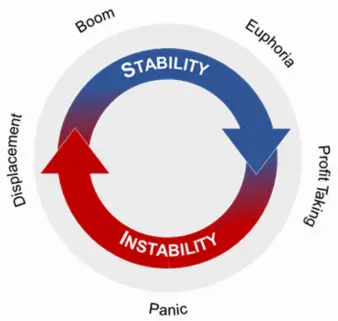
The cryptocurrency bubble phases increase risk due to leverage, Ponzi schemes (excessive risks) on yield, lending and altcoins. The system becomes fragile. An event (the MtGox crash in 2014, the ICO scam in 2018, FTX/Luna in 2022) causes the crash. Total deleveraging follows. Minsky explains why crypto crashes are sudden and violent.
Are you interested in ways to earn crypto bonus? Check it out here: Some Sites To Earn Crypto Bonus (Old & New)






