
The governments of the world have been printing fiat money like it's going out of fashion. Tip: someone should tell them it is !
It's not just their response to the pandemic, it's a kind of knee-jerk reaction to any crisis, however large or small. Pandemic ? Print money. Stock market crash ? Print money. Run on the banks ? Print money.
They dress it up with all kinds of euphemisms, of course. Quantitative easing, issuing government bonds, easing restrictions on fractional reserve banking, improving liquidity, you name it. But it all adds up to waving the magic money wand and creating cash out of thin air. But then, that is what "fiat" means, it comes from the Latin, meaning "let it be done".
The money supply is measured as M and a number. M0 is banknotes and coins in circulation, M1 is M0 plus checking account deposits, and M2 is M1 plus "near money", a term which covers funds which can be converted to cash relatively rapidly, things like savings deposits, mutual funds, and certain securities. M2 is the metric most useful in defining the overall money supply.
Since 2020, both the US and UK (and most other Western governments) have increased their M2 money supply by around 30%. That means that almost a third of the money in circulation has been hand-waved into existence in just two years. Below are charts comparing the UK to US and EU. Yeah, I know it's UK-centric.... it's where I'm from, and I find it easier to visualise it this way.
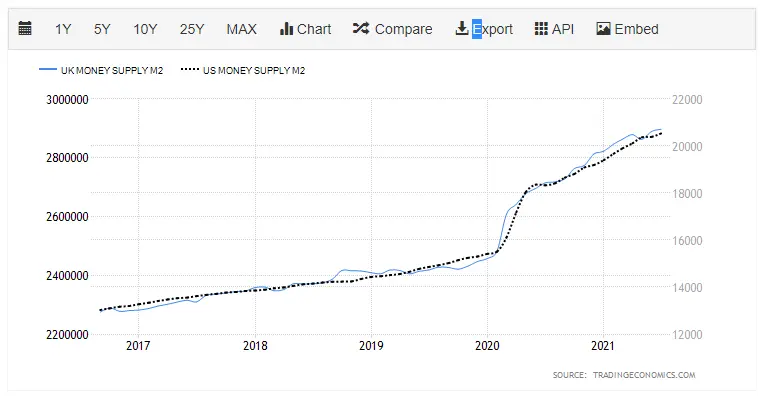
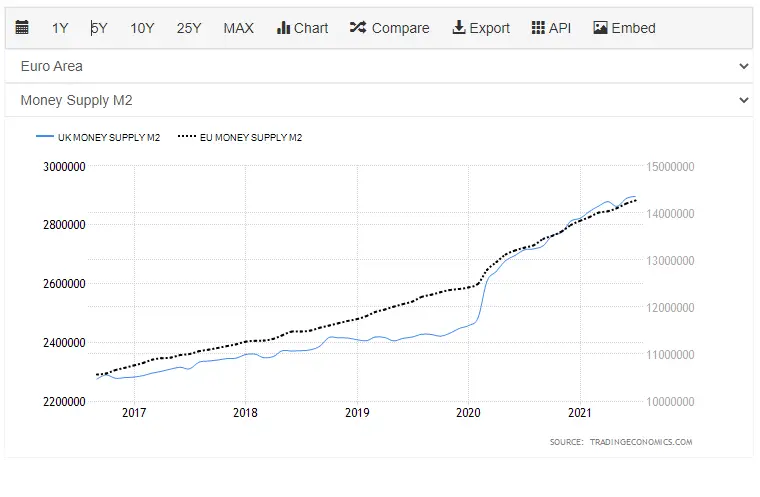
As you can see, the Euro area's curve is smoother, but it's only because they printed more in 2019 as well ! The start and end points are remarkably similar, as if all the governments involved were co-ordinating a response or something.
What they are doing used to be referred to by another term, which has become taboo for politicians to say; devaluing the currency. To my mind, what our governments are doing is little different to the Roman emperors adding lead to their coins to cut down the amount of silver used.
Inflation is a complex thing influenced by money supply, the availability of commodities and labour, and a host of other factors. But at it's most simplistic level, a rapid 30% increase in the money supply adds up to 30% inflation coming at us like a juggernaut. I am guessing that governments will come up with all kinds of dodges to keep the annual inflation rate down. I mean, it's not like governments ever cook their figures or manipulate statistics, right ? My instinct says that they'll try to keep inflation at under 5 or 10 percent. They'll have to make a choice between keeping on printing money or a serious dose of austerity and tax increases, meaning we could be heading for a decade or more of stagflation.
So what does this do to crypto ? It depends on which coins and tokens you look at.
Bitcoin and similar "core" altcoins will prove to be a fabulous way to protect yourself from inflation. The rapidly dropping value of fiat currencies will be reflected in increased crypto prices in relation to those fiat currencies. I must admit I struggle to break the mental link between Bitcoin and fiat values. After 30% inflation, Bitcoin at today's value of $46,000 will have a dollar-equivalent value around $60,000. Anything over that (and I expect it to be well over that !) will be a real-terms gain. Just as relevantly, as a non-inflationary store of value, BTC and similar coins should be recognised as one of the few ways to beat inflation.
Stablecoins are generally pegged to the dollar (or occasionally another currency, although I can't think of any examples of that right now). Those projects are going to need to decide whether to accept a steady decrease in value relative to un-pegged altcoins, or if not, what action to take to try to beat inflation.
Both memecoins and NFT's are, I feel, likely to have a bit of a shake-out. Weaker projects and NFT's that are just gimmicks will disappear. But that's a good thing, in a Darwinian kind of way. Crypto will emerge far stronger from it. Projects with serious real world use cases will prosper and NFT's will evolve into valuable objects or tools fulfilling a function rather than having value just because they're pretty. Oh, and I think that Dogecoin is likely to become less meme and more real-world useful. With it's lower unit price, I believe it could lead the way for use in day-to-day transactions, with ordinary consumers finding it easier to get their heads around it. It'll be like paying with a $20 bill instead of the $60,000 cheque Bitcoin has become. I really must get around to buying some.....
Overall, I feel we are in for a tough few years economically. Governments have been throwing money around during the pandemic, while trying to prevent the virus spreading with lockdowns and other restrictions that have done significant economic damage that will reduce their tax take. Governments and tech monopolies have worked together to create tools to monitor, control and centralise. But I believe strongly that if crypto can maintain it's decentralised nature against the centralising tendencies of government regulators and tech-company data snooping, it will enable those of us who are committed to it to at least mitigate the worst of what is being thrown at us.






