
Recently I found some old photos that I took when I visited this museum and I would like to share them and comment on them, in this sense, I made a series of posts in my blog on Steem, but in Spanish that is my native language, now, I would like to share it to give it more diffusion.
This was an old house of Simón Rodríguez in Caracas, he was the teacher of the Liberator Simón Bolívar and his house was for a long time a school, then it passed to various owners and during the 20th century it was given many different uses, in the 21st century declared national heritage and proceeded to its restoration.
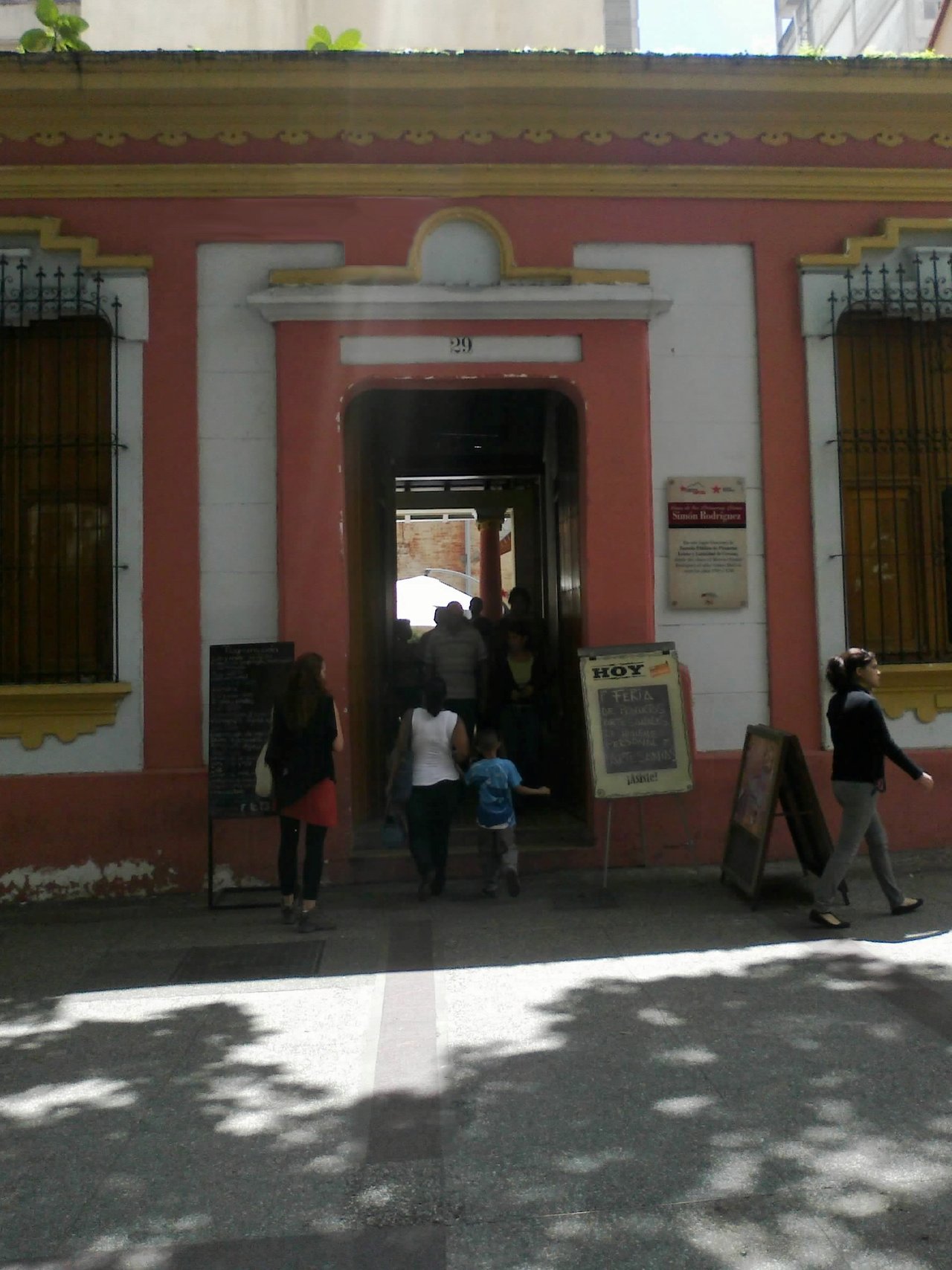
Doors and Hallways
It is obvious that the photo that starts the post corresponds to the main facade of the Museum, specifically focusing on the door of the same.
Once inside you have the atmosphere of an old colonial house, in which the floors present some variations of interesting mosaics and the walls have been worked to leave in some portions part of your old building materials in sight.

On this wall there is a plaque on which I will pay more attention a little later, it will be in another installment. The detail of the arch over the entrance to this side aisle was what caught my attention to take the picture.

In other lintels the use of a wooden beam to support is directly observed.

During the reconstruction, although the original material of the walls was preserved and an attempt was made to replace what was missing, the intervention and modification was not lacking, as is the case with the glass that is seen in the photo along with the cobblestone wall of cooked clay and the wooden beam lintel.

The atmosphere is calm, as I usually think it is the atmosphere of a museum, but it has many activities as I have known.
By the way, this last photo reminds me of a cafeteria that works inside the museum and that I found very pleasant at the time for its coffee and desserts.
Photo source - Facebook of Café Melosa
This last photo is not mine, but I think it is quite accurate to explain what I say.
Floors
Regarding the floors and the risers of a small staircase near the entrance of the museum, the variety of designs caught my attention ... or rather the lack of unity in the styles and motifs of these floors, what which makes me think that they are mostly things that were placed additionally during the 19th and 20th century
The wear that is observed is something that is understood, after all, I think that these mosaics can be a little more than 100 or 200 years old.

On the riser of this staircase you can see that small vertical mosaics were used to give a color effect, I found it interesting.

The use of different mosaics for the floors really stands out a lot, when leaving a corridor to enter an open living room it is seen so clearly that it makes me wonder why I would do that.

Using in the mosaic rooms that delimit the area, I thought about the use of carpets for interiors, as an inheritance of the Arab influence in Spain that extended to its colonies in America, I am not sure that this is the case , but it seems a lot.

This mosaic design that can be seen in the photo that follows is much more delicate than the others, but I do not know if it is more recent or older than the others, it is something that I could not clarify and unfortunately in the museum I did not see any plaque To explain this, I suppose I should have asked some of the museum workers, but on that day I went I didn't think about it and now that I have the doubt I don't have on hand how to clarify it.

Costume and Miscellaneous
In this section of the publication I concentrated on a room that has a sample of the dress of the time at the end of the Colony and the beginning of the Republic.

There is also a sample of the military clothing of an officer and a spearman, by the way, I must comment that the clothing of this spearman is almost a "Gala Costume" as it is quite known in the historical records that these "soldiers" of Low level in many cases were simple day laborers or farm workers who were worn as "cannon fodder" and their clothes, at times, were just a few pants that reached the knee and nothing more.

In one of the corners of the room I saw a shelf with a sample of the accessories of the time.

And it is definitive that a white hat with plumage that was on the shelf caught my attention, seriously, it seems odd to me today, but I try to think that in its time it will have been the most in good taste, high fashion and great class .

Walls and Arches
Now it's time to share the photos of the details in walls and arches that caught my attention in the museum. These are peculiar things, since being a house of the Colonial period of Caracas and its later Republican era, most of it is made of materials such as cooked adobe, stones and wild canes joined with mortar and covered with a stucco, but with the Over the centuries, modifications were made, so many of the original walls were lost, however, some parts retain their original materials and during reconstruction it was decided to leave them exposed to give testimony of the materials and construction techniques of their era.
Something that caught my attention on this first wall is that it looks as if it were a messy placement of materials, but there is a striking detail on the left, it is the placement in the form of overlapping trapezoids of cooked adobe structures, not I understood at the beginning, but it seems that it is a fairly good and simple construction technique, which allows to give greater strength to the construction, in addition to saving some cooked bricks of adobe with its use, it serves as a kind of hidden beam inside the wall and allows loose stone and mortar to be used between these pillars, that lowers the cost of construction.
That detail gave me to think about the social and economic differences of the time, after all, the colonial houses that are museums nowadays in the vicinity, have walls mostly of bricks of cooked adobe, but the house of this teacher I could not afford this type of construction and had to save on their materials ... I think that teachers have had problems of lack of money and poor payment for their services for a long time.

In these two photos that follow, the pattern of overlapping trapezoids is again seen, but now along a wall inside the open-air museum.


The contrast between the background brick wall and the column seen in the following photo, then, caught my attention and I think I remember that it is a common architectural detail in Spanish colonial buildings in America.

The photo that follows I took it out of curiosity, it happens that I cannot identify it with the colonial style, it seems to me that it is an aggregate built later, perhaps during the 20th century, but I dare not firmly assure it, after all, the use of Rosettes in stained glass is very old, I think remember that they are used since the Renaissance. In addition, the woodwork of this window could be a reconstruction of a previous one, but I still don't know if its style fits the age of other things in the museum.

Finally, I had already mentioned a wall that had a plaque and now is when I want to show it better.

The message on the board says:
The title of Teacher should not be given except to the one who KNOWS how to teach this is, to the one who teaches to learn, not ... to the one who commands to learn, nor ... to the one who advises to learn.
Simon Rodriguez






