
Most crypto traders spend hours picking the coin and the entry, then choose the position size in about three seconds, usually by feel. That's backwards. Your position size decides how much a normal losing trade costs you, and that decides whether a bad week is a lesson or the end of the account.
This guide gives you one formula, a full BTC example you can check by hand, and four traps that quietly break position sizing in crypto: tight stops, fees, leverage and correlation.
1. Start with R: the amount you are willing to lose
Define 1R as the amount you will lose if your stop is hit. Many traders set 1R at 1% of their account or less. On a $5,000 account, 1% is $50, so 1R = $50.
Why use R at all? Because it lets you compare trades of different sizes and coins on one scale. A trade that makes twice what you risked is +2R. A trade that hits its stop is −1R. A break-even trade is 0R.
2. The one formula
Position size (in coins) = risk amount ÷ (entry price − stop price)
For a short trade, use (stop price − entry price). Position value is simply the number of coins multiplied by the entry price.
Worked example (illustrative BTC price)
- Account: $5,000
- Risk per trade: 1% = $50
- Buy BTC at $100,000 (an illustrative price, not a current quote)
- Stop at $97,000, which is $3,000 below entry (a 3% stop)
Position size = $50 ÷ $3,000 = 0.016667 BTC. Position value = 0.016667 × $100,000 ≈ $1,666.67, which is about 33% of the account, so your effective leverage is only about 0.33 : 1.
If you set a 2R target at $106,000, the profit at the target is 0.016667 × $6,000 = $100. If the stop is hit, you lose $50. You decided the loss first, and the stop distance set the size. That is the whole method.
3. Trap one: tight stops force big positions
Here is what happens to the position size when you keep the same $50 risk but change the stop distance (account $5,000):
- 1% stop: position value $5,000, which is 1.0 : 1 (your whole account, with no leverage)
- 2% stop: $2,500 (0.5 : 1)
- 3% stop: about $1,667 (0.33 : 1)
- 5% stop: $1,000 (0.2 : 1)
- 10% stop: $500 (0.1 : 1)
Notice the 1% stop: to risk just 1% of your account with a stop only 1% away, you need to put 100% of the account into the trade. A 0.5% stop would need twice your account, which means borrowing. This is how small accounts end up over-leveraged: they pick a tight stop, then discover the "right" size is huge, and they size up anyway.
The honest fix is the opposite: place the stop where the trade idea is actually wrong (not where it makes the size convenient), then accept whatever size the formula gives, even if it is small.
4. Trap two: fees and funding are a tax measured in R
Crypto venues charge trading fees, and perpetual futures also charge or pay funding at regular intervals while you hold. Fees look tiny as percentages, but what matters is how big they are compared with your risk.
Assume an example taker fee of 0.05% per side, so 0.10% round trip, with no funding:
- On the 3% stop trade (position value $1,666.67), the round-trip fee is about $1.67, which is about 0.033R.
- If the target is hit, you net about $98.33. If the stop is hit, you lose about $51.67.
- The fee drag in R equals the round-trip fee divided by the stop distance: 0.10% ÷ stop %. That is 0.10R at a 1% stop, 0.05R at 2%, about 0.033R at 3%, 0.02R at 5% and 0.01R at 10%.
Fees also raise the win rate you need. With a 1:2 reward-to-risk ratio, you break even at a 33.3% win rate before costs. With 0.033R of fees on every trade, the break-even win rate becomes (1 + 0.033) ÷ 3 ≈ 34.4%. The tighter the stop and the more often you trade, the larger this gap becomes. These fee levels are assumptions, so use your own exchange's fee schedule.
5. Trap three: leverage does not change your risk, your size does
Leverage lets you control a bigger position with less margin. It does not change what the trade costs you if the stop is hit. In the example above, the loss is $50 whether you use 1x, 5x or 20x, as long as the position size is 0.016667 BTC. Higher leverage only lowers the margin you post.
What leverage does change is how close you are to being liquidated, the point where the exchange closes your position. If your liquidation price is closer than your stop, the exchange can close you out before your stop ever triggers, and you may lose the margin on that position. Before any leveraged trade, check the liquidation price on the exchange and make sure your stop is comfortably inside it.
The same principle applies in other markets. The US CFTC warns that margin trading in forex can leave you responsible for losses greater than your deposit (see the CFTC forex advisory). Whatever you trade, read your exchange's or broker's terms on margin, liquidation and negative balances.
6. Trap four: correlation, or three bets that are really one
Say you risk 1% on each of three long positions: BTC, ETH and a smaller coin. That looks like 1% risk three times. But coins often tend to move in the same direction during a sharp market move, so a single market-wide drop can hit all three stops at once and cost you close to 3R in one go.
Two rules help:
- Cap your total open risk. Many traders use 2% to 3% of the account across all open trades.
- Count highly correlated positions as one. If you hold several coins that tend to move together, treat them as a single bigger position when you add up the risk.
7. Measure it: log every trade in R
A position size rule only works if you check it against real results. After each trade, record the pair or coin, direction, entry, stop, size, and the result in R. After 50 to 100 trades, calculate:
- Win rate = wins ÷ total trades
- Average R (expectancy) = total R ÷ total trades
- Profit factor = gross profit in R ÷ gross loss in R
- Maximum drawdown = the biggest fall in your running R total from a peak
As an illustration, a 20-trade log with 8 wins (averaging +2R), 11 losses (−1R each) and 1 break-even trade totals +5R: a 40% win rate and +0.25R per trade, with a profit factor of 16 ÷ 11 ≈ 1.45. Twenty trades is far too few to prove anything, but the example shows how a 40% win rate can still be profitable when winners are twice the size of losers. I explain the spreadsheet layout and formulas in my guide to a free trading journal in Excel.
8. Free tools that use the same math
To be upfront: the DailyTraderz calculators are built for forex pairs and gold, so they use pip values and lot sizes rather than coins. The method is identical, though, and if you also trade forex or gold, they save you the arithmetic:
- The forex position size calculator turns a risk amount and a stop distance into a lot size.
- The risk reward ratio calculator shows the ratio of any entry, stop and target.
- The stop loss calculator works out a stop from your size and risk.
- The trading journal calendar is a place to review your trades day by day.
You can see everything in the full collection of free forex trading tools. For crypto trades, a simple spreadsheet with the formula in section 2 does the same job.
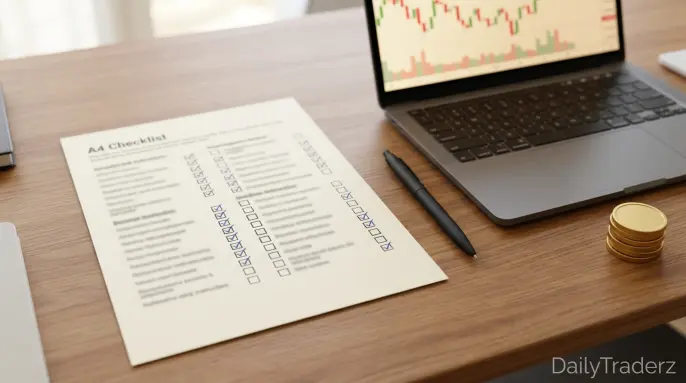
A pre-trade checklist
- What is 1R in dollars for this trade?
- Where is the stop, based on the idea being wrong and not on convenience?
- What size does the formula give, and have I rounded it down?
- What is my effective leverage (position value ÷ account)?
- Is my liquidation price (if leveraged) well beyond my stop?
- What do fees and funding cost in R?
- What is my total open risk including correlated positions?
Frequently asked questions
How much should I risk per trade in crypto? There is no single right number. Many traders use 1% or less, and crypto's volatility is one reason to lean toward smaller risk. Pick a level you can lose repeatedly without panic.
Does the formula work for altcoins and perpetual futures? Yes. The formula only needs your entry, stop and risk amount. For futures, also consider funding and your liquidation price.
Should I round the position size up or down? Down. Rounding up makes your actual risk larger than planned.
Is a smaller position size always safer? Smaller size reduces the loss per trade, but a stop that is too tight for the coin's normal volatility will be hit by noise. Place stops by market structure first, then size from the stop.
Risk disclaimer: This article is for educational purposes only and is not financial advice. Prices, fees and examples are illustrations, not current quotes, recommendations or expected returns. Trading cryptocurrencies and leveraged products carries a high risk of loss, and you can lose all your capital. Only trade with money you can afford to lose.





