
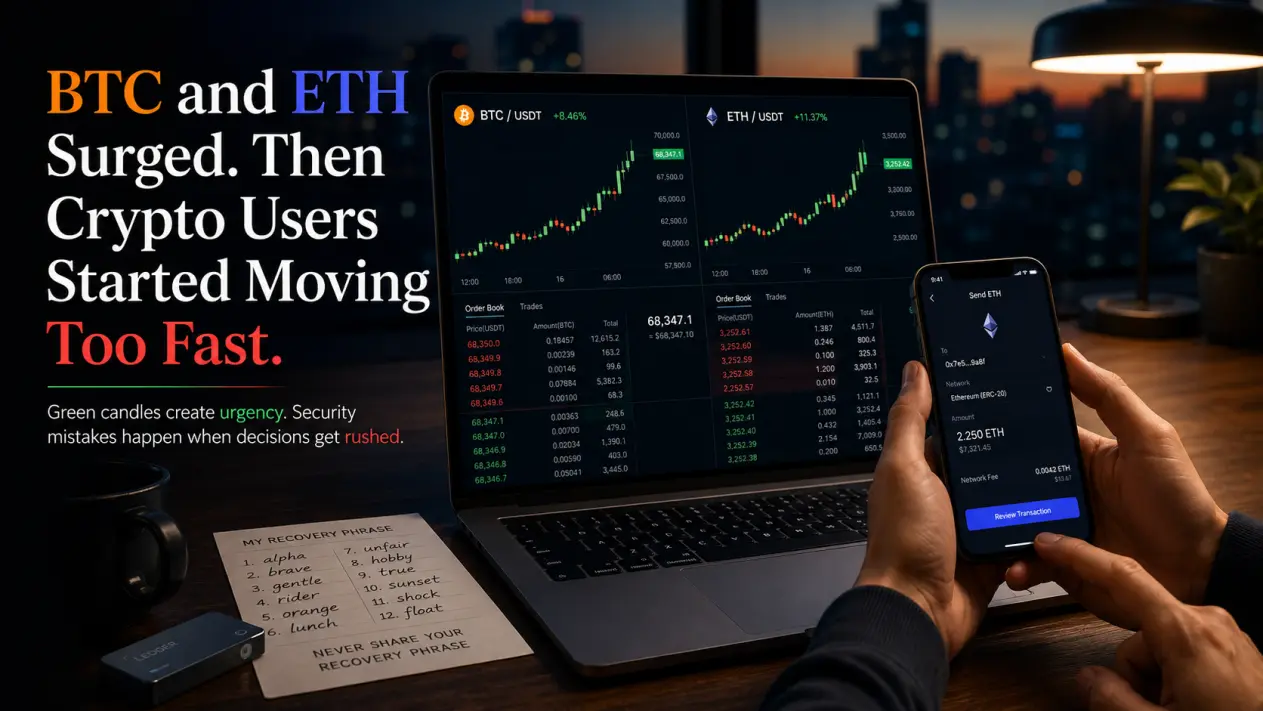
Yesterday’s rally crushed short positions and brought the excitement back. It also brought back one of crypto’s most expensive habits: rushing.
Yesterday finally felt like crypto again.
Bitcoin spent part of the day around the mid-$64,000s.
Then the market moved.
Fast.
By later in the session, BTC had pushed above $69,000, gaining more than 6% and reaching its highest level in nearly three months. Ethereum moved even more aggressively, reclaiming $2,000 before pushing above $2,100 and later extending beyond $2,200.
And suddenly, every crypto timeline looked different.
Green candles.
Screenshots.
“WE ARE BACK.”
People who had barely opened their portfolio for weeks were checking it every few minutes.
The market had energy again.
I understand the feeling.
But there is something about days like yesterday that worries me more than a red candle.
People start moving faster.
And crypto punishes rushed decisions extremely well.
Yesterday Wasn't Just an Ordinary Green Day
The move had several catalysts behind it.
The U.S. Treasury announced plans to increase buybacks of longer-dated government debt, doubling the maximum size of certain operations from $2 billion to at least $4 billion. Bond yields fell and the dollar weakened as markets interpreted the intervention as support for liquidity and risk assets.
At roughly the same time, Washington was delivering a much more crypto-friendly policy signal.
A White House meeting brought together crypto industry leaders and regulators, with President Trump again pushing Congress toward clearer digital-asset legislation. That helped strengthen sentiment around the sector.
Then came the accelerant.
Short sellers were heavily positioned against the move.
As Bitcoin began climbing, those bearish positions started being forcibly closed.
MarketWatch reported that more than $1 billion of crypto shorts were liquidated in approximately one hour. Other market data put short liquidations during the broader move around $1.4 billion.
Forced buying created more upward pressure.
More upward pressure triggered more liquidations.
And suddenly a normal rally became something much faster.
If you have been in crypto long enough, you know the feeling.
Your phone starts demanding your attention.
The Green Candle Changes People
This is the part charts don't show.
At 2% up, you watch.
At 5% up, you start thinking.
At 8% up, you start doing things.
Maybe you open an exchange account you haven't used in months.
Maybe you move funds from cold storage.
Maybe you connect an old wallet.
Maybe you look for an altcoin you forgot you owned.
Maybe you suddenly decide your crypto needs to be “ready.”
Ready for what?
You're not completely sure.
But everyone else appears to be moving.
And doing nothing starts feeling like a decision.
That is where mistakes begin.
Red Markets Create Fear. Green Markets Create Urgency.
People talk constantly about fear during crashes.
But greed creates its own form of panic.
It sounds like:
“I need to move this now.”
“I should connect this wallet before it goes higher.”
“I haven't used this account in two years, let me recover it quickly.”
“I'll just transfer everything at once.”
“This link looks right.”
“I'll check the address after.”
Those are not technical vulnerabilities.
They are behavioral vulnerabilities.
And a hardware wallet cannot fix most of them.
The Most Expensive 30 Seconds in Crypto Usually Feel Normal
Imagine Bitcoin is moving quickly.
You decide to transfer funds.
You copy an address.
Paste.
Check the first few characters.
Check the last few.
Looks good.
Confirm.
Thirty seconds later, you start wondering:
Did I check the network?
Was that definitely the right address?
Did the hardware-wallet screen show exactly the same thing?
Why did I send the full amount first?
Anyone who has moved a meaningful amount of crypto knows this feeling.
The transfer is already broadcasting.
Now you wait.
Those 30 seconds can feel longer than the previous three years of holding.
And on a day like yesterday, users are more likely to create those moments because the market itself is telling them:
Hurry.
The Market Doesn't Care That You're Excited
Bitcoin does not know that BTC just broke above $69,000.
Ethereum does not know that people on social media are posting rockets.
Your wallet does not know that you are experiencing FOMO.
A blockchain will process a valid transaction whether it was created after 20 minutes of careful verification or 20 seconds of excitement.
That neutrality is one of crypto's strengths.
It is also what makes mistakes unforgiving.
Scammers Love Green Days Too
If yesterday got your attention, it got attackers' attention too.
Rising markets create perfect conditions for social engineering.
People start searching:
- “move Bitcoin to wallet”
- “Ledger not showing balance”
- “Ethereum wallet recovery”
- “claim token”
- “connect wallet”
- “update hardware wallet”
- “best DeFi opportunity”
- “airdrop”
Traffic increases.
Urgency increases.
And users become much more receptive to messages that appear to help them act quickly.
The phishing page does not need to be brilliant.
It only needs to appear at the exact moment someone wants to move.
One Fake Support Message Can Suddenly Feel Reasonable
Imagine your wallet has been untouched for eight months.
Yesterday's rally makes you open it again.
Something looks wrong.
The balance isn't where you expected it.
Now a message appears:
“Your wallet requires synchronization.”
Or:
“Urgent security update required.”
Or:
“Restore wallet to continue.”
On a quiet Sunday, maybe you investigate carefully.
During a violent market move, your brain is thinking about something else:
What if the market keeps moving while I deal with this?
That emotional pressure is useful to attackers.
And if the “solution” asks for a seed phrase, the hardware wallet itself doesn't need to be compromised.
The user can accidentally hand over the master recovery secret.
I recently wrote a deeper breakdown of this exact problem—fake support, phishing pages, digital seed copies, malware and unsafe recovery—in “Can Your Ledger Seed Phrase Be Stolen? 7 Real Attack Vectors” on CryptoSafeKit.
The recurring pattern is surprisingly simple:
the attacker often doesn't defeat the cryptography.
They convince the owner to bypass it.
Yesterday Made Me Think About Cold Storage Differently
There is a reason long-term storage is supposed to be boring.
A wallet holding assets you do not intend to move frequently shouldn't need to participate in every market event.
Bitcoin moves 7%.
The wallet remains boring.
Ethereum moves 10%.
Still boring.
Twitter becomes euphoric.
Still boring.
That separation is valuable.
Not because cold storage predicts the market.
Because it creates friction between:
feeling something
and
doing something irreversible.
Sometimes friction is security.
A Good Wallet Setup Should Slow You Down
We normally design technology to eliminate friction.
One-click checkout.
Face ID.
Auto-fill.
Instant login.
Crypto security often benefits from the opposite.
Before moving meaningful funds:
Stop.
Check the network.
Check the full destination.
Check the amount.
Check the device screen.
Send a test transaction if appropriate.
Then move the rest.
These steps feel painfully slow when everything is green.
That is exactly when they matter.
Yesterday's Short Squeeze Is a Perfect Example
More than $1 billion in bearish positions reportedly disappeared in roughly an hour.
Think about the speed of that.
Thousands of leveraged market positions were automatically closed because price moved faster than their risk limits allowed.
Crypto markets can change dramatically in sixty minutes.
Your security process should not.
Whether Bitcoin is:
$50,000,
$69,000,
or $100,000,
the receiving address still deserves the same verification.
Your seed phrase should still never go into a random website.
Your hardware-wallet screen still matters.
Your cold-storage recovery backup still needs to remain offline.
Price changes.
The rules shouldn't.
The Funny Thing About Bullish Days
Nobody wakes up thinking:
“Today I am going to lose crypto through a careless mistake.”
They think:
“Let me just move some funds.”
“I'll quickly check this wallet.”
“I'll connect for a second.”
“I'll update this device.”
“I'll claim this before it ends.”
That word—
quickly
—is doing a lot of work.
I Don't Think the Biggest Risk After Yesterday Is Missing the Rally
You will see endless debate about whether Bitcoin goes higher.
Whether ETH continues outperforming.
Whether this was only a short squeeze.
Whether the Treasury intervention changes the macro picture.
Whether the next resistance level breaks.
I don't know.
And I don't think anyone needs another confident prediction from someone looking at yesterday's candle.
The more useful question is:
Did yesterday's price movement change your behavior?
Did you open wallets you hadn't touched in months?
Move funds you had planned to leave alone?
Click links more quickly?
Check your portfolio twenty times?
Suddenly feel that your long-term storage needed to become active?
That is worth noticing.
The Best Security Habit During a Rally Is Boring
When the market gets faster:
you get slower.
That might be the entire article.
Bitcoin jumps?
Slow down.
Ethereum runs?
Slow down.
Everyone says you're missing out?
Slow down.
A wallet suddenly needs an “urgent update”?
Definitely slow down.
Because there is almost never a legitimate reason to expose your recovery phrase simply because the market is moving.
Green Candles Eventually Disappear
Yesterday's candle will eventually become a tiny bar on a chart.
People will forget the exact percentage.
They will move on to the next market narrative.
But an irreversible transaction remains irreversible.
A compromised seed remains compromised.
A wrong address remains wrong.
A malicious approval remains a problem until dealt with.
That is why one of the strange truths of crypto is this:
The days that feel the best can also be the days when discipline matters most.
One Question for the Comments
Be honest.
Did yesterday's BTC and ETH rally make you do anything you hadn't planned to do 24 hours earlier?
Check your wallet?
Move funds?
Open an old exchange account?
Think about buying?
Connect to DeFi?
Or simply stare at the chart far more than you would like to admit?
No balances needed.
I'm more interested in how a fast green market changes people's behavior.
Because I suspect most of us are much more disciplined when nothing is happening.
Security disclaimer: This article is for educational purposes only and does not provide investment, trading, or price-prediction advice. Never share a seed phrase, private key, PIN, or passphrase because of an unsolicited wallet alert, market event, support message, or website prompt.






