
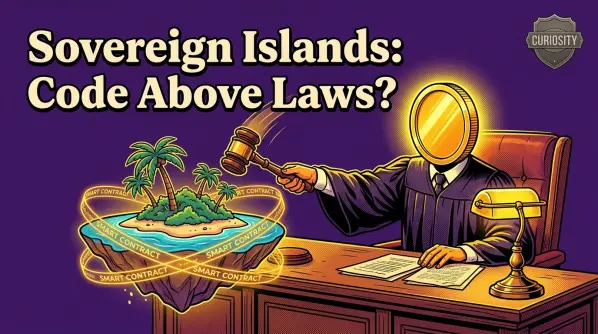
The convergence between blockchain technology and territorial sovereignty has evolved from a science fiction narrative into one of the most daring social experiments of the twenty-first century. For years, cypherpunk enthusiasts, libertarians, and Web3 investors have harbored the vision of establishing ecosystems where state bureaucracy is entirely replaced by immutable code. Central to this vision are the experiments involving private islands and micro-nations governed by Decentralized Autonomous Organizations (DAOs), where taxation, property registries, and community decisions operate seamlessly over smart contract infrastructures and native tokens.
How the cypherpunk philosophy drove the pursuit of sovereign digital jurisdictions
The quest for physical autonomy through cryptocurrencies is deeply rooted in the seasteading movement and the concept of competitive jurisdictions. With the advent of Ethereum and the maturation of smart contracts, the premise of structuring a society founded on code gained practical momentum. Instead of relying on slow judicial systems and centralized political structures, these projects introduced a model where the community constitution is automatically executed across the blockchain ecosystem. Voting rights, public resource allocation, and even the issuance of residency titles became directly tied to holding governance tokens or identity NFTs.
From the island ecosystems of Vanuatu to private crypto island initiatives
Emblematic cases have attempted to materialize this utopia in the real world, ranging from efforts to purchase islands in the Caribbean to collaborative projects in island territories such as Vanuatu. The "Satoshi Island" initiative, for instance, was designed to transform an 800-acre private island into a true hub for the crypto community, where land ownership is fractionated and traded in the form of NFTs. Under this framework, local governance, urban development, and land use rights rely on community votes recorded directly on a public ledger, eliminating traditional land registries and local government intermediaries.
The utility of native tokens and DAO governance in spatial management

Within these experimental jurisdictions, the internal economy relies strictly on the architecture of its governance and utility tokens. These digital assets function simultaneously as a medium of exchange for local services, fuel for daily transactions, and proportional voting weight within the DAO general assemblies. When a resident or investor intends to approve a solar energy infrastructure or amend island zoning laws, the proposal is submitted through an on-chain protocol. Quorum is achieved via smart contracts, ensuring that community treasury funds are automatically dispatched to the project developer without the risk of fund misallocation.
Legal bottlenecks and the harsh reality of international diplomacy
Despite the powerful technological appeal and the influx of global capital, the primary challenge facing these crypto micro-nations remains their inevitable collision with international law. No blockchain mechanism possesses the authority to override the sovereignty of a recognized nation-state claiming maritime or terrestrial jurisdiction. The lack of diplomatic recognition hinders the establishment of legal borders, the issuance of valid passports, and integration with traditional financial systems. When regulatory friction emerges, code immutability reaches its physical and legal boundaries enforced by central governments, which frequently halt building permits or fiat financial operations.
How the model of private cities and DAOs will shape the future of physical governance

The enduring legacy of smart contract-governed islands does not lie in the immediate replacement of global nation-states, but rather in the maturation of decentralized governance applied to Real-World Assets (RWA). The integration of self-sovereign identity (SSI), DAO governance, and real estate tokenization has set a viable precedent for special economic zones, private cities, and modern municipal administration. As more jurisdictions aim to attract technological capital by establishing Web3-friendly frameworks, the insights gathered from these island experiments will serve as the foundation for building more efficient, transparent, and individually sovereign urban environments.
Did you enjoy this analysis on the intersection of blockchain technology and territorial sovereignty? Leave your thoughts in the comment section below about the future of DAOs in the physical world, and don't forget to follow this profile on Publish0x for more in-depth analytical articles!
Disclaimer: This content is strictly for educational and informational purposes and does not constitute financial, investment, or legal advice. Always conduct your own research (DYOR) before engaging with crypto protocols or real estate tokenization projects.





