
As part of the ceasefire, Iran has secured the right to levy a $1-per-barrel fee on every oil tanker passing through the strait—amounting to up to $2 million per ship, and potentially several billion dollars per year.
The Financial Times confirms this today: Tehran accepts three forms of payment—the yuan, stablecoins (USDT/USDC), and Bitcoin.
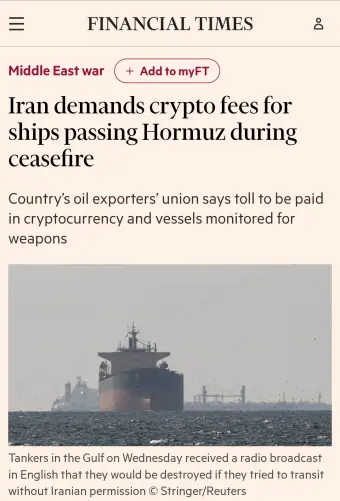
This is significant. For the first time, Bitcoin is placed on an equal footing with a state currency in an official sovereign toll system. And on this menu, it is the only option that no one can block:

Yuan — the natural choice for Beijing’s allies (China, Russia, Pakistan, India…). Convenient among allies, but subject to China’s goodwill.
💵 USDT / USDC — fast, stable. This synthetic dollar-denominated oil transit fee is actually Washington’s last card to prolong the petrodollar a little longer. It’s surprising, then, that Iran trusts the United States on this point—Tether and Circle can freeze any wallet at the mere order of the DOJ. False friend.

Bitcoin — elusive by design. No government, no company, no bank can block the transaction. Volatility is mitigated with a delta-neutral hedge (equivalent short position in derivatives), and speed is managed with Lightning.
In a world where sanctions are becoming the primary weapon, Bitcoin isn’t the only option—but it’s the only truly neutral one.





