
Crypto loves the idea that people are interchangeable once the code is live. That decentralization magically replaces leadership, that incentives self-organize, and that markets will somehow take care of themselves as long as GitHub stays active. It is a comforting myth and one that collapses the moment a founder steps away.
The Myth of “It Will Run Itself”
In reality, when a founder leaves, most projects do not fail loudly. They do not implode, don’t get rugged, don’t disappear from Twitter overnight. Instead, they continue, and that is precisely the problem. What follows is not collapse, but drift: slow, quiet, structural, and usually invisible to everyone except the market.
What Founders Really Do (That Never Shows Up in the Docs)
Founders are rarely just “visionaries” or “lead devs.” In early-stage crypto systems, they act as informal institutions. They hold together exchange relationships, market-maker contacts, early liquidity assurances, and the kind of trust capital that does not fit into governance proposals or Discord votes. These functions are never decentralized by default, and pretending otherwise is one of the oldest self-deceptions in crypto.
When that person exits, those responsibilities do not automatically distribute themselves across “the community.” More often, they simply vanish unless someone explicitly takes ownership. The code can keep running without friction. The market usually cannot.
The Silent Phase: When Nothing Breaks, but Everything Changes
This is where the pattern becomes interesting. Development continues. Updates are shipped. Roadmaps are refreshed. From the outside, everything still looks alive. But under the surface, liquidity begins to thin. Order books lose depth. Slippage increases. Selling stops being an action and starts becoming an event.
Liquidity never announces its departure. Market makers don’t write farewell posts. They simply step back when coordination weakens, and responsibility becomes unclear. At that point, language shifts. Liquidity becomes “organic.” Exits become “long-term.” And responsibility dissolves into abstraction.
Presearch as a Clean Case Study
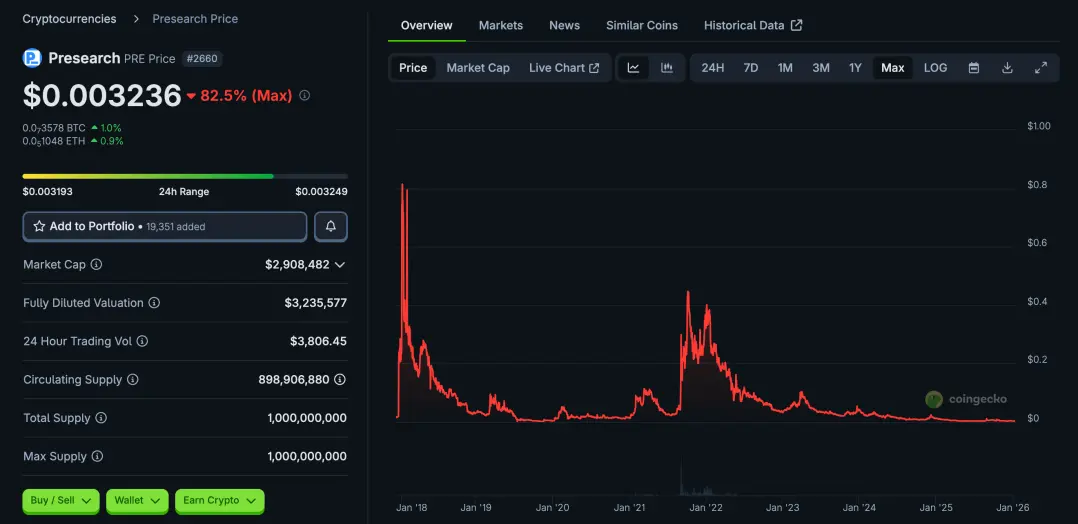
Presearch is particularly instructive because nothing dramatic happened. The founder, Colin Pape, sold the project and stepped away without scandal, and the team continued building. Web3 integrations, UI and UX improvements, node restructuring, regular updates; all of it kept moving forward.
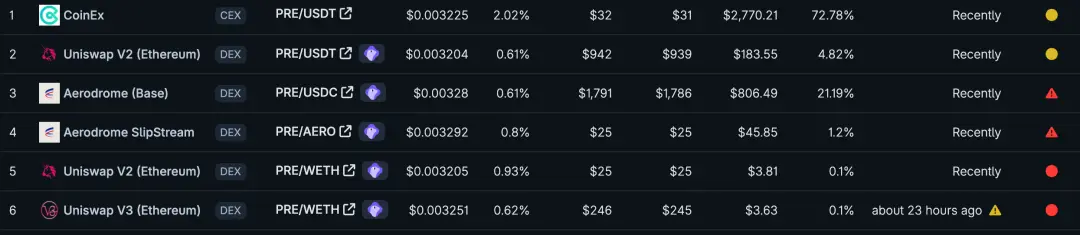
Yet over time, $PRE stopped behaving like a liquid reward token and started behaving like something else: a token that still exists, is still earned, still has a price, but can no longer be exited in practice without damaging its own market. Liquidity became thin enough that selling meaningful amounts defeats the point of earning them in the first place.
This did not happen because the product stopped improving. It happened because the financial layer was never reanchored after the founder's exit.
When “Community Liquidity” Becomes a Cop-Out
At this stage, many projects reach for the same answer: the community can provide liquidity. On paper, this sounds decentralized. In reality, it is a liability transfer. Users who earn rewards are, by definition, on the sell side. Asking them to also provide liquidity means asking them to absorb market-making risk, such as impermanent loss, price exposure, and capital lock-up, just to make the reward system function.
That is not empowerment. It is the outsourcing of responsibility.
Liquidity is infrastructure. Just like servers, nodes, or indexes, it requires ownership, coordination, and capital. When nobody explicitly owns it, it does not emerge organically. It disappears.
The Structural Lesson Most Projects Miss
The important point here is not that Presearch failed, nor that anyone acted in bad faith. The lesson is more uncomfortable: after the founder's exit, no explicit replacement for financial stewardship became visible.
The builder layer survived. The coordination layer did not.
This is a structural failure mode, not a moral one, and it will repeat itself across crypto as more projects age, founders step back, and “decentralization” becomes a substitute for accountability rather than its outcome.
My Final Conclusion
In short: Code Can Be Decentralized And Companies Can Be Sold, But Markets Can’t Be Abstracted Away.
Presearch is not a scandal. It is a mirror. It shows what happens when a project keeps building but forgets that tokens are not just ideas; they are markets. And markets do not care about roadmaps. They care about depth, exits, and responsibility.
If you are using Presearch for privacy or some other kind of ideology, that may be a perfectly rational choice. If you are treating $PRE rewards as income, however, you should be honest about what the market is telling you, not what the dashboard implies.
Crypto does not usually fail by explosion. It fails by evaporation.
If you are tired of “community-driven liquidity” and prefer crypto where exits do not require philosophical debates, you already know the drill:
Open an account on Binance, where liquidity is not a promise but a property. Trade assets that actually have order books behind them.
Followme on Publish0x and Medium for more crypto analysis that talks about structure, incentives, and market mechanics; not vibes, not hopium, not hamster wheels.
Because sooner or later, every crypto project learns the same rule: Liquidity is not a feature. It is the foundation.






