
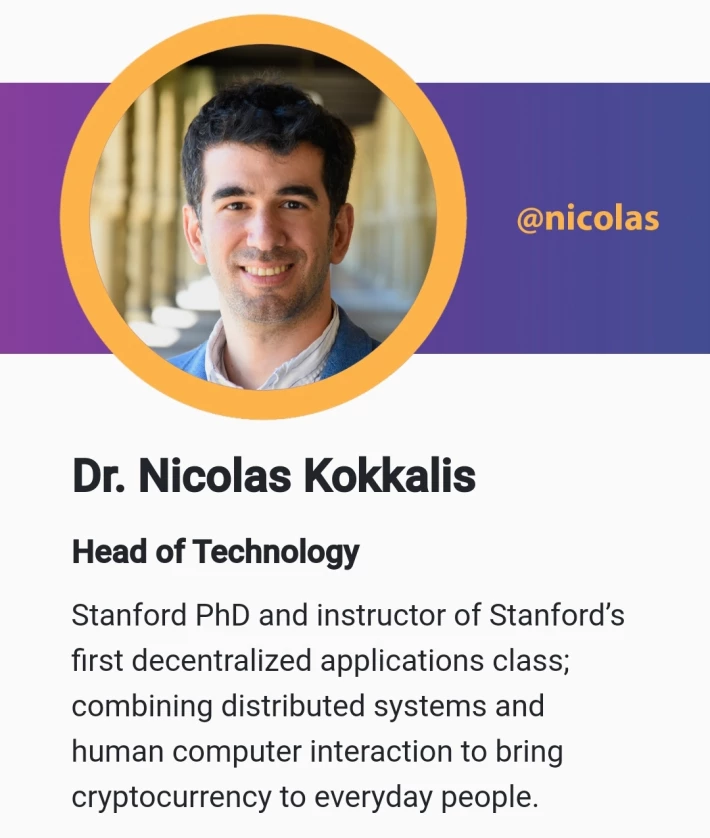
An interesting project which has been in Phase I for the last year or so. Pi is an interesting project developed by 3 Stanford Graduates who comprise the Core Team.


Phase 1 was basically adoption. They successfully recruited 3.5 million people to "mine" crypto from their phones. The mine is in inverted commas because it is actually just a simulation of mining. The actual mining is done on a computer, however it will be migrated to actual mining in Phase 3 when the network goes live.
We are currently entering Phase 2 where DApps will be developed for the Pi community and the testnet will be deployed. They will also introduce the ability to run computer nodes.
There are four roles Pi users can play, as Pi miners. Namely:
-
Pioneer. A user of the Pi mobile app who is simply confirming that they are not a “robot” on a daily basis. This user validates their presence every time they sign in to the app. They can also open the app to request transactions (e.g. make a payment in Pi to another Pioneer)
-
Contributor. A user of the Pi mobile app who is contributing by providing a list of pioneers he or she knows and trusts. In aggregate, Pi contributors will build a global trust graph.
-
Ambassador. A user of the Pi mobile app who is introducing other users into Pi network.
-
Node. A user who is a pioneer, a contributor using the Pi mobile app, and is also running the Pi node software on their desktop or laptop computer. The Pi node software is the software that runs the core SCP algorithm, taking into account the trust graph information provided by the Contributors.
Pi - Token Supply
Token Emission Policy
-
Total Max Supply = M + R + D
-
M = total mining rewards
-
R = total referral rewards
-
D = total developer rewards
-
-
M = ∫ f(P) dx where f is a logarithmically declining function
-
P = Population number (e.g., 1st person to join, 2nd person to join, etc.)
-
-
R = r * M
-
r = referral rate (50% total or 25% for both referrer and referee)
-
-
D = t * (M + R)
- t = developer reward rate (25%)
M - Mining Supply (Based on fixed mining supply minted per person)
In contrast to Bitcoin which created a fixed supply of coins for the entire global population, Pi creates a fixed supply of Pi for each person that joins the network up to the first 100 Million participants. In other words, for each person that joins the Pi Network, a fixed amount of Pi is pre-minted. This supply is then released over the lifetime of that member based on their level of engagement and contribution to network security. The supply is released using an exponentially decreasing function similar to Bitcoin’s over the member’s lifetime.
R - Referral Supply (Based on fixed referral reward minted per person and shared b/w referrer and referee)
In order for a currency to have value, it must be widely distributed. To incentivize this goal, the protocol also generates a fixed amount of Pi that serves as a referral bonus for both the referrer and the referee (or both parent and offspring :) This shared pool can be mined by both parties over their lifetime - when both parties are actively mining. Both referrer and referee are able to draw upon this pool in order to avoid exploitative models where referrers are able to “prey” on their referees. The referral bonus serves as a network-level incentive to grow the Pi Network while also incentivizing engagement among members in actively securing the network.
D - Developer Reward Supply (Additional Pi minted to support ongoing development)
Pi will fund its ongoing development with a “Developer Reward” that is minted alongside each coin that is minted for mining and referrals. Traditionally, cryptocurrency protocols have minted a fixed amount of supply that is immediately placed into treasury. Because Pi’s total supply is dependent on the number of members in the network, Pi progressively mints its developer reward as the network scales. The progressive minting of Pi’s developer reward is meant to align the incentives of Pi’s contributors with the overall health of the network.
f is a logarithmically decreasing function - early members earn more
While Pi seeks to avoid extreme concentrations of wealth, the network also seeks to reward earlier members and their contributions with a relatively larger share of Pi. When networks such as Pi are in their early days, they tend to provide a lower utility to participants. For example, imagine having the very first telephone in the world. It would be a great technological innovation but not extremely useful. However, as more people acquire telephones, each telephone holder gets more utility out of the network. In order to reward people that come to the network early, Pi’s individual mining reward and referral rewards decrease as a function of the number of people in the network. In other words, there is a certain amount of Pi that is reserved for each “slot” in the Pi Network.
The 3rd and Final Phase will be the live network (mainnet). By the time we reach Phase 3, Pi will have millions of users, DApps that can be used for various things including market places, DeFi and whatever else developers can conceive of. At that stage it will be listed on exchanges and have real world value.
If you're interested in joining this project, click on my invitation link:https://minepi.com/Pihole101 and use my username (Pihole101) as your invitation code.






