
As always, remember: Never invest money you can't afford to lose.
Do your own research. Browse my digital art.
The official release of the Web3 card/strategy game Blockchain Brawlers by Tyranno Studios is imminent. It's the most compelling new game I've played in years, and I strongly suspect it will be popular for livestreaming. I've had great fun streaming the beta version on my Twitch channel, which I invite you to check out here:
twitch.tv/NashvilleLou
The game itself is relatively simple at a glance. For PvP (Player vs. Player) mode in Blockchain Brawlers, you begin with a shared deck of 32 cards, four each numbered one through eight.
Each player provides eight deck cards, 1-8, with the game itself providing 16 more to make a full deck of 32.
Here's a visual to demonstrate how it works. In this mock-up, my opponent decided on all uncommon (green) cards, the CPU provided two rows of commons, and then my snazzy cards are on the bottom row. 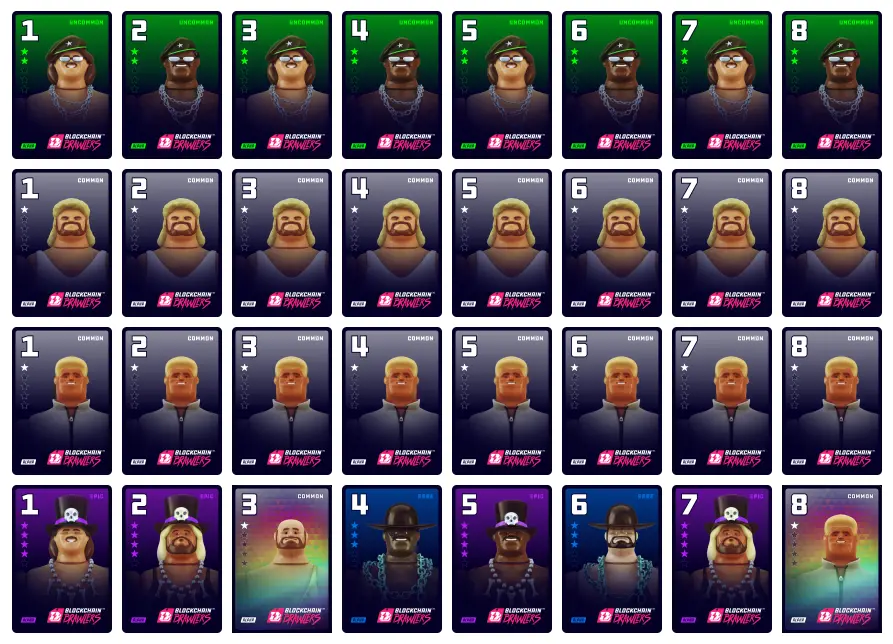
Note that card rarity provides no advantage in PvP mode. All that matters is the number on the card.
I'm using in-game images from the Beta 1.3.2 version for the examples below, so note that this might differ visually in some ways from the final release.
You start a match with 25 health points. To begin, each player receives three cards face-down from the shared pool of 32 and decides on two cards to play: the Set Up and the Slam. 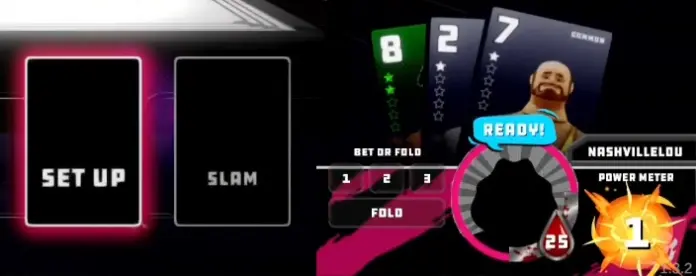
Your hope is that your two cards will combine to a higher total than your opponent's two cards. The order matters, as having a higher number for your Set Up card than your Slam card means you are Flexing.
If you win on a Flex, it doubles your Power Meter as a one-time boost for that round. But beware, as a Flexing hand (e.g. 8/3, 7/5, 4/1, etc.) always loses in a showdown to a Non-Flexing hand. 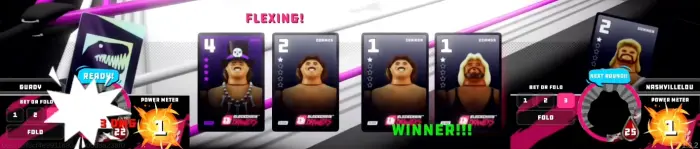
It makes me irrationally happy to win with a 1/1. The fun factor with this game is exceptionally strong.
Here are some screencaps from the first round of a match I had against Gurdy recently. From the deck of 32, I landed a pretty nice draw with 8-2-7.
I played 7/8 from that, with 7 as the Set Up card and 8 as the Slam card. 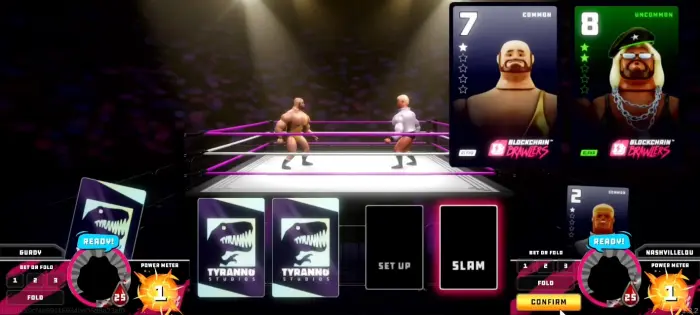
Playing 8/7 would've been very foolish, as I'd be taking a pair that wouldn't lose to anything but 8/8 and downgrading it to where I would lose to any Non-Flexing hand with minimal gain.
Frequently, when a good player decides to Flex in Round 1, it's with something like 6/3, 7/1, etc. The primary goal isn't the Flex -- it's sneaking a win with a 1 or a 3 for a Power Meter boost in Round 2.
Once both players decide (and you're on a timer, so don't doddle), the Set Up cards are simultaneously revealed face-up. 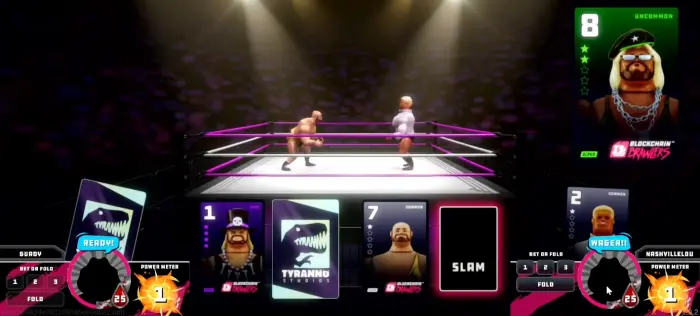
Each player then secretly decides whether to fold or bet 1, 2 or 3. If you bet a lower number than your opponent, you'd receive the option to either match the bet or fold.
The bet is essentially a multiplier for the Power Meter, which is a crucial element as that determines the damage delivered in a given round. The match begins with each player's Power Meter at 1. 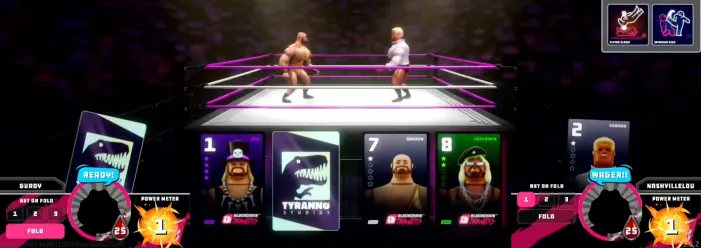
If you win a round, you gain a point on your Power Meter for the next round. If you win with a 1 and/or 3 played, you gain an additional two points to your Power Meter for the next round for each.
If you lose in a showdown, which is the term for when neither player folds in a round, your Power Meter resets to 1.
If you fold, while you end up taking damage (unless your opponent also folds), you protect your Power Meter and you don't have to reveal what you had as your Slam card.
You also gain an additional card for your next hand, an advantage you maintain for the rest of the match. That's true whether you fold immediately or bet a lower number and then fold.
At most, you can have six cards in your hand in a given round.
The easiest way to learn about Blockchain Brawlers is to watch someone else play. Here is a video I made of my series of nine matches against Gurdy, which includes live commentary from me that might be helpful for newcomers.






