If you're tired of trippy tokenomics, rebases, deflationary scams and other coin setups that never seem to work towards profitability, join the club. Defi is still very much in its experimental stage. A lot of people are trying a lot of things, and most of them are realizing that the market doesn't respond well to most of them.
Here's what I've found. You can have the most in depth pH.d. whitepaper in the world — if you ever see a chart that takes on this shape, the project is dead.
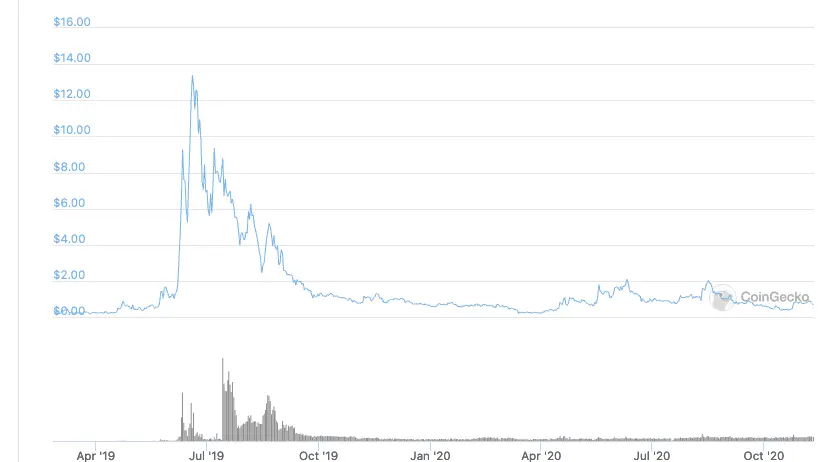
This chart is of a long-forgotten project that is still alive, but hardly making anyone any money. Regardless of tokenomics or slick marketing, the majority of failed crypto projects will produce a chart of this shape. Let's take a closer look at it.
The Initial Pump
You'll notice at the beginning of the chart around July 2019 that the coin begins to pump, achieving prices above US $13 from sub-$1 lows. This has to do with the initial hype of the coin. All crypto projects can achieve a modicum of attention because of the algorithms running many top apps. Big money players from ETH mainnet will always be willing to throw a few ether at a new project, because they know they can control the liquidity and leave as soon as the initial parabolic momentum starts to fade.
Initial pumps are also helped by the algorithms that run price discovery in most of crypto. The first few transactions for any project will usually be massively underpriced because of a lack of data for the algorithm to compute. As a result, coins with low volume (like the one above) can achieve huge initial pumps from whales who want to play on the limited supply.
The Quick Dump
After whales pump the coin into a place far above any presale price, they have the leverage to leave in profit any time they want. Most of the time, they do, dumping the coins they bought from the faulty algorithm on the heads of later investors. The sell pressure in this profit taking escapade is enormous, causing a dump that most coins cannot recover from. Otherwise legitimate projects can be ruined by bad tokenomics that do not account for whale dumpage or punish quick selling in some way.
Projects that are dumped quickly do not have the funding to market themselves in any substantial way. Regardless of the sophistication of the tokenomics, there is no project that can succeed for the current holders of an investment without new adoption. Without it, the project will go into the slow but predictable slide into oblivion.
The Slow Slide
During this phase, you will often see Telegram groups full of hopeful holders and admins promising that investors will be rewarded. It is essential to note the total number of holders and participants in the group, because people will begin lying about their participation at this point (people will begin to sell but say they are holding). Without an extraordinary use case or a huge marketing budget for YouTube shills, there is no way to ensure new adoption to counteract the selling pressure. As a result, the project begins to slowly fade.
The bottom line: Don't be fooled by long, drawn out whitepapers and promises of future use cases. If a project begins to take on this shape, it is usually best to exit that project as soon as possible. If you are not in profit, do not hold waiting for a comeback, because there probably won't be one. Get out and preserve your capital for a new project that has more promise, bigger marketing or a better use case.