
Good day everyone,
I hope you are all having a good day, welcome to CryptoGod-1's blog on all things crypto. In this post I will be looking at the market reactions following the announcement by Donald Trump that he is imposing 'reciprocal' tariffs on goods imported in the USA.
Trump Tariffs - Market Reacts
United States President Donald Trump announced his 'Liberation Day' 'reciprocal' tariffs on Wednesday, as markets around the globe reacted to the stunning news. Industries and historical geopolitical alliances alike have been rocked by the news, with a baseline 10% set on all imported goods with areas such as the European Union facing a 20% tariff. Trump claims it 'mirrors' half of each trading partner’s respective rate, although from the off it clearly does not take into account the differences between how taxes in the United States (Sales Tax which is applied on the consumer at the final point of sale) compared with the likes of Value Added Tax (VAT - which imposes a tax on each transaction during the supply chain). The fundamental fact that the USA does not impose VAT means much of the tariffs being imposed by Trump are not actually based on 'half' of what those countries tax the USA.
:max_bytes(150000):strip_icc()/Value-Added-Tax-bfc9359a52f74ae9a430d4c2d7ce91e2.jpg)
As stated by the White House:
"Reciprocal tariffs are calculated as the tariff rate necessary to balance bilateral trade deficits between the US and each of our trading partners. This calculation assumes that persistent trade deficits are due to a combination of tariff and non-tariff factors that prevent trade from balancing."
This oversimplifies the drivers of trade deficits and does not truly represent how international trade really works. Since the 1970s the USA have operated a deficit and in general these trade deficits balance over time. This is because they create a downward pressure on a country’s currency (as the result of demand for foreign currency, to buy imported goods, outstrips demand for domestic currency). As the USA sit at the top of the food-chain they have managed to run larger trade deficits than other nations would be able to. It is also important to understand that developing nations would not be in a position to purchase the expensive goods produced in the United States.
Anyway, ignoring pure common sense on how things work, financial markets have reacted to the news as cryptocurrency crashed further. With markets anticipating the implications for inflation, corporate earnings, and supply chains due to the new tariffs, Bitcoin fell towards the $81,000 mark and currently sits at $82,275.70 at the time of writing, according to CoinGecko. As Bitcoin dropped 3.9% the second largest cryptocurrency, Ether, dropped 5.2% in value.
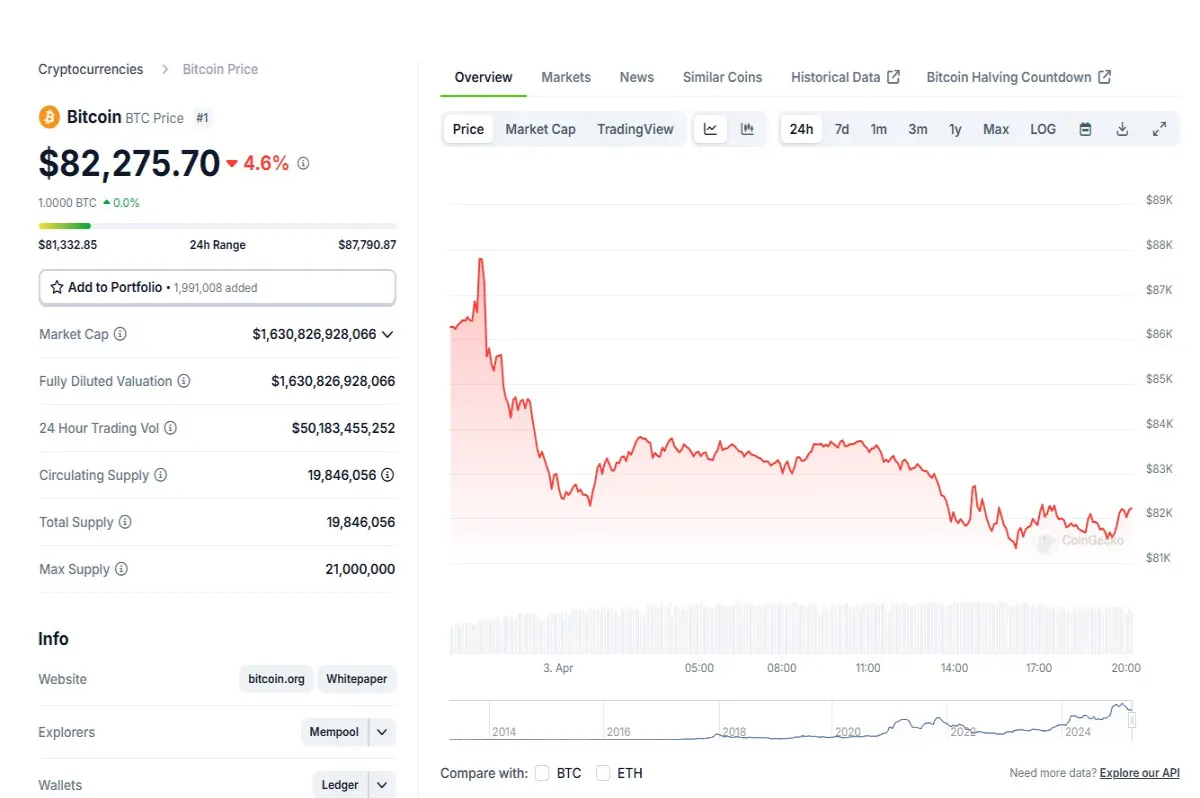
The Trump administration has signalled a willingness to embrace crypto and adopt a lighter regime compared to that of the Biden administration, his latest moves have had a negative impact on the market. With broader economic instability and a level of unknowingness growing globally regarding what Trump could do next, there is likely further bad times ahead for the crypto market.
In terms of stock trading, the S&P 500 and Dow Jones Industrial Average both dipped in pre-market trading while tech-heavy Nasdaq, with its exposure to global semiconductor supply chains, took a sharper hit. Gold continued to climb in value as investors have flocked back to the old safe heaven of investing.
Trump’s reciprocal tariff structure places heavy levies on imports from Cambodia (49%), Vietnam (46%), Bangladesh (37%), and China (34%), all of which are critical sourcing hubs for textiles, electronics, and consumer goods. Major companies such as sportswear giants Adidas and Nike have faced the fallout, while Tech reliant nations such as Taiwan (32%) with their semiconductor production market are watching the market nervously. In terms of automobiles it was Japan (24%) and the European Union (20%) which have been hit the hardest.

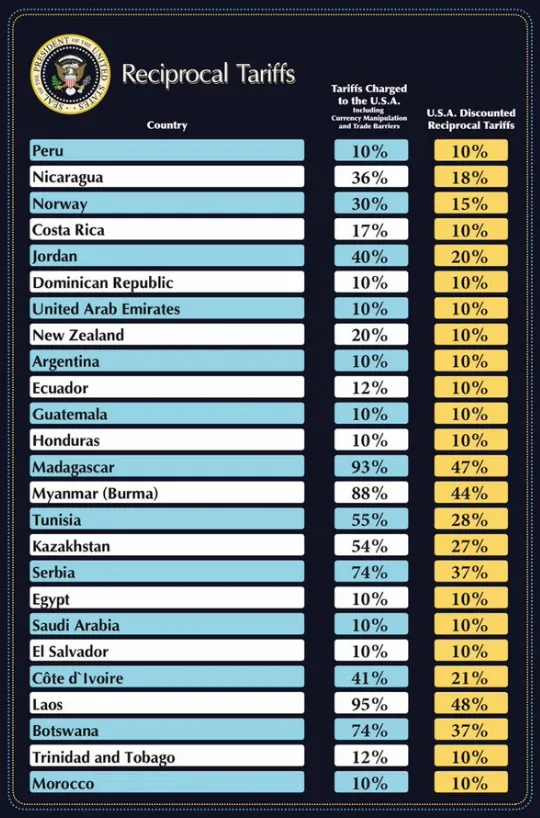
The crypto market will likely continue to feel the impact of Trump. Ben Kurland, CEO at crypto research platform DYOR, stated on the impact of the tariffs on the crypto market:
“Bitcoin moves at the intersection of narrative, liquidity, and leverage. Right now, it’s mostly trading like a high-beta macro asset, tracking real yields, rate expectations, and dollar strength. Yields pulled back, risk assets caught a bid, and bitcoin responded instantly. It’s not about crypto fundamentals today, it’s about global liquidity signals and positioning. When real rates dip and the dollar softens, bitcoin breathes.”
Have a great day.
Peace. CryptoGod-1.
Referral Links and Follow Me:






