
Good day everyone,
I hope you are all having a good day, welcome to CryptoGod-1's blog on all things crypto. In this post I will be looking at a recent operation to crack two Russian money laundering gangs which used cryptocurrency.
Operation Destabilise
The United Kingdom have announced they have cracked open multibillion-dollar money laundering networks which were reliant on cryptocurrency, as part of what is known as “Operation Destabilise.” The money laundering operation made use of crypto in an aim to conceal wealth and move money internationally. The “Operation Destabilise” was the brainchild of the UK's National Crime Agency (NCA) and managed to expose malicious actors “supporting serious and organized crime around the world.”
As part of the investigation and operation they managed to crack two Russian networks known as Smart and TGR. These networks played a major role in assisting traffickers and wealthy oligarchs move money and bypass restrictions. The investigators noted that the scheme involved fiat currency from drug gangs which was then converted into digital assets which had been stolen by cybercriminals in attacks and hacks.
This made the illicit funds much harder for crime agencies to trace and also reduced the flow of funds across international borders. The NCA stated that the use of crypto made the process a vicious cycle which meant gangs could purchase greater volumes of drugs and weapons without detection.
The NCA’s director general of operations Rob Jones stated:
“For the first time, we have been able to map out a link between Russian elites, crypto-rich cyber criminals, and drug gangs on the streets of the UK. We have identified and acted against the Russians pulling the strings at the very top, removing the air of legitimacy that enabled them to weave illicit funds into our economy.”
He went on to say that the investigation managed to cause widespread disruption to this criminal service and that over 80 arrests were made along with the confiscation of cash and crypto worth around £20 million (€24.2m). Along with this, the United States went on to sanction six individuals who were involved in the running of Smart and TGR. They included George Rossi, a Russia-born Ukrainian who heads TGR, and his Russian deputy Elena Chirkinyan and it means any property they own on American soil has been frozen.
The acting undersecretary for terrorism and financial intelligence at OFAC, Bradley Smith, stated:
“Through the TGR Group, Russian elites sought to exploit digital assets — in particular U.S. dollar-backed stablecoins — to evade U.S. and international sanctions, further enriching themselves and the Kremlin.”
The US Department of the Treasury’s Office of Foreign Assets Control (OFAC) went on to state that Tether (USDT) was the most common cryptocurrency used to avoid sanctions while laundering money, and that the overall network extended across more than 30 countries. Both the Smart and TGR networks aided Russian ransomware groups to launder ill-gotten gains and it is estimated they managed to launder in excess of £27m ($34m) from 149 victims in the U.K. alone.
One of the ransomware used was Ryuk, which encrypted data on infected systems and held it hostage until cryptocurrency was paid. This ransomware was used to target organisations rather than individuals, which included hospitals around the globe. This meant that some medical facilities were unable to provide critical care for their patients. Along with hospitals places such as schools and businesses were also impacted. The NCA stated:
“This activity has also been extremely costly to the networks, who are assessed to operate on very low profit margins – often charging as little as 3% commission for the amount laundered. Based on this figure, they would need to launder around £700m for free to pay back the £20m seized by the NCA and partners.”
There were also allegations that the Russian crypto exchange Garantex was involved with both money-laundering networks involved in Operation Destabilise. There are wider concerns that the recent changes to the country’s crypto legislation could also be used to evade sanctions after there had been tighter restrictions initially imposed following Vladimir Putin’s invasion of Ukraine.
A British security minister, Dan Jarvis, described the NCA’s sting as “a significant step against economic crime.” He added:
“Op Destabilise has exposed Russian kleptocrats, drug gangs and cyber criminals — all of whom relied on the flow of dirty money. Illicit finance inflicts immense harm around the world and this major global operation marks a significant step against economic crime. The UK and its allies will continue to work together to crack down on illicit finance and the criminality it enables."
The UK worked with law enforcement agencies from the US, France, Ireland and the United Arab Emirates (UAE) as part of this operation. However, the world of organised crime is ever developing and when money-laundering networks, darknet markets and ransomware strains are taken down a new one often appears in its place. During bull market the bad actors become especially active and emboldened. While it adds to the notion that cryptocurrency is a dangerous 'Wild West', it does not acknowledge how on-chain investigations orchestrated by the likes of Chainalysis bring the flow of illicit crypto funds into the open. This is a level unmatched elsewhere in any form of finance, especially cash. Below is an intricate graph by Chainalysis that show the connections between service providers, intermediary wallets and the addresses relied on by linchpins in this operation.
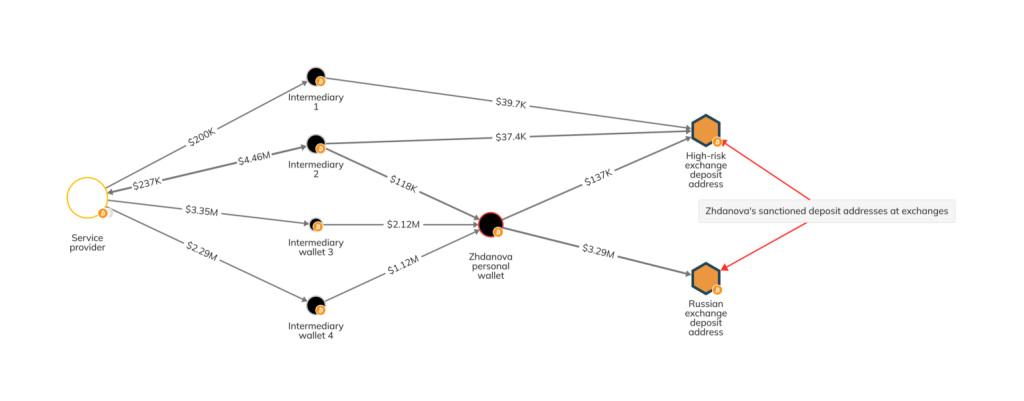
It estimates that just 0.34% of total on-chain transaction volumes in 2023 were linked to crypto crime. This gives a clear view on just have small the number of illicit actions takes place in crypto, but Operation Destabilise shows digital assets still hold appeal for money launderers, drug kingpins and gangs concealing vast wealth.
With the details of Operation Destabilise being published last week, it come after Transparency International, a movement which aims to stop corruption, warned the British government that it must turn its attention to shell companies in British Overseas Territories. This came as they warned them to stem the flow of dirty money into UK shores. An analysis by Transparency International UK found that £5.9 billion (€7.1bn) worth of suspicious money had been spent on UK properties via firms which are registered in British Overseas Territories.
Below is a video from YouTube which outlines the details of Operation Destabilise.
Have a great day.
Peace. CryptoGod-1.
Referral Links and Follow Me:






