
Ethereum 2.0 (or Serenity) is scheduled for January 3, 2020, many have wondered what they have to do to "migrate" their Ether, the truth is that we must not be alarmed because as far as we know now, we will not have to do anything.
Ethereum 2.0 "Serenity" is the most ambitious upgrade on which the Ethereum community aims to achieve the high degree of scalability necessary to make Ethereum usable in a widespread manner and in large quantities.
Currently, Ethereum processes a few dozen transactions per second, far from the tens of thousands of transactions per second required for a wide-scale diffusion and use.
Over time, it was realized that the target scaling was not achievable through the classical blockchain model, ie the one in which each node takes care of all the functions.
To achieve the goal of high scalability, the community is focusing on the Ethereum 2.0 project. The latter, more than an Ethereum upgrade, constitutes a real change.
Ethereum 2.0 will be a "multilayer" platform, therefore with a high level of complexity.
The Ethereum 2.0 mainnet will focus on the Sharding scalability solution. This will be combined with second-level solutions, such as Plasma, and the combination of key projects to obtain a Proof of Stake (PoS) consent mechanism.
In other words, there will not only be the "simple" blockchain model, understood as a chain of blocks that include transactions.
The blockchain will become a base layer for dApps built on its second level sidechains. The dApps will maintain the security of the Ethereum protocol, but will operate independently to avoid network congestion.
Due to its complexity and multi-level structure, Ethereum 2.0 will not be released in a single solution. Here you can take a look at the phases of Ethereum 2.0.
Ethereum 2.0 will consist mainly of the "Beacon Chain" (phase 0), the Shard Chains (phase 1) and the layer that will be used for the execution of contracts and transactions, based on eWASM (phase 2).
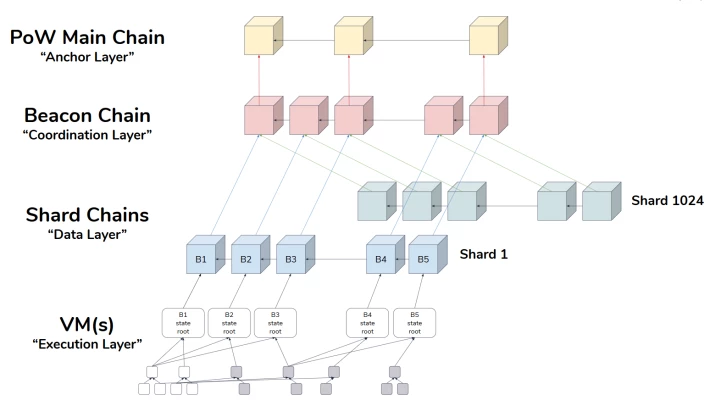
The blockchain we are currently using (the PoW Chain) will continue to operate mainly as today, at least in the early stages of Ethereum 2.0.
The first piece of the Ethereum 2.0 puzzle will be the Beacon Chain. The Beacon Chain can be considered as the "conductor" of the entire structure.
It is a coordination layer. Its function is to provide a source of "randomness" to the rest of the system, particularly in the management of PoS, both for itself and for the Shard Chains.
Shards and EVMs on shards will arrive only in successive phases, around 2020 and 2021 (purely indicative). Therefore, at first, the Beacon Chain will be the only component of Ethereum 2.0.
What does it mean for ether and smart contracts?
The ether on the Beacon Chain: what changes?
In the absence of the remaining part of the underlying infrastructure, the very first iteration of the Beacon Chain will be very simple. It will therefore not support accounts, asset transfers and smart contracts.
It means that the ether on the Beacon Chain, at least until phase 2, cannot be moved. Therefore, for example, it should not be possible to transfer them to trading exchanges.
The next question is: how will the ether be generated on the Beacon Chain? There are 2 ways.
First of all, it must be considered that the Beacon Chain will be based on the PoS consent algorithm. So, first of all, the ether (here called "BETH") will be created as a reward for the validation activity (only of the Beacon Chain, first, and of the Shard Chains then, when they will be implemented in phase 1).
Furthermore, a ether transfer mechanism is provided from the current PoW blockchain to the Beacon Chain.
If you want to become a validator on the Beacon Chain, you will have to send your ether (minimum stake 32 ether) to a smart contract. For each "deposited" ether you will receive a corresponding amount of BETH.
The peculiarity, however, lies in the fact that the smart contract to which the ether must be sent does not have a withdrawal function. Who is more technical, can view here the specifications of the smart contract of registration of the validators.
It means that once you "transfer" your ether to the Beacon Chain, there will be no way to make them go back to the current PoW mainnet, at least in the first phase that does not include the implementation of the shards and the possible inclusion of the PoW Main Chain in the Ethereum 2.0 shards structure.
In other words, the transfer of ether to the validator registration contract essentially determines the burning of the ether itself.
The difference between BETH and ETH will be in the fact that those who own the dairy will still have the faculty of choosing about the "transformation" in BETH, as well as The reasons for this are the reasons why.
As a result of the BETH, during the period of the Beacon Chain, it is plausible that, in the event of high demand, exchanges will be carried out on the lines of what has been done in advance of hard forks that would have led to the creation of a new currency.
And the price of BETH?
The ether must be "deposited" in the appropriate smart contract of registration of the validators. Apparently, however, it will not be possible to take back the deposited ether.
BETH will be linked to 1 ether in a unidirectional process of "financing" of the Beacon Chain, with the consequence that BETH could never have higher price than ether, while it could have a lower price.
Conclusions
Who will then move his ether to the Beacon Chain, in the early stages where they will not be transferable?
Considering that to start it at least 524,288 ether will be necessary, plausibly, the core developers and the Ethereum foundation will provide for it.
But it cannot be ruled out that even simple users will decide to transfer only a minimum portion of their ether to begin to become familiar with the activity of staking and validating the PoS protocol, in addition to the opportunity to immediately obtain a return from the own ether in stake.
Ethereum 2.0 will be a completely different system than Ethereum. However, the two structures will continue to exist in parallel for years and with widely different functions.
It is useful to recall, once again, that at the moment nothing must be done. The path towards the finalization of Ethereum 2.0 will be long and, probably, not exempt from program changes.
The best strategy to adopt, for those looking at ether from an investment perspective, will have to be weighted as the situation evolves and more specifications emerge.
Etherevolution will continue to provide updates during the dissemination of news on the evolution of the Ethereum scaling roadmap.






