
For more than fifteen years, one of Bitcoin’s greatest mysteries has remained untouched: the enormous fortune believed to belong to Satoshi Nakamoto.
No message. No movement. No signature. Nothing.
Those early coins have become almost mythological. They are not just a pile of Bitcoin. They are a symbol of the network’s origin, its creator’s disappearance, and the strange trust that holds the system together. But now, a new question is starting to disturb that silence.
What if Satoshi’s coins do not move because Satoshi is gone?
And what if, one day, a quantum computer can move them anyway?
That is the unsettling debate reopened by Binance founder Changpeng Zhao, better known as CZ. His suggestion is simple in appearance but explosive in practice: if Bitcoin eventually migrates to quantum-resistant cryptography, and if Satoshi’s coins remain unmoved after a public warning period, should the network freeze them before a future quantum attacker can steal them?
It is one of the most uncomfortable questions Bitcoin has ever faced.
Because protecting Bitcoin may one day require violating one of its deepest principles.
Why Satoshi’s Coins Suddenly Matter Again
Satoshi Nakamoto’s presumed Bitcoin holdings have always fascinated the market.
They are estimated at around one million BTC, mined during Bitcoin’s earliest days, when almost nobody was paying attention. These coins have never moved, which has created endless speculation. Maybe Satoshi is still alive and simply refuses to touch them. Maybe the keys were destroyed. Maybe the creator of Bitcoin died. Maybe the coins were intentionally abandoned as a final gift to the network.
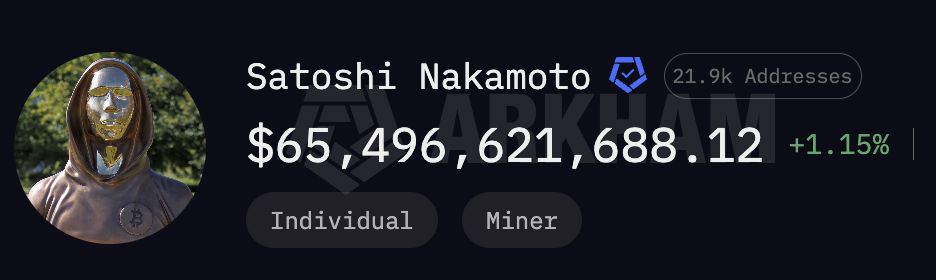
No one knows.
For years, that silence was comforting. It meant Satoshi was not selling. It meant the creator was not interfering. It meant Bitcoin had outgrown its founder.
But quantum computing changes the meaning of dormant coins.
Bitcoin does not store coins inside wallets in the way people imagine. It uses cryptographic locks. To spend BTC, a user must prove control of the correct private key. Today, that system is effectively impossible to break with normal computers. But a sufficiently powerful quantum computer could, in theory, derive a private key from an exposed public key.
That is where old Bitcoin addresses become sensitive.
Some early Bitcoin outputs used formats where the public key is visible on-chain before the coins are spent. Other coins become exposed when users reuse addresses or spend from certain types of wallets. Once the public key is known, a future quantum attacker could have a target.
This does not mean Bitcoin is about to be hacked tomorrow. The required machines do not exist yet at the necessary scale. But the threat is no longer treated as science fiction by serious researchers. It is a long-term risk with real technical foundations.
And Satoshi’s coins sit right at the center of that risk.
If they are truly abandoned, they cannot migrate to quantum-safe addresses.
That makes them symbolic, valuable and potentially dangerous.
CZ’s Provocation: Freeze the Coins Before Someone Else Takes Them
CZ’s idea is not that he can personally freeze Satoshi’s Bitcoin. He cannot. No exchange founder, miner, developer or company has that power over Bitcoin.
His point is different.
He is asking whether the Bitcoin community should eventually consider a protocol-level rule: after a future quantum-resistant upgrade, users would be given a migration window. Anyone still controlling their old coins could move them to safer addresses. But after that window closes, coins that remain in vulnerable legacy formats could become unspendable.
In theory, this would prevent a quantum attacker from claiming abandoned Bitcoin.
In practice, it would be one of the most controversial changes in Bitcoin history.
Supporters would argue that freezing vulnerable coins is not theft. The coins would not be transferred to developers, miners, governments or any third party. They would simply become inaccessible. From that point of view, the goal is not confiscation. It is damage control.
The alternative could be worse.
If a quantum-capable actor suddenly gained access to millions of dormant or exposed BTC, the economic shock could be enormous. Those coins might be sold, used as collateral, moved through exchanges, or weaponized to damage confidence in Bitcoin. Even if the protocol itself continued working, the market could panic.
The argument for freezing is therefore defensive: better to permanently neutralize vulnerable coins than allow them to be stolen by whoever wins the quantum race first.
But the counterargument is just as powerful.
Bitcoin’s value is built on strict property rights. If you have the keys, you own the coins. If the network can decide that some coins are too risky to remain spendable, then Bitcoin begins to look less absolute. A door opens. And once that door exists, people will ask where it closes.
Today it might be Satoshi’s unmoved coins.
Tomorrow, critics warn, it could be sanctioned coins, hacked coins, politically controversial coins or coins judged “too dangerous” by some future majority.
That is why CZ’s suggestion exploded into debate.
It is not really about Satoshi.
It is about whether Bitcoin should ever choose security over immutability.
3. The Quantum Threat Is Real — But Often Misunderstood
The phrase “quantum threat” is easy to sensationalize.
It makes people imagine Bitcoin’s entire blockchain collapsing overnight. That is not the most realistic scenario.
Quantum computers would not simply rewrite Bitcoin’s history. They would not automatically break proof-of-work mining or change old blocks. The more serious risk is narrower: digital signatures.
Bitcoin relies on elliptic curve cryptography to prove ownership. If a quantum computer becomes powerful enough to break that cryptography, then coins protected by exposed public keys could become vulnerable. The attacker would not need to guess a seed phrase. They would mathematically derive the private key.
That is terrifying, but it is also specific.
Coins whose public keys remain hidden behind hashed address formats are less immediately exposed until they are spent. Coins in old formats, reused addresses, Taproot-style exposed-key situations, and dormant early outputs may face higher risk. The danger is not evenly distributed across the network.
This is why the solution is also complicated.
Bitcoin cannot simply “turn on” quantum resistance with a software update and call it done. Wallets must change. Hardware devices must support new cryptographic schemes. Exchanges must migrate funds. Users must move coins. Developers must agree on standards. Miners and nodes must accept new rules. And all of this must happen without breaking the conservative culture that makes Bitcoin trusted in the first place.
That is the real bottleneck.
The technology may be solvable. The governance may be harder.
Post-quantum signatures already exist. Researchers have explored multiple paths for making blockchains safer against quantum attacks. But Bitcoin is not a normal software platform. It does not have a CEO. It does not move quickly. It upgrades only when the ecosystem broadly agrees that the change is necessary and safe.
That caution is part of Bitcoin’s strength.
It may also become a weakness if the quantum clock starts ticking faster than expected.
4. The Impossible Choice: Protect the Network or Preserve the Myth
Satoshi’s coins create a unique moral problem.
If Satoshi is alive and still controls the keys, then freezing those coins would be a violation of property rights. The creator would be forced to move, reveal activity, or lose access to a fortune that is rightfully theirs.
If Satoshi is gone, then leaving the coins spendable could allow a quantum attacker to seize them one day. That would not restore ownership. It would transfer one of the most important dormant fortunes in history to whoever owns the first sufficiently powerful machine.
Neither option feels clean.
This is why some developers and researchers are exploring more subtle solutions. One idea is to let old holders privately prove control of vulnerable addresses before quantum computers become dangerous, without publicly moving their coins. Later, if vulnerable addresses are frozen, those holders could use a quantum-resistant proof to reclaim access.
That kind of approach tries to solve the Satoshi problem without forcing Satoshi to wake up.
But even this has limits. If the real owner never creates the proof, no system can save the coins later. You cannot retroactively prove control of a private key after that key has become vulnerable or lost.
At some point, Bitcoin may have to choose between imperfect options.
That is what makes this debate so important. It is not a simple technical upgrade. It is a philosophical test.
Bitcoin was designed to remove trust from money. But quantum computing may force the community to decide which trust assumption matters most: trust that valid coins can always be spent, or trust that no attacker should be allowed to loot the past with future technology.
There may be no answer that satisfies everyone.
The Mystery at the Heart of Bitcoin
Satoshi disappeared, and Bitcoin survived.
That absence became part of the network’s power. No founder to obey. No central authority to pressure. No living creator to change the rules.
But the same silence now creates a dilemma.
If quantum computing eventually threatens exposed keys, Satoshi’s unmoved coins may become the most important test case in Bitcoin’s history. Freeze them, and Bitcoin proves it can defend itself — but at the cost of breaking a sacred rule. Leave them alone, and Bitcoin preserves its purity — but risks letting the first quantum attacker claim the creator’s ghost fortune.
For now, the threat remains distant enough to debate calmly.
But not distant enough to ignore.
The million coins are still sleeping.
The question is whether Bitcoin should let them wake up.






