

If you want more cryptocurrency analysis, including full-length research reports, trading signals, and social media sentiment analysis, use the code "Publish0x" when subscribing to CryptoEQ.io to make your first month of CryptoEQ just $10! Or simply click the button above!
The market share for stablecoins in the crypto economy has skyrocketed since 2020, surpassing $145 billion in total market cap. However, not all stablecoins are created equal. There are several different approaches projects have taken to keep their stablecoin “stable.”
By far, the easiest approach (and therefore most popular) is backing a crypto stablecoin 1:1 with fiat dollars (or equivalent) in a bank. This is the approach market leaders USDT and USDC have taken. For every one USDT in circulation, there's $1 (or dollar equivalent) in reserves with the Tether parent company. There are also stablecoins like PAXG backed by the equivalent amount in gold. While these are the current market leaders, fiat-backed stablecoins inherit all of the issues that come with fiat plus require trust in a centralized custodian. This isn't exactly the revolution crypto promised!
Because of this, over-collateralized stablecoins, such as DAI and others were created. These stablecoins are over-collateralized with another cryptoasset (usually at a ~2:1 ratio), ensuring you can always redeem one unit of their stablecoin from the collateral’s value. If the collateral’s value drops below the liquidation level (varies depending on the protocol), the collateral is sold to ensure no losses are sustained. While these stablecoin solutions generally hold their peg, they can suffer in times of high volatility due to cascading liquidations.
 Source: Chain Debrief
Finally, algorithmic stablecoins—which have been around for years but only really began gaining adoption after 2020—use algorithms to control the stablecoin peg and the underlying tokenomics. Generally speaking, algorithmic stablecoins are run by pre-programmed smart contracts that execute specific actions to maintain the peg. They usually exhibit some or all of the following properties:
- No outside collateral backing the token
- Partially/fully collateralized by a native token
- Floating peg (e.g., RAI)
Competitive Advantage
USDT, formerly known as “RealCoin,” was released in 2014 as one of the earliest stablecoins created and today is the most widely used. All coins are issued by the associated company Tether Limited which notably has the same founders as Hong Kong-based exchange Bitfinex. It’s become blockchain-agnostic, having been deployed on nine public blockchains, including Algorand, EOS, Ethereum, Bitcoin (Liquid & Omni), Bitcoin Cash, Tron, OMG Network, and most recently, layer-one Ethereum competitor Solana. Hypothetically, it could also launch on Bitcoin’s scalable layer-two network, Lightning, as it’s rumored Tether has contributed undisclosed funding to Lightning’s issuance protocol RGB.
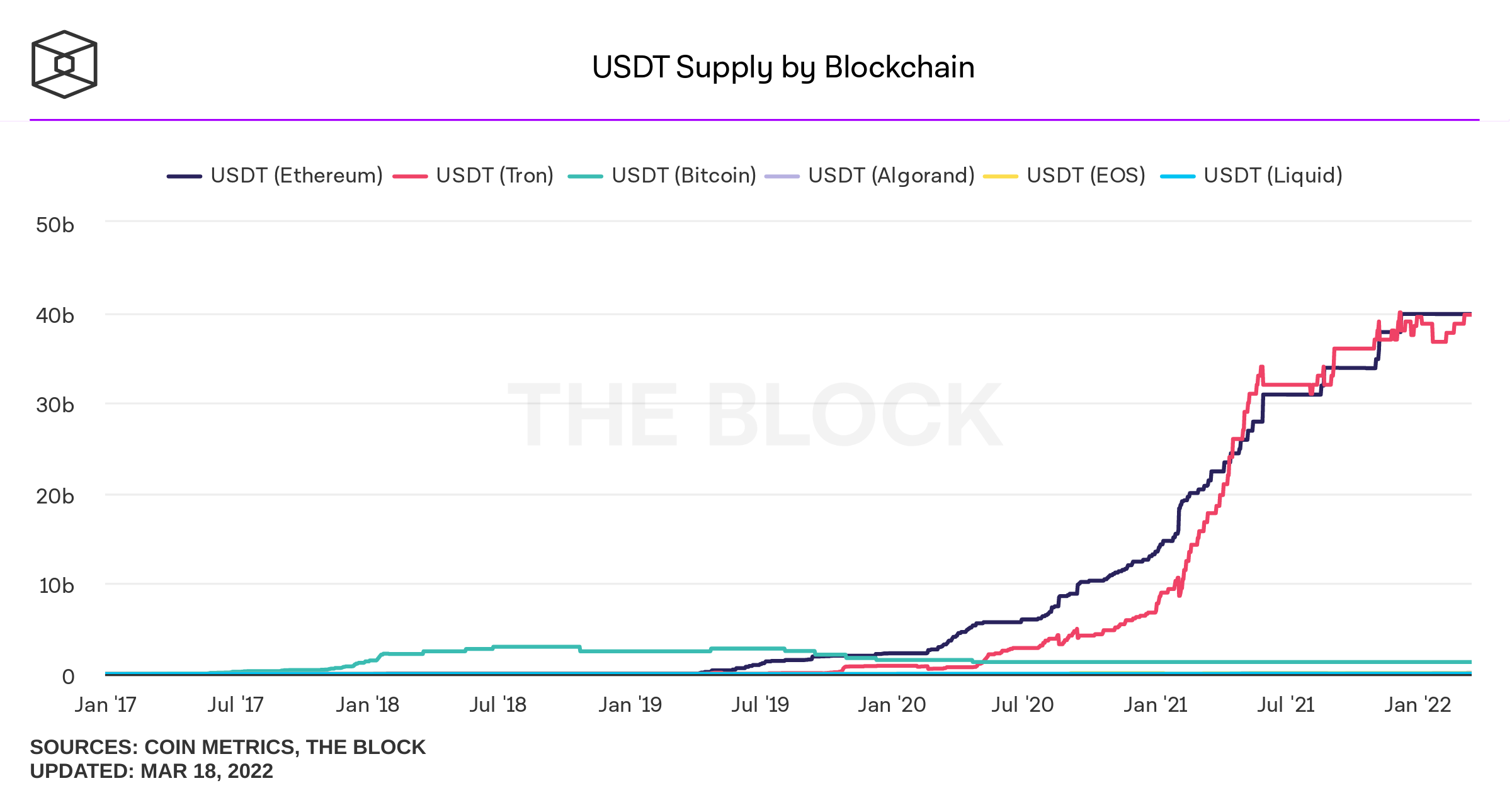 Distribution of USDT on several blockchains.
A cash-equivalent digital currency (especially one tracking the world’s reserve currency) enables investors to curate more complex trading strategies and developers to create more complex financial applications. While USDT has centralized and decentralized stablecoin competitors in USDC and DAI, relative trading volume has indicated USDT is entrenched in the broader market beyond its adoption as a first-mover. Thus, its greatest competitive advantage is perhaps its liquidity. Being highly available (listed on exchanges and public blockchains) and mostly maintaining its dollar-peg over time has proved its safety and depth to speculators, merchants, and hodl-ers alike.
Challenges to Adoption
The largest hurdles for USDT are legal compliance and trust from the industry. While USDT has proved product-market fit with users, it has struggled to maintain banking relationships and accrue confidence from government officials. USDT (collectively on Bitcoin, Ethereum, Tron, EOS, Algorand, and other blockchains) has a circulating supply of over $65 billion, despite Bitfinex’s legal issues and a fraud dispute involving Tether with the New York State Attorney General’s office in April 2019. Despite the legal issues, Tether’s market cap swelled beyond $60 billion this year, more than 5x where it started. Some clarity came to this legal matter in February 2021 when Tether and Bitfinex reached a settlement with the New York Attorney General’s Office. Under the terms of the settlement, Tether did not have to admit any wrongdoing but did pay an $18.5 million fine. The investigation took over two and a half years, and for Tether to come out of the matter with only a small fine can only be viewed as a win for the project. The settlement resolved the allegations about the $850 million loan Tether made to Bitfinex when Bitfinex was having issues accessing funds. The loan was repaid early and in full, including interest. At no point did the loan impact Tether’s ability to process redemptions.
Furthermore, the spirited cryptocurrency community originally sought to disintermediate institutions and remove trust in third parties. Taking the opposite approach, Tether requires trust as a centralized institution to maintain proper reserves and issue new supply responsibly. Although rival stablecoin, USDC, is also centralized, it has far fewer legal troubles than USDT. Because of this stellar reputation, USDC is quickly becoming the preferred stablecoin in the Ethereum DeFi ecosystem and has taken market share away from USDT all of 2021.

 USDT Ethereum stablecoin market share. Source: Glassnode





