
You are reading an excerpt from our free but shortened abridged report! While still packed with incredible research and data, for just $20/month you can upgrade to our FULL library of 50+ reports (including this one) and complete industry-leading analysis on the top crypto assets.

Becoming a Premium member means enjoying all the perks of a Basic membership PLUS:
- Full-length CORE Reports: More technical, in-depth research, actionable insights, and potential market alpha for serious crypto users
- Early access to future CORE ratings: Being early is sometimes just as important as being right!
- Premium Member CORE+ Reports: Coverage on the top issues pertaining to crypto users like bridge security, layer two solutions, DeFi plays, and more
- CORE report Audio playback: Don’t want to read? No problem! Listen on the go.
This article is one portion of a longer look into Bitcoin DeFi. In this short piece, we will discuss the Lightning Network, Taro upgrade, stablecoins on Bitcoin, and more!
Lightning Network (LN)
The LN has grown drastically since its inception. Currently, the Lightning channel capacity has crossed $100M and continues to hit all-time highs as measured by BTC locked in public Lightning channels. It is also worth mentioning that roughly 30% of channels are private, meaning the true value of the network is likely to be understated by current metrics.
With 17,000+ active nodes and over 5,000 BTC deposited into the network, the trajectory of the network is promising. Using the LN becomes easier as the network grows, and since the start of 2021, the number of LN channels has increased from about 12,000 to 90,000. What’s even more encouraging is the amount of companies and services building upon the LN. (3+4+6)
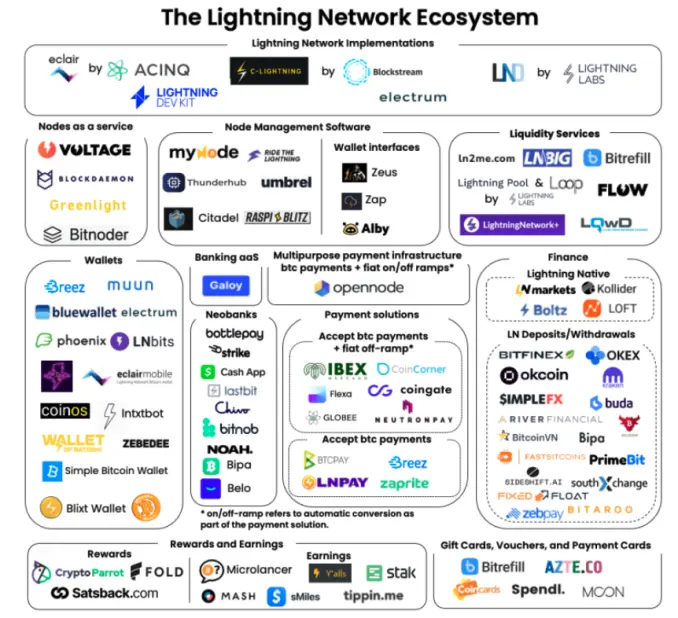
Bitcoiners have a copious amount of options when it comes to interacting on the Lightning Network. Companies like Casa, Lightning Labs, and Umbrel allow users to run their own Lightning node. Users can also choose from a full range of Lightning wallet solutions such as Muun, Bluewallet, and Strike. Widely considered to be the most popular LN service, Strike is an app that enables users to transact on the Lightning Network with a USD bank account. With Strike, users could pay in bitcoin without being exposed to volatility/tax liabilities or in fiat without taking exposure to BTC. This results in speedier settlement times and lower fees. Strike has shown strong signs of growth over the years given their partnerships with big names such as Shopify, NCR, BitPay, and Robinhood.
Taro
The latest improvement to the Lightning technology stack is the proposed Taro upgrade, made possible by the Taproot soft fork. Introduced by Lightning Labs in April 2022, Taro aims to allow Lightning users to send stablecoins and other assets over the LN at virtually zero cost. As of Q3 2022, Taro is still in the implementation process. So far, analysis conducted on Taro and the LN as a whole has concluded that Taro will effectively serve as a tool to remove taxable events from Lightning Network transactions. By leveraging the fiat-to-bitcoin-to-fiat payment railway, those in developing nations with high inflationary pressures or inefficient banking resources could utilize Taro to facilitate global payments with no tax implications.
So how does Taro work? Taro does not have its own blockchain as it is a protocol that is tied down to Bitcoin’s base layer. Taro assets can be considered Bitcoin UTXOs that exist within a Bitcoin Taproot UTXO. However, a lot of the data that make up a Taro asset is off-chain; only the hash of this data is committed to the Bitcoin base layer. Bitcoin essentially acts as a publication system enabling an embedded consensus for the Taro protocol. The off-chain data that makes up a Taro asset consists of the Taro signature, the Taro sparse-Merkle sum tree, and the Taproot tree. To create one or more Taro assets, a single on-chain transaction is required. All off-chain data is signed and only the Taproot script tree’s root is committed onto the blockchain. This on-chain root can be verified by relevant parties that are involved in the asset exchange against the root’s off-chain data for the Taro asset in question. This is how one can establish proof that off-chain Taro data/specifications are correct. (5)
In the midst of this bear market, the future use cases of Taro, the LN, and Bitcoin shine bright. The European Central Bank (ECB) has even gone as far as to identify Bitcoin and the Lightning Network as strong competitors in the global cross-border payments market in its latest Q3 2022 report on the subject. The ability to exchange stablecoins over the Lightning Network gives the entire network more utility and further solidifies the fundamental Bitcoin peer-to-peer network as usable on a global scale. As of 2022, the global cross-border payments market is valued at above $37 trillion. Cross-border payments have long been inefficient and costly, remaining a largely unsolved problem. Lightning certainly appears to have the foundation to address this striking issue on top of providing a host of DeFi solutions as a Bitcoin L2. But despite the high level of optimism surrounding its projects, there are still notable drawbacks to the Network.
Whether or not Bitcoin-based DeFi projects will achieve success remains up for debate. But the fact is, there are many Bitcoin holders that continue to crave these solutions. The Lightning Network is an important step, but only suitable for payments at the moment. In order to unlock activities such as borrowing, lending, and staking…one must explore more general-purpose protocols that offer smart contract capabilities on top of Bitcoin.





