You are reading an excerpt from our free but shortened abridged report! While still packed with incredible research and data, for just $20/month you can upgrade to our FULL library of 50+ reports (including this one) and complete industry-leading analysis on the top crypto assets.

Becoming a Premium member means enjoying all the perks of a Basic membership PLUS:
- Full-length CORE Reports: More technical, in-depth research, actionable insights, and potential market alpha for serious crypto users
- Early access to future CORE ratings: Being early is sometimes just as important as being right!
- Premium Member CORE+ Reports: Coverage on the top issues pertaining to crypto users like bridge security, layer two solutions, DeFi plays, and more
- CORE report Audio playback: Don’t want to read? No problem! Listen on the go.
Primary Use Case
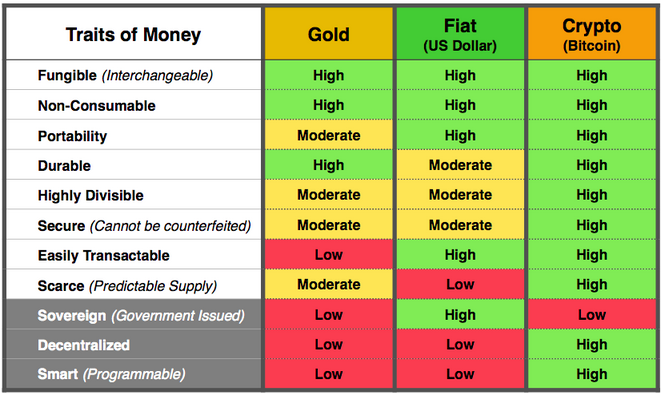
Bitcoin eliminates many of the problems and inefficiencies created by the traditional financial system: intermediaries, unnecessary fees, settlement times on the order of days, currency debasement, corruption, and the inevitability of fraudulent transactions. How does it solve for all that? By exhibiting these qualities and traits:
- Decentralized: There is no central entity that can censor transactions, charge fees, alter the existing rules, or be attacked/extorted by bad entities. There is no Federal Reserve of Bitcoin to manipulate the money supply. There is no board of directors that can decide to charge higher fees. There is no CEO to sue. Bitcoin is P2P and open-source software, like BitTorrent.
- Censorship-resistant: No one can dictate what you choose to do with your money. Bitcoin is apolitical. If you want to conduct a transaction and have paid the small miner’s fee, the network will process it.
- Immutable, irreversible, and unstoppable: This is critical to any system in which value is being transferred. Users want to be certain that when they send $10, that transaction will be processed, their recipient will receive that money, and that the transaction can never be reversed in the future by someone in power.
- Impossible to counterfeit/digital scarcity: This is the monumental breakthrough afforded by Bitcoin’s Proof of Work (discussed below) model that has created, for the first time, digital scarcity. Before Bitcoin, everything on the internet (pictures, files, documents, etc.) could be duplicated at no cost. If you received a picture and then sent it to a friend, you didn’t send the actual picture, but rather you just sent them a copy of the original. You still had a version of the picture in your possession. Due to this reason, the concept of digital money did not work without a central middleman, but luckily, Bitcoin solved this dilemma known as the “Double-spend problem.”
- Predictable, transparent, and auditable: There will only ever be 21 million bitcoins created based on a predictable and known supply schedule that is always and forever publicly verifiable and auditable. No government can change that. This is paramount to the value of bitcoin! A fixed supply that everyone knows ahead of time is far more egalitarian than an infinite supply of money created behind closed doors by a small group of individuals that decides where it goes. With bitcoin, no government can devalue your wealth through inflation, Quantitative Easing, or any other economic experiment in vogue at the time.
- Permissionless/anyone may use bitcoin: Anyone can exchange bitcoin with anyone, anywhere, and anytime. The Bitcoin protocol, for the first time in history, allows users to send money like we currently send packets of data (emails, web links, pictures, etc.). It is the digital equivalent of having the ability to directly hand a $5 bill to your friend in Europe or anywhere else. No middlemen. No hidden fees. No exchange rates. No company harvesting your transactions in order to sell that information to advertisers. Most of us are forced to transact and save in a particular currency based on where we were born. For many, this is a terrible deal as over half the world currently lives under an Authoritarian regime and double-digit inflation. Imagine if the people of Venezuela, Turkey, or Zimbabwe had a choice in their day-to-day currency. Would they use those currencies or something else? Bitcoin at least gives them a choice.
- Global: No one country owns Bitcoin, and it isn’t limited by the physical borders of any country.
 Comparing the traits of what makes good money across different current forms.
Core Report Regulation
As bitcoin’s popularity (and price) began to take off in 2017 eventually reaching (at the time) all-time highs, the US government began taking notice and releasing some clarification as to how they view BTC, its role in the economy, and how they may regulate it. Current statements made regarding the regulation of bitcoin can be a bit confusing as different government bodies view bitcoin differently. For instance, the U.S. Internal Revenue Service (IRS) classifies bitcoin as property for tax purposes, while the U.S. Commodity Futures Trading Commission (CFTC) categorizes it as a commodity.
In the U.S., crypto is at the mercy of the Financial Services Oversight Council (FSOC) and its 10 voting members. There’s the Federal Reserve (Fed), the Department of Treasury, the Commodities & Futures Trading Commission (CFTC), the Securities & Exchange Commission (SEC), the Office of the Comptroller of the Currency (OCC), the Federal Deposit Insurance Commission (FDIC), the Consumer Financial Protection Bureau (CFPB), and a couple of others that are less directly relevant to crypto.
The FSOC’s duties include identifying risks and emerging threats to the financial system. This gives the FSOC the authority to organize a policy response to emerging tech like cryptocurrencies. The committee is led by Treasury Secretary Janet Yellen and aims to create and enforce a “proper” U.S. financial regulatory framework. As the U.S. makes up ~40% of the world’s financial market, the FSOC’s impact is far-reaching and critically important to the global economy.
The SEC's laws on the marketing and sale of securities are intended to prevent a certain mischief: insiders and promoters of a business will have more information than investors (information asymmetry). This is remedied by the SEC requiring truthful and comprehensive disclosure in a regulated format.
The Howey test, the main case law on the features of a security', remains the best measuring stick despite its many shortcomings when applied to crypto assets. For the purposes of this analysis, understand that the degree of decentralization of a protocol is a significant factor in determining which, if any, United States securities regulations apply.
“When a promoter, sponsor, or other third party (or affiliated group of third parties) (each, an “Active Participant” or “AP”) provides essential managerial efforts that affect the success of the enterprise, and investors reasonably expect to derive profit from those efforts, then this prong of the [Howey] test is met.
There are essential tasks or responsibilities performed and expected to be performed by an AP, rather than an unaffiliated, dispersed community of network users(commonly known as a “decentralized” network).”
-SEC guidance “Framework for ‘Investment Contract’ Analysis of Digital Assets
Regardless, one thing that is known for certain is that in April of 2018, (then) SEC chair John Clayton made the statement, “A pure medium of exchange, the one that's most often cited, is Bitcoin. As a replacement for currency, that has been determined by most people to not be a security.”
In August 2021, current SEC Chairman, Gary Gensler, gave a speech suggesting The Securities and Exchange Commission will "regulate cryptocurrency markets to the maximum extent possible" using its existing authority. Gensler continued the speech stating the asset class is fraught with “fraud, scams, and abuse.” The comments and aggressive language suggest the SEC is likely to become more active in policing cryptocurrencies in the future.
In October 2021, the Commodity Futures Trading Commission (CFTC) chairman stated “nearly 60% of cryptocurrencies are commodities” and that his team is positioned to lead regulations over the market. Meanwhile, SEC chairman Gary Gensler has continually commented that many cryptocurrencies, including stablecoins, are no different than securities and, as such, should fall under his sphere of influence in the name of “consumer protection.”
In addition to all of this, the Biden administration is reportedly considering an executive order for cryptocurrencies that would create a government-wide approach to regulation in the space and also in October, the Financial Action Task Force (FATF) released its updated guidance for cryptocurrencies in which they look to shoehorn the 21st-century nascent industry into the existing regulatory framework for 20th-century banks.
Lastly, President Biden’s Working Group on Financial Markets finally released its report on stablecoins and the risks they may pose to the financial system. The report provides “guidance” like calling for Congress to establish new laws that would limit which types of entities can issue stablecoins.
One exception is El Salvador, who as of June 2021, passed a bill making Bitcoin legal tender in the small Central American country. This law passing allows bitcoin to be used to pay taxes, businesses are mandated to accept bitcoin, and there will no longer be capital gains taxes levied on bitcoin transactions (in El Salvador) now that it is treated as currency. This marks the first time a nation has formally recognized a cryptocurrency as a currency.
Because cryptocurrencies largely operate outside the conventional financial system and securities laws, regulators are trying to find a balance between obstructing a world-changing technology and ensuring the technology is not used for illegal activities. In 2015, the CFTC outlined its stance regarding BTC as a commodity and that it would be regulated as such. The general consensus of today is that bitcoin does not fit the definition of a security and is viewed more as property in its current state.
As for precedent, and in order to estimate the likelihood any particular crypto asset will be classified as a security the most common legal test is known as the Howey Test, the four-component questions of which are listed below:
- Is there an investment of money?
- Is there an expectation of future profits?
- Is there an expectation of future profits?
- Do any profits come from the efforts of a promoter or third party?
When examined through the lens of the Howey Test, it does not appear that one could make a case that BTC should be classified as a security. While there is an investment of money, and most investors do expect future profits (although not in the form of dividends, for example), the definitional question of what constitutes a “common enterprise” is a difficult one rife with ambiguity. Most importantly, however, is the answer to the final question; it would be difficult to argue that the profits that would result from an investment in BTC are the product of the efforts of a singular party.
Globally speaking, the issue varies from country to country. However, only a handful of countries have outright banned bitcoin including notables like Afghanistan, Pakistan, Saudi Arabia, and as of September 2021, China.
Bitcoin and the crypto industry, as a whole, continue to try to recover after yet another China crypto ban in September 2021, this one targeting crypto trading and exchanges. This official word came from The People’s Bank of China (PBOC), posting a list of newly illegal activities on September 15th. The latest ruling from the CCP states that foreign crypto exchanges can no longer provide services to mainland Chinese exchanges or traders, that all crypto trading activities are illegal in the country, and that regulators would be stepping up enforcement activities for any infractions.
This is not the first time China has “banned Bitcoin.” In fact, earlier this year in May, China outlawed Bitcoin mining, causing a swift dip in the hash rate (and price) as ~50% of the Bitcoin mining network had to relocate or shut down entirely. The Chinese government has been working to eradicate “speculation” from its economy including crypto, video games, giant tech monopolies, and even for-profit school tutoring. It also strictly regulates its currency market in an effort to avoid capital flight as well as cement its own Central Bank Digital Currency (CBDC) as the premier digital payment vehicle in the country. Crypto offers an alternative economic system outside the control of any one country, something that China could not stomach.
Governments would find it difficult to completely stop Bitcoin and Bitcoin mining. The Bitcoin network continues to run so long as there is just one computer/miner, anywhere in the world, running the protocol. Governments can have more success regulating and controlling crypto exchanges and the on/off ramps between crypto and fiat money. A clamp-down on the inflows and outflows of fiat money would almost certainly hinder the adoption and price of Bitcoin, which could then disincentivize current and potential new miners from joining the network. Miners need a healthy bitcoin price in order to continue their operations and secure the network. However, it's important to distinguish between government regulatory risk in a specific geographic location and the security of the Bitcoin protocol itself.
The market seems to be gaining a better understanding of that distinction – between technology risk and regulatory risk in cryptocurrencies. That's a sign of improving efficiency, at least for the time being. In the vacillation between retail- and institution-driven market cycles, that dynamic could change quickly.