

If you want more cryptocurrency analysis including full-length research reports, trading signals, and social media sentiment analysis, use the code "Publish0x" when subscribing to CryptoEQ.io to make your first month of CryptoEQ just $10! Or simply click the button above!
When will the crypto participants demand more from their "blockchain"?! When will security, liveness, dependability, robustness, anti-fragility, anti-censorship, credible neutrality, fair token distributions, no insiders, permissionlessness, openness, inclusivity, borderless, sustainable scaling, outweigh "this token could pump"???
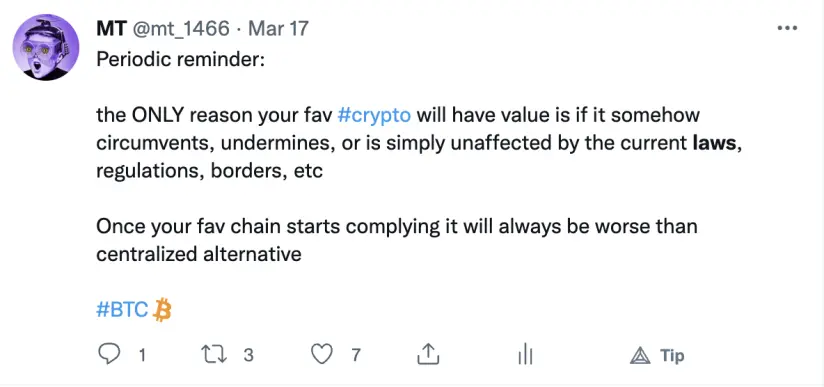
Just as a reminder, all of these things already exist and their "crypto" counterpart is no more decentralized or state-resistant than the Web2 version :
- permissioned databases (Algorand)
- consortium sidechains (Avalanche subnets)
- highly-performant trading platforms (Solana)
- supply chain trackingf (Vechain)
- interbank bridging tech (XRP)
- memes (Dogecoin)
- copies of Bitcoin (BCH, BSV, and others)
- copies of Ethereum (Tron, BSC, Avalanche C-chain, Fantom, and others)
At what point, do the millions of Solana fans and investors take a good hard look in the mirror and come to the realization that Solana is neither a reliable database nor a decentralized blockchain. So then, what the heck is it?! So many tout it as the most promising non-EVM Ethereum competitor but those people obviously have never heard of Cosmos, Polkadot, Near (to an extent), or Celestia+rollups. WE HAVE OTHER OPTIONS.
Solana won't blow up Terra/Luna fashion but rather fade something more closely resembling EOS. So stop waiting for the explosion and OPEN YOUR EYES. Here are 8 HUGE reasons Solana should be criticized wayyyy more.
1) It doesn't do "50k+ TPS."
More like 300, of which dozens of chains can do.
Transactions on Solana can be divided into either consensus votes or token transfers and smart contract logic. Non-vote transactions are analogous to EVM transaction counts and represent the actual economic activity on the network. If validators on the network increase, then the number of vote transactions also increases regardless of any meaningful financial activity or adoption.
This means TPS numbers purported by Solana aren’t an “apples-to-apples” comparison with most other chains that don’t count such metrics. This is because Solana is (one of) the only blockchains that hold consensus votes on chain—a process that accounts for up to ~85% of the TPS numbers. Filtering for consensus votes, Solana operates much closer to 300-1,000 TPS depending on the period.
 Source: Delphi Digital
Hence, testnet levels are likely overstated compared to other platforms due to how transactions are defined. Additionally, this throughput was achieved with about 200 nodes, which is about one-third of the nodes currently on its mainnet, and communication overhead in a production environment is likely higher.

2) It has no path to higher TPS other than more performant and expensive hardware requirements
In the monolithic blockchain approach, network scalability is constrained to what the single weakest node can process. This means the performance of the chain is thereby limited by hardware/computer performance, e.g. higher throughput is only achieved by more expensive, performant hardware. As of Q2 2022, Solana has been able to achieve a blazing fast blockchain for today’s standards with a sufficient amount of nodes (relative), making it a great choice on the performance-decentralization spectrum.
However, ~1,000 or even 50,000 TPS won’t be sufficient if adoption continues to grow and Solana delivers on some of its promises dApp and DeFi promises. Therefore, more specialized and more expensive hardware will be required in the future to run the chain. One can follow this train of thought to the end in which, if Solana continues to grow, network health and governance will be maintained by a select few that have the access, technical prowess, and capital to run these machines. Solana’s growth actually makes it more difficult to maintain the same performance and decentralization guarantees.
Ethereum+rollups have a very clear path towards 10,000+ TPS while still remaining just a secure. Fees on L2s will also be competitive with Solana currently while doing 10x the transactions in a more trustless environment.
3) "Proof of History" was the big innovation (a decentralized clock to increase TPS capacity) and it doesn't keep accurate time
In May 2022, slower slot times caused the Solana blockchain clock to drift and significantly deviate from real-world time (~30 minutes behind). Slot time refers to the time interval within which a validator can submit a block to the network.While the issue does not affect network operations, it could contribute to reduced earnings from staking rewards.
Solana’s ideal slot time is 400 milliseconds (ms) but this value has almost doubled to about 746ms, according to data from the Solana blockchain explorer dashboard. Solana uses clusters, a collection of validators that are responsible for processing transactions on its blockchain.
Apart from on-chain timekeeping being out of sync with real-world time, the slow slot time issue could also have some economic consequences related to annualized staking rewards.
4) (Nearly) Any blockchain could be as "fast" as Solana if it reduced the validating set and required super expensive hardware. They don't because that is exclusionary and antithetical to the entire crypto movement
Another downside to monolithic blockchains is the validator costs to maintain a highly competitive blockchain. While a minimum amount of SOL is not required to become a validator, it’s been stated that simply voting to agree with each block can cost up to 1.1 SOL daily. This could potentially cost 33 SOL per month or the equivalent of ~$36,500 per year based on Q2 2022 prices, or ~$91,000 per year based on all-time high SOL prices. Due to the costs of running a validator (~50,000 SOL/$5M delegated stake break-even cost), everyday users may choose to delegate their SOL.
For most of the population, this is simply already out of reach. Additionally, the hardware requirements for becoming a validator are also out of reach for many.
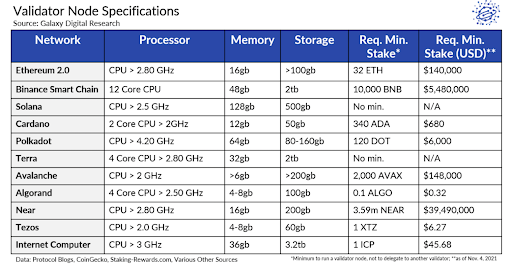 Source: Galaxy Digital Research
Hardware requirements on Solana, compared to Bitcoin & Ethereum:
- Bitcoin¹: 350GB HDD disk space, 5 Mbit/s connection, 1GB RAM, CPU >1 Ghz. Number of nodes: ~10,000
- Ethereum²: 500GB+ SSD disk space, 25 Mbit/s connection, 4–8GB RAM, CPU 2–4 cores. Number of nodes: ~6,000
- Solana³: 1.5TB+ SSD disk space, 300 Mbit/s connection, 128GB RAM CPU 12+ cores. Number of nodes: ~1,600
Taking Jameson Lopp’s 2020 Bitcoin Node and 2021 Node Sync Tests as an indicator, Table 1 compares the time it takes to sync a full node of Bitcoin vs. Ethereum vs. Solana on an average consumer-grade PC.
 Blockchain throughput and node-sync comparison
5) Becoming a validator is out of reach for 99.99% of humans AND it's not all that profitable
To break even as a validator, it would require at least ~$500,000 worth of SOL that’s self-delegated with a 100% commission rate. This is simply unobtainable for the majority of participants. With the high costs of purchasing the hardware, paying for consensus votes, obtaining a meaningful stake, and running a profitable validator, network validator growth on Solana may experience difficulties.
 Source: Galaxy Digital
Another reason is the majority of the stake distribution is controlled by the foundation which has a program where validators can apply, perform KYC, and sign an agreement in return for the foundation delegating stake to their node. This raises possible concerns with how decentralized Solana could even become over time.
Additionally, a regular user also can't run an archival node and validate the chain from genesis. The early history is only stored by the foundation in Google Cloud and is around 20 TB despite launching less than two years ago. Due to the bandwidth costs, this isn’t available for others. With such a significant barrier to entry, validator growth will undoubtedly be stunted. With only a small number of on-chain validators, issues could arise more frequently.
6) It's the least reliable blockchain since IOTA.... that's not good. It also took them 3 years to figure out they needed a fee market (fee markets have been standard since 2017 when Nano and others tried not having them)
September 2021, May 2022, and June 2022 Network Outages
A major security issue on the Solana network surfaced in September of 2021. On September 14th, 2021, a large number of bots flooded the network and created a large number of transactions, effectively overflowing the network and causing validators to stall. This attack on the network made consensus impossible, effectively crippling the network.
 Source: Galaxy Digital
This is possible because bots in Solana can propose as many transactions as they want due to there being no fee market. Because bots can spam the network without penalty, they do. This means bots spam Gulfstream, Solana’s “mempool,” and the block producer has to check all of the transactions before making the next block. If there are too many transactions submitted, the block producer simply cannot sift through all the submitted transactions in the allotted block time (200ms). This results in some transactions simply being left out. With so many transactions trying to get processed, Solana validators gets overwhelmed and excessive forking occurs. This only exacerbates the problem, requiring validators to keep track of a numerous increasingly larger forks, requiring more RAM, which leads to validators running out of memory.
While no funds were lost in the attack, the network went offline for 17 hours. To counteract the crash, the Solana community proposed a hard fork “upgrade-and-restart” of the network, a proposal that requires 80% of all validators to agree. Despite the network crash, the community was able to diagnose the problem, integrate a solution, and get Solana back online in under 24 hours.
Six months later, Solana suffered another network outage due to similar reasons. The network halted due to a large influx of transactions (spam) from an NFT project. An earlier Twitter post posted “Solana Mainnet Beta lost consensus after an enormous amount of inbound transactions (4m per second) flooded the network, surpassing 100gbps.”

Engineers were still investigating why the network was unable to recover from the crush of transactions that caused the outage. However, validator operators successfully completed a restart on Saturday (4/21/22) following ~7 hours of downtime.
7) Validators openly discussed censorship tactics because the protocol simply couldn't combat simple spam
Additionally, if the downtime wasn't bad enough, several Solana validators advocated for censoring certain NFT projects they deemed nonessential to help reboot the network. The entire ordeal is yet another bad look for the network where outages are becoming regular occurrences (see below) and traditional cryptocurrency ideals like decentralization, permissionless, and credible neutrality are being compromised.

The Solana team discussed several upcoming developments to help avoid similar outages in the future, including implementing QUIC (discussed in Technology section) to reduce message flooding. QUIC will allow block producers to instruct bots to propose only a small number of transactions at a time, mitigating some of the spam issues and (hopefully) creating a more manageable workload for block producers.
Other solutions include stake-weighted transactions that guarantee stakers succeed in submitting transactions based on their percentage of staked supply and fee-based execution priority. This last one may be most important as it is the first (semi)concession that Solana will need a fee market. Almost every other blockchain to date has eradicated this problem (DDoS or spam attacks) through the use of transaction fees. Solana’s low, fixed fees combined with no mempool enables this sort of spam attack and denigrates the user experience and network reliability.
In June 2022, Solana was down for ~four hours due to a bug with the durable nonce feature of the blockchain. Yakovenko tweeted that the issue “caused part of the network to consider the block is invalid,” and that “no consensus could be formed” as a result. Validators worked together to restart the Solana network with the durable nonce feature disabled, and Yakovenko added that the bug will be fixed in a future update.
8) Solana ecosystem accepts a closed-sourced mentality... Again, antithetical to crypto's open-source, transparent, and auditable ethos.
Beyond simply being new/immature products, Solana dApps are often closed-source as opposed to cryptocurrency space’s general open-source standard. Analysis from The Block found that six of the largest 10 Solana dApps by TVL are closed-source. Closed-source projects are typical in legacy finance, but in the new world of blockchains, transparency and permissionless-ness are key value propositions. Open-source allows anyone and everyone to examine the code, understand the governance rules, and verify the claims made by the team. It’s central to the “don’t trust, verify” slogan that’s often mentioned in crypto circles.

8) Sketchy launch early on which is just a reflection of the larger VC, money-grab problem with Solana
The early days of Solana and the release of the SOL tokens began with controversy. In April 2020, the circulating supply of SOL on the popular exchange Binance was listed at 8.25 million. However, that month, another Solana wallet containing 13 million SOL (5 million more than the listed entire circulating supply!) tokens was unearthed by a community member.
The Solana team explained this wallet was from market makers which the team didn’t consider part of the actual circulating supply. The team announced they would recover the tokens and burn them all within 30 days to resolve the issue. However, ultimately, the team was only able to recover ~3.3 million worth of SOL and moved on from the issue. This meant that in the early days of the project, the circulating supply instantly doubled for early investors and the Solana team failed twice to properly resolve an issue. As the project and token price grew exponentially over the next 1.5 years, the issue seems to primarily be forgotten or simply an anecdote of the early days of the project.





