
You are reading an excerpt from our free but shortened abridged report! While still packed with incredible research and data, for just $40/month you can upgrade to our FULL library of 60+ reports (including this one) and complete industry-leading analysis on the top crypto assets.

Becoming a Premium member means enjoying all the perks of a Basic membership PLUS:
- Full-length CORE Reports: More technical, in-depth research, actionable insights, and potential market alpha for serious crypto users
- Early access to future CORE ratings: Being early is sometimes just as important as being right!
- Premium Member CORE+ Reports: Coverage on the top issues pertaining to crypto users like bridge security, layer two solutions, DeFi plays, and more
- CORE report Audio playback: Don’t want to read? No problem! Listen on the go.
Consensus Mechanism
Filecoin (FIL) uses a consensus mechanism called Proof of Replication (PoRep) to ensure the integrity and reliability of its peer-to-peer network. PoRep is designed to incentivize miners to store and replicate data in a way that ensures the network’s durability and availability.
In PoRep, blocks are proposed, produced, and added to the blockchain through a process called sealing. Sealing is the process of proving that a miner has stored and replicated a specific set of data. This is achieved by running a PoRep challenge on the data, which generates a unique proof that can be submitted to the network. If the proof is verified by other nodes on the network, the miner is rewarded with FIL.
Miners' role in the network is to store and replicate data, which is achieved through a process called Filecoin Storage Mining. Miners participate in storage mining by providing storage capacity to the network, which is then used to store data. In return, they receive FIL rewards for their participation.
Core Technology
Centralized data storage presents a challenge in verifying the integrity of stored data. However, the Filecoin network provides a peer-to-peer version of Amazon S3 and regularly verifies data storage. Instead of a fixed pricing structure, Filecoin uses storage deals that are priced based on supply and demand dynamics. Users pay fees to storage providers to store data for a specified duration. The network uses a crypto-economic incentive model that regularly verifies storage with zero-knowledge proofs. Storage providers receive rewards in the form of the network's native token (FIL) but face penalties if the data becomes unretrievable or the storage fails. Data retrieval involves paying a retrieval provider to fetch the data with off-chain payment channels for faster retrieval.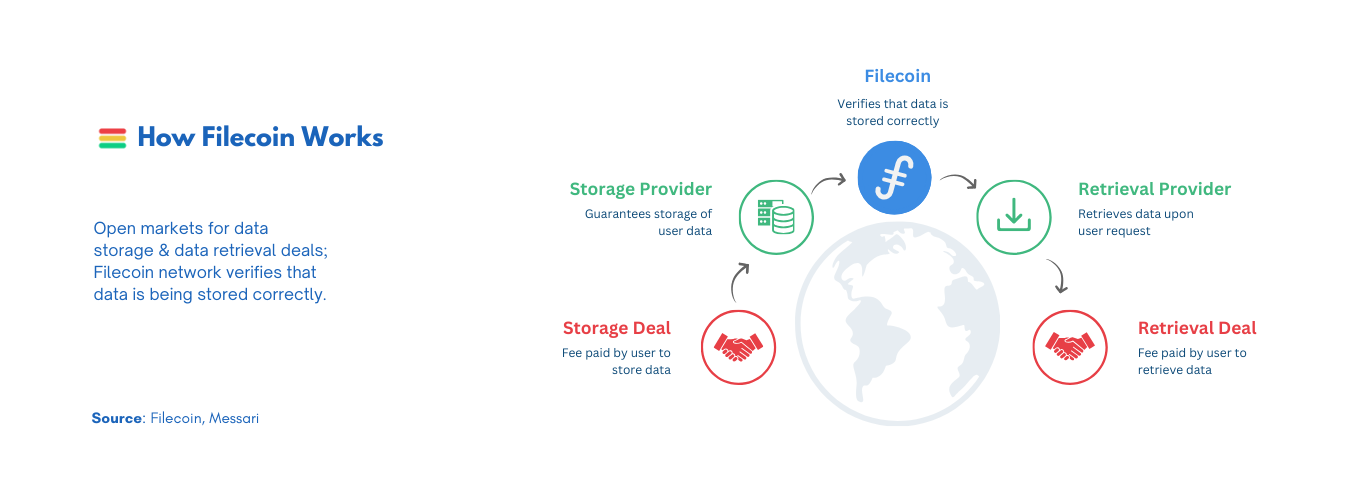
Source: Messari
Achieving the dynamic market model found within the Filecoin network relies on a set of core technologies to provide optimal functionality, uptime, and accessibility. This includes a deep interconnection with IPFS (InterPlanetary File System), the use of Sectors within Filecoin, and the release of the Filecoin Virtual Machine (FVM).
IPFS
InterPlanetary File System (IPFS) is a peer-to-peer hypermedia protocol designed to provide a more secure, faster, and open web. It uses a decentralized approach to storing and sharing content, which enables users to host and access files from a global network of peers. IPFS is an important component of the Web 3.0 movement to create a more decentralized Internet experience for users. IPFS and Filecoin are complementary protocols used to store and share data in a distributed web.
IPFS uses content-addressed storage, which involves assigning unique hashes to files to ensure they remain immutable and their integrity is maintained. Instead of using URLs like traditional web protocols, IPFS uses Content Identifiers (CIDs) to locate files. CIDs are cryptographic hashes that represent a file’s content, which means the content is the identifier. As a result, files remain accessible as long as there's a node on the network hosting them.
IPFS also uses a Distributed Hash Table (DHT) to manage content indexing, discovery, and delivery. The DHT is a distributed database that stores metadata about the files on the IPFS network. The metadata includes information such as file hashes, node addresses, and file paths, among others. This approach ensures that the network remains robust, even when some nodes go offline, by enabling content to be located and accessed from other nodes on the network.
The IPFS and Filecoin protocols share several building blocks, including data representation formats (IPLD) and network communication protocols (libp2p). Filecoin is an open-source cloud storage marketplace, protocol, and cryptocurrency that allows users to rent out storage space in exchange for cryptocurrency. Filecoin uses IPFS as its storage layer, which means that it can leverage the IPFS network to store and retrieve data.
Filecoin and IPFS interconnect by allowing users to use Filecoin to store data on IPFS and retrieve data stored on IPFS using Filecoin. The integration between IPFS and Filecoin is achieved through a set of APIs provided by Filecoin. The APIs enable users to interact with the Filecoin network and store and retrieve data on IPFS.

INTEGRATING FILECOIN TO IPFS
Integrating the Filecoin and IPFS protocols can be done through a variety of tools and libraries, depending on the specific use case and programming language being used. However, there are a few common patterns and approaches that developers can follow to connect the two protocols.
One common approach is to use the IPFS Filecoin Remote Storage (IFRS) module, which is a JavaScript library that provides an interface for storing and retrieving data on the Filecoin Network using IPFS. IFRS abstracts away many of the details of interacting with the Filecoin Network, making it easier for developers to get started.
Another approach is to use the Powergate API, which is a higher-level interface for building decentralized storage applications using IPFS and Filecoin. Powergate provides a range of features, including automated storage and retrieval, content-addressed storage, and decentralized backups.
There are also several other tools and libraries available for integrating Filecoin and IPFS, including the Filecoin IPFS Hybrid (FIH) module, which provides a way to use IPFS as a caching layer for Filecoin, and the Filecoin Retrieval Protocol (FRP), which allows developers to retrieve data from the Filecoin Network using IPFS-compatible commands.
Regardless of the specific approach used, integrating Filecoin and IPFS can provide a powerful way to build decentralized applications that leverage both protocols’ benefits. By using IPFS for content-addressing and distribution and Filecoin for incentivizing storage and retrieval, developers can build applications that are efficient, decentralized, and provide users with greater control over their data.
Sectors
Sectors on the Filecoin network are the basic units of storage, balancing security and usability. Each sector has a standard size and a defined lifetime that's determined in the storage market, which sets the duration of the sector. Sectors form the basis for individual storage deals between storage miners and clients on Filecoin's storage market. Committed capacity is introduced to prevent self-dealing and incentivize miners to upgrade committed capacity sectors to real client deals, earning additional revenue.
The code behind Sectors within the Filecoin GitHub can be found in the go-filecoin/sector repository. This repository includes sector sealing and PoRep code, which are essential components of Filecoin's storage system. The sealing process uses a Proof of Replication (PoRep) algorithm that creates a unique encoding of the sector. The storage miner generates a proof, runs a SNARK on the proof to compress it, and submits the compressed result to the blockchain as a certification of the storage commitment.
After a sector is generated and a storage deal is incorporated into the blockchain, storage miners begin generating Proofs of Spacetime (PoSt) on the sector to potentially win block rewards and earn storage fees. The PoSts ensure miners guarantee their sectors will be available for the duration of the original contract, with miners generating and capturing more value for longer-lasting sectors. The go-filecoin/sector repository contains the sector sealing code, which includes PoRep and PoSt.
EVM-Compatibility
In early 2023, the Filecoin team announced the FVM (the Filecoin Virtual Machine) implementation to enable migration, execution, and interoperability with other chains. FVM targets WASM as its native contract runtime and is targeting the support of any VM as part of its runtime, including EVM equivalence. With the FVM's support of EVM equivalence, dApps will be able to use Filecoin storage capacity from their EVM-compatible smart contracts.

FILECOIN VIRTUAL MACHINE
Filecoin is one project that has made significant strides in this area. The team has introduced the FVM to Filecoin’s distributed storage network, which allows for smart contract deployment and a multi-language-friendly execution environment. The FVM was successfully launched in the Filecoin v16 Skyr upgrade in July 2022. The first phase of the FVM implementation allows for the smooth execution of the Filecoin network’s core logic in smart contracts. In the second phase, users will be able to deploy custom logic into the network, fulfilling the vision of "smart contracts + provable storage."
Filecoin successfully completed the integration of the Filecoin Virtual Machine (FVM) following the effective implementation of the v18 Hygge network upgrade in March 2023. The FVM serves as an Ethereum-compatible layer constructed atop the Filecoin network, providing developers with a seamless avenue for developing and deploying smart contracts written in Solidity. This integration incorporates the Web3-compatible, WASM-based Filecoin Actor system into the FVM, fostering interoperability with various blockchain networks and applications. Utilizing the Filecoin network's native token, FIL, for gas fees and smart contract execution, the FVM supports Filecoin Improvement Proposals (FIPs) that introduce new features and optimizations to the platform while simultaneously ensuring Ethereum compatibility.
The FVM is compatible with the Ethereum Virtual Machine (EVM), which means that existing Ethereum smart contracts can easily be ported to the FVM. This is achieved through the Filecoin EVM (FEVM), which is the Ethereum Virtual Machine virtualized as a runtime on top of the FVM. This means that developers can use existing Ethereum development tools, such as Hardhat and Brownie, to create smart contracts that can run on the Filecoin network.





